
Featured Precision Engineering Components (Part I)
High-precision OEM automotive engine parts, powder metallurgy hardware, MIM electronic gears, and aluminum/zinc die casting solutions produced under certified quality protocols.






1. Executive Summary: The Evolution of China Injection Molding Services
The global manufacturing landscape has undergone a paradigm shift, transitioning from conventional, high-labor component production to highly integrated, AI-driven, and automation-enhanced manufacturing systems. At the epicenter of this transformation stands the China Injection Molding Service Ecosystem. Modern OEM/ODM buyers no longer evaluate Chinese injection molding manufacturers solely on unit price; instead, procurement directors, senior manufacturing engineers, and supply chain executives prioritize Design for Manufacturability (DFM) support, micro-tolerance capabilities (±0.005mm), advanced multi-cavity tooling economics, material compliance (RoHS, REACH, FDA, ISO 10993), and total landed cost efficiency.
Injection molding technology in China now spans a vast multi-material spectrum. While high-precision plastic injection molding remains a bedrock process for complex polymer geometries—utilizing engineering resins like PEEK, PPS, PEI (Ultem), and glass-filled Polyamides (PA66-GF30)—leading manufacturers have cross-pollinated metal powder processing technologies. This includes Metal Injection Molding (MIM), Powder Metallurgy (PM), Ceramic Injection Molding (CIM), and Aluminum/Zinc Pressure Die Casting. This technical convergence enables a single tier-1 custom manufacturer to offer multi-process optimization, steering engineering teams toward the optimal manufacturing method based on annual volume, geometric complexity, mechanical stress requirements, and thermal dissipation needs.
2. Global Procurement Intelligence & Intent Mining
Through intent mining of global supply chain procurement data across North America, Europe, and Asia-Pacific, strategic sourcing teams display distinct behavioral metrics when searching for custom injection molding suppliers in China. The core search intent transitions through three distinct procurement phases:
Phase 1: Technical Qualification
Procurement engineers investigate tooling capabilities, mold steel selection (S136, H13, NAK80), runner systems (Yudo or Mold-Masters hot runners vs. cold runners), and injection clamping tonnage (ranging from 30T micro-molding to 3200T structural molding).
Phase 2: Total Cost Ownership (TCO)
Evaluating NRE (Non-Recurring Engineering) tooling costs against unit part prices. Buyers assess mold longevity guarantees, cavitations (single vs. 4/8/16/32 multi-cavity molds), and automated cycle time reduction strategies.
Phase 3: Supply Chain Risk Mitigation
Verifying quality management accreditations (ISO 9001, IATF 16949, ISO 13485 for medical devices), IP protection frameworks, localized engineering support, post-molding secondary finishing, and buffer stock warehousing.
3. Comprehensive Engineering Process Selection Matrix
Selecting the correct injection molding technology requires a rigorous cross-examination of part geometry, mechanical strength requirements, thermal demands, surface aesthetic requirements, and production scale. Below is an engineering comparison matrix designed by tier-1 toolmakers:
| Manufacturing Process | Primary Material Focus | Dimensional Tolerance | Min Wall Thickness | Geometric Complexity | Optimal Production Volume |
|---|---|---|---|---|---|
| Thermoplastic Injection Molding | ABS, PC, PEEK, PA66+GF, PP, POM, TPE/TPU | ±0.010 mm to ±0.050 mm | 0.5 mm | High (Undercuts, Threads, Overmolding) | 1,000 to 1,000,000+ units |
| Metal Injection Molding (MIM) | 316L, 17-4PH Stainless, Fe-Ni Steel, Titanium | ±0.003 mm / mm (±0.03 mm) | 0.3 mm | Ultra-High (Complex 3D Micro Geometry) | 5,000 to 500,000+ units |
| Aluminum / Zinc Die Casting | ADC12, A380, Zamak 3, Zamak 5 | ±0.020 mm to ±0.080 mm | 0.8 mm (Zinc) / 1.2 mm (Al) | Medium-High (Housings, Heat Sinks) | 2,000 to 250,000+ units |
| Powder Metallurgy (PM) Press & Sinter | Sintered Bronze, Iron-Nickel, Brass | ±0.015 mm to ±0.050 mm | 1.5 mm | Medium (Prismatic Shapes, Spur Gears) | 10,000 to 1,000,000+ units |
| Ceramic Injection Molding (CIM) | Zirconia (ZrO2), Alumina (Al2O3) | ±0.005 mm to ±0.025 mm | 0.4 mm | Ultra-High (Wear/Heat Resistant Components) | 2,000 to 100,000+ units |
4. Macro Industry Solutions & Multi-Process Application Engineering
Automotive & New Energy Vehicles (NEV)
The transition toward Electric Vehicles requires lightweighting without sacrificing structural integrity. Chinese injection molding manufacturers provide critical insert molding solutions for busbar insulation, high-voltage battery connector housings, and automated driver-assistance system (ADAS) sensor brackets. Furthermore, metal injection molding (MIM) and aluminum die casting are paired to produce high-torque planetary gearboxes, variable valve timing (VVT) components, and lightweight motor end-frames under strict IATF 16949 audit protocols.
Medical Devices & Bio-Compatible Hardware
Medical OEM solutions require ISO Class 8 cleanroom injection molding environments. Applications include surgical stapler components, minimally invasive endoscopic handle assemblies, fluidic diagnostic cartridges, and wearable monitor housings. By utilizing bio-compatible PEEK, medical-grade PC, and 316L medical stainless steel via MIM, manufacturers achieve pore-free, highly sterilizable components that pass rigorous ISO 10993 cytotoxicity and biocompatibility testing.
Consumer Electronics & Smart Wearables
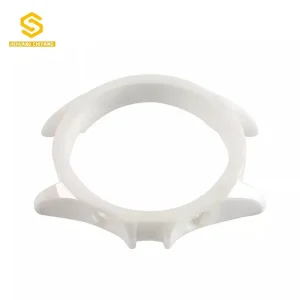
Smartphones, smartwatches, and AR/VR headsets demand ultra-thin wall plastic molding (down to 0.4mm) and high-aesthetic cosmetic metal elements. Injection molding suppliers leverage mold flow simulation software to eliminate weld lines, sink marks, and residual stress. High-precision MIM titanium and ceramic watch bezels/cases are sintered and finished with PVD coating, diamond-like carbon (DLC) finishes, or precision CNC post-machining.
Industrial Automation & Power Tools
Heavy-duty industrial applications demand impact resistance, dimensional stability under thermal load, and wear resistance. Injection molding services fulfill these requirements using glass fiber-reinforced polymers, sintered powder metallurgy gears, and high-strength zinc alloy die-cast housings. Integrated DFM analysis guarantees optimized gate placement, balanced cooling channels, and engineered ejection pins to prevent structural distortion during high-volume production.
5. DFM Engineering Protocols & Advanced Quality Infrastructure
Information gain in advanced manufacturing stems from understanding how pre-production engineering mitigates physical defects. Leading Chinese custom injection molding manufacturers utilize a standardized 5-Step DFM and Quality Validation Workflow before steel is cut:
1. Moldflow Analysis
Simulating resin fill patterns, volumetric shrinkage, warpage vectors, gas traps, and weld line formation to adjust wall thickness and gate location.
2. Tooling Design
Selecting premium tool steel (S136H, NAK80, 718H), designing conformal cooling channels, and engineering side-action lifters/sliders for undercuts.
3. First Article (FAI)
Full CMM dimensional layout inspection, PPAP Level 3 documentation, CPK/PPK statistical process capability evaluation on critical dimensions.
4. Inline IPQC & CT
Automated optical inspection (AOI), inline cavity pressure monitoring, and X-ray Industrial CT scanning for internal void detection.
6. Technology Roadmap: Smart Injection Molding 2.0 & Sustainability
As industry standards advance toward Industry 4.0, leading injection molding manufacturers in China are incorporating cyber-physical systems across the production floor. The technological roadmap focuses on three key pillars:
AI-Driven Closed-Loop Control
Real-time piezoelectric cavity pressure sensors directly communicate with injection machine controllers. If viscosity fluctuates due to batch variations in raw polymer or metal powder feedstock, the machine automatically adjusts injection velocity, holding pressure, and switchover points in milliseconds, guaranteeing zero-defect output.
Conformal Cooling via 3D Printing
Legacy straight-drilled cooling lines leave hot spots in complex mold cavities. Modern toolmaking employs Direct Metal Laser Sintering (DMLS) to print curved cooling channels that match the exact contour of the component, reducing cycle times by up to 35% and completely eliminating thermal warpage.
ESG & Sustainable Materials
To meet global carbon neutral targets, manufacturers are implementing closed-loop regrind integration, bio-based polymers (PLA, PHA), and low-temperature sintering metal powders. Energy-efficient electric servo injection machines further reduce power consumption by up to 40% compared to traditional hydraulic units.
Featured Precision Engineering Components (Part II)
Custom CNC machined castings, powder metallurgy structural parts, inserted molded connectors, and high-performance MIM 316L hardware.




7. Frequently Asked Questions (Technical & Procurement Intelligence)
Accelerate Your Hardware Manufacturing Pipeline
Upload your 3D CAD files (STEP / IGES / X_T) and 2D drawings. Receive a detailed DFM analysis report, moldflow assessment, and transparent pricing proposal within 48 hours.