
Featured Titanium & MIM Hardware Solutions
Explore our certified custom titanium metal injection molded parts, sintered components, and high-precision OEM assembly hardware engineered for global industrial OEMs.

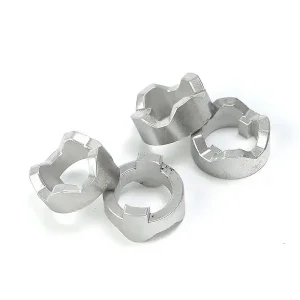






Metallurgical Foundations & Thermal Kinetics of TiMIM
Titanium Metal Injection Molding (TiMIM) represents the pinnacle of powder metallurgy engineering, combining the geometric flexibility of plastic injection molding with the high specific strength, low density, and biocompatibility of titanium alloys. As global demand escalates for complex, miniature components in aerospace, medical device implants, and high-end consumer electronics, TiMIM offers a high-yield manufacturing path that bypasses the traditional challenges of titanium machining—namely work-hardening, severe tool wear, and excessive material waste.
Powder Atomization & Morphology Control
The structural integrity of a sintered TiMIM component begins with feedstock powder synthesis. Premium TiMIM suppliers utilize spherical titanium powders manufactured via Electrode Induction Melting Gas Atomization (EIGA) or Plasma Atomization (PA). Particle size distribution (PSD) is strictly controlled within the range of $d_{50} = 15 - 25 \mu m$. Spherical morphology guarantees optimal solid loading (typically 60-68 vol%) in polymer binders while ensuring low viscosity and uniform mold filling without shear-induced powder-binder separation.
Interstitial Gas Control & Alpha-Case Prevention
Titanium exhibits an extreme affinity for interstitial elements ($O_2, N_2, C, H_2$) at elevated temperatures ($>400^\circ C$). Excessive oxygen pick-up forms a brittle, hard surface phase known as the alpha-case, severely degrading fatigue limit and elongation. Advanced TiMIM manufacturing utilizes multi-stage thermal debinding in catalytic or solvent baths followed by ultra-high vacuum sintering ($10^{-4}$ to $10^{-5} \text{ mbar}$) using getter materials (such as high-purity titanium sponge) to maintain interstitial oxygen content below 0.20 wt%, fully complying with ASTM F2885 standards.
Engineering Performance Matrix: TiMIM vs. Alternative Processes
| Property / Metric | TiMIM (Ti-6Al-4V ASTM F2885) | 5-Axis Machined Ti-6Al-4V | Investment Cast Ti-6Al-4V | Stainless Steel MIM (17-4PH) |
|---|---|---|---|---|
| Density ($g/cm^3$) | 4.41 - 4.43 (>98% Theoretical) | 4.43 (100% Wrought) | 4.40 - 4.42 (>97.5%) | 7.75 - 7.80 |
| Ultimate Tensile Strength (MPa) | 880 - 960 | 950 - 1050 | 830 - 900 | 1100 - 1250 |
| Yield Strength (0.2% Offset, MPa) | 780 - 850 | 880 - 930 | 750 - 810 | 1000 - 1150 |
| Elongation at Break (%) | 10.0 - 14.0 | 14.0 - 18.0 | 8.0 - 10.0 | 6.0 - 10.0 |
| Material Utilization Rate | 95% - 98% | 10% - 30% (High Scrap) | 60% - 75% | 95% - 98% |
| Geometric Complexity Index | Very High (Undercuts/Internal) | Moderate to High | Moderate | Very High |
China Factory 4.0: Supply Chain Resilience & Efficiency Advantage
China’s advanced manufacturing ecosystem—specifically specialized powder metallurgy hubs like Ningbo and Shenzhen—has transformed global procurement dynamics for complex titanium metal parts. By integrating raw material powder atomization, state-of-the-art CNC mold toolmakers, vacuum debinding infrastructure, and secondary finishing under automated Factory 4.0 operations, Chinese TiMIM suppliers deliver unprecedented scalability and cost-efficiency.
Vertical Raw Material Integration
Direct industrial partnerships with domestic spherical titanium powder atomizers enable tight control over raw powder chem-specs. Domestic feedstock blending lowers raw material cost volatility by up to 35% compared to Western imported feedstocks, transferring direct cost savings to OEM procurement budgets.
In-House Precision Toolmaker Hubs
Equipped with high-speed CNC machining centers, wire EDM, and mirror spark erosion machinery, Chinese TiMIM mold factories design and build multi-cavity injection molds in 20-30 days—cutting Western tooling lead times in half while guaranteeing mold life exceeding 500,000 shots.
Continuous High-Vacuum Sintering Lines
High-throughput vacuum debinding and sintering furnace arrays equipped with real-time mass spectrometers monitor outgassing profiles continuously. Computerized thermal uniformity prevents part distortion and ensures microstructural homogeny across multi-thousand-part sintering runs.
Macro Industry Solutions & Precision Engineering Applications
The combination of ultra-lightweight density ($4.43 g/cm^3$), high strength-to-weight ratio, and exceptional corrosion resistance makes TiMIM components the material of choice across high-tier engineering industries.
Medical & Dental Implants
TiMIM is widely specified for orthopedic trauma plates, spinal cages, dental implant abutments, and surgical instrument jaws (forceps, scalpels). Ti-6Al-4V ELI (Extra Low Interstitial) grades ensure full biocompatibility under ISO 10993 standards and facilitate direct bone osseointegration due to controlled surface roughness.
Aerospace & Defense
Weight reduction is paramount in aerospace system design. TiMIM produces intricate UAV flight control connectors, missile actuator linkages, cabin interior structural latches, and fuel nozzle brackets. Near-net-shape molding minimizes costly titanium scrap metal generation.
Consumer Electronics & Wearables
From smart watch cases and smart ring skeletons to foldable smartphone hinge mechanisms and premium optical frames, TiMIM delivers a luxurious tactile feel, scratch resistance, non-allergenic skin contact, and ultra-light weight desired by global consumer tech brands.
Automotive & High-Performance Racing
Specified for high-rpm engine train components including titanium valve retainers, turbocharger wastegate levers, exhaust flap links, and luxury supercar key housings where thermal endurance and low rotational inertia are required.
Technical Roadmap & Future Outlook of Titanium Powder Processing
As powder metallurgy moves toward Industry 4.0 integration, Titanium MIM technology is evolving rapidly. Key innovation vectors being developed by leading factories include Micro-TiMIM, novel titanium matrix composites, and hybrid additive manufacturing workflows.
Micro-TiMIM & Sub-Millimeter Parts
Micro-injection molding using ultra-fine nano-spherical Ti powders ($d_{50} < 5 \mu m$) allows mass production of micro-mechanisms weighing less than 0.05 grams, with wall thicknesses down to 0.15 mm and surface roughness values reaching $Ra < 0.8 \mu m$ without secondary polishing.
Intermetallic Titanium Aluminides ($\text{TiAl}$)
Development of gamma-titanium aluminide ($\gamma\text{-TiAl}$) feedstocks via injection molding provides lightweight alternatives to nickel superalloys in high-temperature turbine environments ($650^\circ C - 850^\circ C$), reducing component weight by 50% in aero-engines.
Binder Jetting Additive-MIM Hybrid Lines
Merging binder jet 3D printing with standardized MIM sintering equipment allows rapid prototyping of titanium parts without hard tooling. Once design validation is achieved, the same metallurgical furnace profile is deployed for high-volume injection molding.
Global Enterprise Procurement Demands & Standardized RFQ Protocols
Sourcing titanium MIM components requires strict technical governance to guarantee part performance and minimize project risk. Global OEM procurement managers and engineering teams follow a structured 5-stage qualification protocol when onboarding a certified TiMIM factory.
DFM & Shrinkage Simulation
MIM parts undergo volumetric shrinkage of 12% to 18% during sintering. Suppliers must execute 3D mold-fill dynamic simulation and FEA shrinkage modeling to design multi-cavity tooling with precise scale-factor offsets.
Feedstock Rheology Verification
Checking binder blend homogeneity and melt flow index (MFI) ensures uniform mold filling under low injection pressure, preventing powder segregation and density gradients in green parts.
Debinding & Sintering Validation
Thermal gravimetric analysis (TGA) defines debinding ramp rates. Vacuum sintering logs prove oxygen level retention below target thresholds ($<0.20\%$) across all furnace zones.
PPAP Level 3 & Inspection
First Article Inspection (FAI) reports include 3D CMM dimensional scanning, non-destructive X-ray CT internal void detection, metallographic grain structure analysis, and tensile pull testing.
Localization Support, Quality Assurance & Regulatory Compliance
Partnering with an overseas manufacturing facility requires full legal, quality certification, and logistics transparency. Premier Chinese TiMIM factories maintain comprehensive international quality management systems to provide seamless integration into global supply chains.
Certified Quality Systems & Testing Lab
- IATF 16949:2016 & ISO 9001:2015: Audited automotive and general manufacturing quality protocols.
- ISO 13485: Medical device quality management for bio-compatible titanium implants.
- In-House LECO Gas Analyzers: Precise quantitative measurement of oxygen, nitrogen, hydrogen, and carbon interstitials in every sintered batch.
- Coordinate Measuring Machines (CMM) & Optical Comparators: 100% key dimensional verification prior to packing.
Global Logistics & Trade Compliance
- RoHS, REACH & Conflict-Free Minerals: Full environmental and raw material traceability compliance for EU and US markets.
- DDP & FOB Global Fulfillment: Direct air/sea door-to-door delivery with managed customs clearance and duty processing.
- Strict NDA Protection: Dedicated IP control protocols ensuring customer drawings and step files remain secure.
- Engineering Support in English: Technical sales managers providing 24-hour turnaround on DFM feedback.
Additional Custom MIM & Sintered OEM Assemblies
Browse our extended line of precision die casting, ceramic injection molding, custom metal sintering, and high-density powder metallurgy components.





Frequently Asked Questions (FAQ) for TiMIM Sourcing
Technical guidance for engineering leads and global procurement officers evaluating titanium injection molding suppliers.
What titanium alloy grades can be processed using Metal Injection Molding (TiMIM)?
The most commonly processed grade is Ti-6Al-4V (Grade 5) and its extra-low interstitial variant Ti-6Al-4V ELI (Grade 23), which account for over 80% of industrial applications due to their exceptional strength-to-weight ratio and bio-compatibility. Unalloyed Commercially Pure Titanium (CP-Ti, Grade 2 and Grade 4) is also produced for applications requiring maximum corrosion resistance and ductileness, such as watch cases and luxury optical frames.
How does TiMIM mechanical strength compare to traditional wrought titanium?
With modern high-vacuum sintering furnace technology and spherical atomized powders, TiMIM components regularly achieve sintered densities exceeding 98% of theoretical density. Mechanical properties (Yield strength ~820-850 MPa, UTS ~920-960 MPa) reach over 95% of wrought titanium specifications under ASTM F2885 standards. Post-sintering Hot Isostatic Pressing (HIP) can further eliminate micro-porosity to achieve 100% wrought-equivalent fatigue performance.
What is the cost tipping point between TiMIM and 5-axis CNC titanium machining?
TiMIM becomes highly cost-effective for medium-to-high annual production volumes (typically starting at 2,000 to 5,000 pieces per year) for components with complex geometry, undercuts, cross-holes, or thin walls. Because titanium metal raw stock is expensive and hard to machine, traditional CNC milling can scrap up to 80% of the initial titanium billet. TiMIM achieves a 95%+ material yield, lowering piece costs by 30% to 60% after amortizing mold tooling costs.
What are the design tolerances and dimensional limits for TiMIM parts?
Standard as-sintered dimensional tolerances for TiMIM are ±0.3% to ±0.5% of nominal dimensions (e.g., ±0.03 mm on a 10 mm feature). Critical features requiring tighter tolerances (down to ±0.005 mm) can be achieved by integrating secondary CNC coining, sizing, or micro-machining operations in-house at our factory.
How do you control oxygen contamination during sintering?
We enforce strict environmental controls: solvent debinding under inert atmospheres, loading parts into high-purity ceramic trays using sacrificial titanium sponge getters, and sintering in metal-wall high-vacuum furnaces operating at $10^{-5} \text{ mbar}$. Outgassing is continually analyzed via mass spectrometry. Each production batch is tested via LECO combustion elemental analyzers to confirm oxygen concentration stays strictly below $0.20 \text{ wt}\%$.
What lead times should buyers expect for prototype samples and production runs?
DFM analysis and 3D simulation are completed within 48 hours. Mold tooling build and sample submission (FAI samples) typically take 25 to 35 calendar days. Upon sample approval, full mass production lead times range from 3 to 5 weeks depending on order quantity and secondary finishing requirements.
Request a 48-Hour Technical DFM & Quotation
Send us your 2D (PDF) and 3D (STEP/IGES) CAD drawings. Our senior powder metallurgy engineering team will evaluate manufacturability, recommend optimal material alloys, and provide a transparent factory quotation.