
Featured Powder Metallurgy & Sintered Parts (Part I)
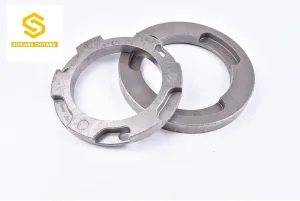
Engineered for extreme wear resistance, tight dimensional tolerances (±0.01mm), and high mechanical strength across automotive and industrial sectors.






Global Commercial Status & Industrial Powder Metallurgy Analysis
Powder Metallurgy (PM) represents a cornerstone of modern near-net-shape manufacturing, converting micro-fine elemental and alloy powders into structural components with unmatched material utilization efficiency.
The global Powder Metallurgy market is experiencing an unprecedented technical evolution driven by the convergence of automotive lightweighting, electrification, industrial automation, and surgical device miniaturization. Valued at over $12.5 billion, the PM ecosystem encompasses conventional press-and-sinter powder metallurgy, Metal Injection Molding (MIM), and powder-based additive manufacturing (Metal 3D Printing). As Tier-1 original equipment manufacturers (OEMs) face mounting pressures to reduce scope-3 carbon emissions while lowering total cost of ownership (TCO), powder metallurgy has established itself as the green manufacturing technology of choice.
From a macroeconomic perspective, the Asia-Pacific region—anchored by advanced manufacturing hubs like Ningbo and Shenzhen in China—dominates global PM volume output. China's industrial strategy has elevated domestic PM capability from basic porous bearings and soft magnetic cores to ultra-high-density structural planetary gears, variable valve timing (VVT) rotors, electric vehicle traction drive components, and medical-grade titanium implants. High-capacity presses ranging from 100 to 1,000 tons (10,000 kN) combined with continuous mesh-belt sintering furnaces equipped with precise endothermic atmosphere control now allow Chinese factories to serve global supply chains across North America, Europe, and Japan with ISO 9001 and IATF 16949 certified quality.
Comprehensive Powder Metallurgy Process Engineering
From micro-fine atomization to solid-state diffusion sintering, explore the multi-stage thermodynamics behind high-density PM component fabrication.
1. Powder Synthesis & Atomization
Elemental iron, copper, nickel, molybdenum, and stainless steel powders are synthesized via water atomization (producing irregular, highly compressible particles) or gas atomization (producing spherical particles ideal for MIM and high-flow compaction).
2. Precision Blending & Lubrication
Custom alloy masterbatches are homogenously blended with solid lubricants (e.g., zinc stearate, ethylene bis-stearamide) to reduce inter-particle friction during die pressing and optimize green strength prior to sintering.
3. Automated Compaction Pressing
Using multi-level hydraulic and mechanical CNC presses (up to 1,000 tons capacity), loose powder blends are compacted at pressures between 400 to 800 MPa into rigid 'green' preforms with engineered pore structures.
4. Controlled Atmosphere Sintering
Green preforms travel through continuous mesh-belt or vacuum furnaces heated to 1,120°C–1,300°C (70-80% of melting temperature). Atomic diffusion forms necking structures, metallurgically bonding particles together.
5. Sinter-Hardening & Heat Treatment
Rapid convective cooling zones directly integrated into sintering furnaces transform austenite into hard martensitic microstructures, eliminating post-sintering heat treatment steps and minimizing thermal distortion.
6. Secondary Finishing & Coining
To achieve sub-hundredth millimeter tolerances, sintered parts undergo sizing (coining), resin/oil impregnation (self-lubricating bearings), steam treatment for anti-corrosion, or surface tumbling.
Technology Roadmap & Future Development Trends (2025–2035)
As industrial engineering shifts toward carbon neutrality and extreme performance density, PM manufacturing is undergoing four major technological paradigms.
Trend 1: Ultra-High-Density & Warm Compaction (Density > 7.5 g/cm³)
Mechanical properties of sintered iron-based alloys scale exponentially with density. Historical limitations kept conventional single-press PM density around 6.8 to 7.1 g/cm³. Today, Ningbo Jiehuang (JHMIM) leverages warm compaction technology—where heated powders and dies reduce yield strength during pressing—and high-temperature sintering (1,250°C to 1,320°C). This process yields sintered densities reaching 7.55 g/cm³ (>96% theoretical density), bridging the fatigue strength gap between PM parts and forged structural steels.
Trend 2: Green Powder Metallurgy & Low-Carbon Decarbonization
Powder Metallurgy is intrinsically aligned with global ESG frameworks. With zero hazardous coolant waste during primary shaping and substantially lower furnace thermal overhead per kilogram compared to melt casting, PM reduces embodied carbon footprint by up to 45%. Future factories are transitioning to hydrogen-rich sintering atmospheres ($H_2/N_2$ gas mixtures) and 100% recycled scrap-derived metal atomization lines.
Trend 3: Hybrid Manufacturing: Press-and-Sinter + MIM + Additive Metal Printing
Modern factories no longer treat manufacturing processes in isolation. Leading OEMs combine press-and-sinter for high-volume planar geometry (gears, flanges), Metal Injection Molding (MIM) for intricate 3D geometries under 250 grams, and Metal 3D Printing (Binder Jetting & Selective Laser Melting) for rapid functional prototyping and low-volume customization without tooling investments.
| Technology Route | Density Range | Geometric Complexity | Optimal Volume (MOQ) | Tolerance Standard |
|---|---|---|---|---|
| Conventional PM Pressing | 6.8 - 7.4 g/cm³ | Medium (2.5D Axial Profile) | 5,000 + pcs | ISO IT 8 to IT 10 (±0.015mm) |
| Metal Injection Molding (MIM) | 7.5 - 7.85 g/cm³ (>97%) | Extreme (Complex 3D features) | 2,000 + pcs | ISO IT 9 to IT 11 (±0.03mm) |
| High-Temp Warm Compaction | 7.4 - 7.65 g/cm³ | Medium-High (Multi-level gears) | 3,000 + pcs | ISO IT 7 to IT 9 (±0.010mm) |
| Metal Additive (Binder Jet) | 7.2 - 7.6 g/cm³ | Infinite (Internal channels) | 1 to 500 pcs (Prototypes) | ISO IT 11 to IT 12 (±0.08mm) |
Localized Industrial Applications & Case Scenarios
Discover how custom sintered parts power critical assemblies across automotive, industrial power tools, medical instruments, and fluid control machinery.
Automotive Powertrains & EV Drives
High-stress Variable Valve Timing (VVT) stator/rotor pairs, oil pump gerotors, ABS sensor rings, transmission synchronizer hubs, and planetary gear sets engineered from MPIF FN-0205 heat-treated nickel-steel.
Heavy-Duty Power Tools
Multi-stage bevel gears, ratchet mechanisms, impact anvils, and hammer drive components for cordless drills, rotary hammers, and angle grinders requiring exceptional impact toughness and wear resistance.
Medical & Surgical Devices
Precision endoscopic scissor jaws, surgical stapler components, titanium bone-fastening screws, and orthodontic brackets produced via titanium metal injection molding (Ti-MIM) with complete biocompatibility.
Fluid Filtration & Pneumatics
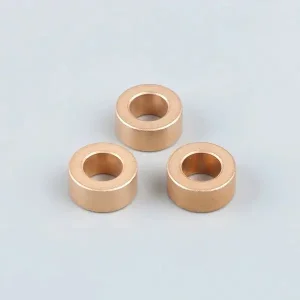
Sintered bronze sleeve bearings with oil impregnation for maintenance-free self-lubrication, porous stainless steel (316L) micro-filters, and high-pressure hydraulic valve bodies.
Consumer Electronics & Smart Wearables
Miniature foldable smartphone hinges, smartwatch chassis brackets, camera ring housings, and high-permeability soft magnetic cores (Fe-Ni, Fe-Si) for high-frequency induction charging coils.
Aerospace & Defense Assemblies
High-temperature nickel superalloy turbine vanes, titanium alloy structural brackets, and specialized ceramic-metal matrix composites (Cermets) engineered for thermal barrier resistance.
Macro Industry Material Solutions & Mechanical Performance
JHMIM offers a fully unified metallurgical laboratory capable of blending powders to strict MPIF 35, DIN 30910, and ISO 5755 international material specifications.
| Material Designation | Equivalent Standard | Tensile Strength (MPa) | Yield Strength (MPa) | Hardness (HRB/HRC) | Target Application |
|---|---|---|---|---|---|
| MPIF FC-0208-50 | ISO Fe-Cu-C (Cu 1.5-2.5%) | 520 MPa | 410 MPa | 75 HRB | Structural gears, pulleys, sprockets |
| MPIF FN-0205-130HT | ISO Fe-Ni-C (Ni 1.5-2.5%) | 890 MPa | 820 MPa | 35-42 HRC | High-stress VVT rotors, power tool gears |
| Sintered 316L Stainless | DIN 1.4404 / MIM-316L | 520 MPa | 210 MPa | 65 HRB | Corrosion-resistant medical & fluid valve parts |
| Sintered 17-4PH SS | DIN 1.4542 / MIM-17-4PH | 1,150 MPa | 1,000 MPa | 38-44 HRC | High-strength structural aerospace & tool parts |
| Sintered Bronze (SAE 841) | ISO Py 90-CuSn (Oil Impregnated) | 130 MPa | 70 MPa | 40 HB | Self-lubricating sleeve bushings & bearings |
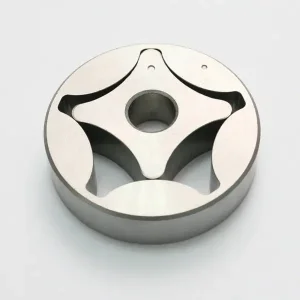
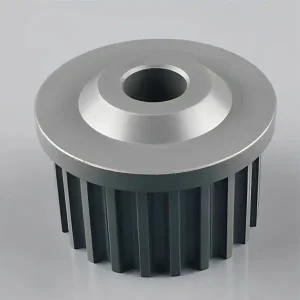
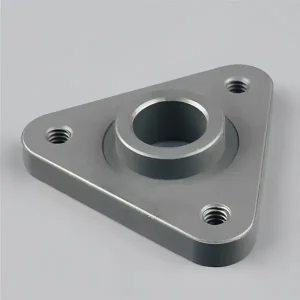
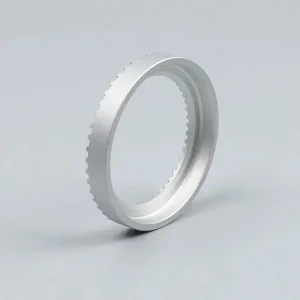
Featured Powder Metallurgy & Sintered Parts (Part II)
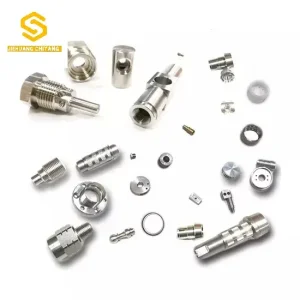
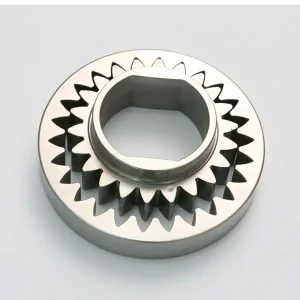
Explore our full line of sintered fluid pumps, pulleys, bronze sleeve bearings, ABS rings, and porous filters manufactured in Ningbo, China.

Frequently Asked Questions: Powder Metallurgy Manufacturing
Get authoritative engineering answers regarding material selection, density controls, tolerance limits, and DFM design rules from Ningbo Jiehuang's senior technical team.