Precision Powder Metallurgy & Mould Fabrication
Explore customized compacting molds, high-density sintered structural components, and die casting assemblies engineered for ultra-tight tolerances.






The Shift in Global Powder Metallurgy Manufacturing
As global automotive powertrains, industrial automation, and medical device architectures demand lightweight, high-strength structural components, China's metal powder metallurgy (PM) sector has transformed into a high-precision, tech-driven innovation hub.
Near-Net-Shape Optimization
Conventional subtraction machining discards up to 50% of raw material stock as metal shavings. Advanced press-and-sinter powder metallurgy achieves a raw material utilization rate exceeding 95%, making it the most sustainable and cost-efficient option for high-volume component production.
- Eliminates multi-axis CNC secondary operations.
- Drastically lowers cost per unit on runs exceeding 5,000 pieces.
- Reduces overall carbon footprint during material preparation.
MIM vs. PM Sintering Synergies
The integration of Metal Injection Molding (MIM) with press-and-sinter technologies permits complex 3D micro-geometries previously impossible via traditional press compacting, enabling wall thicknesses as thin as 0.5 mm and intricate internal undercuts.
- High density (up to 98% theoretical density).
- Superior mechanical strength matching wrought metals.
- Ideal for complex medical handheld tools and 3C hinges.
Advanced Atomization Powders
Chinese material refiners have refined gas atomization, water atomization, and plasma rotating electrode processes (PREP). This guarantees fine particle size distribution (PSD) for stainless steels, low-alloy steels, titanium alloys, and soft magnetic materials.
- Enhanced powder flowability for defect-free mold filling.
- Ultra-low oxygen content preventing intergranular oxidation.
- Consistent shrinkage rates during high-temperature sintering.
Powder Metallurgy Process Selection Matrix
Selecting the optimal manufacturing route depends on component mass, geometry complexity, structural strength requirements, and annual production volumes. Our engineering framework compares key parameters below:
| Technical Characteristic | Press & Sinter PM | Metal Injection Molding (MIM) | Aluminum / Zinc Die Casting | CNC Precision Machining |
|---|---|---|---|---|
| Optimal Part Mass | 5g to 2,000g | 0.1g to 250g | 20g to 10,000g | Any Mass |
| Geometrical Complexity | Moderate (2.5D shapes, steps) | Extremely High (3D intricate shapes) | High (Thin walls, housings) | Limited by Tool Accessibility |
| Dimensional Tolerance | ±0.05 mm (IT 8 - IT 10) | ±0.3% to ±0.5% | ±0.1 mm | ±0.005 mm (Tightest) |
| Relative Density | 85% - 92% (Porosity for oil-impregnation) | 95% - 99% (Near Wrought) | 90% - 95% (Die Cast porosity) | 100% (Solid Stock) |
| Material Range | Iron, Copper, Bronze, Stainless Steel | 316L, 17-4PH, Titanium, Fe-Ni | A380, ADC12, Zamak 3, Zamak 5 | All Machinable Metals |
| Surface Roughness (Ra) | 1.6 – 3.2 µm | 0.8 – 1.6 µm | 1.6 – 3.2 µm | 0.4 – 1.6 µm |
| Economic Volume Threshold | > 5,000 pcs / year | > 2,000 pcs / year | > 2,000 pcs / year | 1 to 1,000 pcs (High cost at scale) |
Global Enterprise Procurement & Sourcing Framework
Overseas OEM procurement officers and supply chain directors evaluating Chinese metal powder metallurgy manufacturers must look beyond unit piece price. A holistic evaluation encompasses tooling life, quality assurance metrics, and total cost of ownership (TCO).
Statistical Process Control (SPC) & Quality Audits
Tier-1 automotive and medical buyers require manufacturers to demonstrate continuous capability through rigorous SPC analysis rather than simple post-production batch inspection.
- Cpk / Ppk Metrics: Capability indices exceeding 1.67 on critical-to-quality (CTQ) dimensions.
- Automated Optical Inspection (AOI): High-speed camera visual sorting systems for 100% surface defect and crack detection.
- 3D CMM Metrology: Coordinate Measuring Machines with laser scanning capability to verify complex profiles against CAD step models.
Tooling Design & Mold Life Guarantees
Tooling engineered for powder metallurgy compaction and MIM injection faces intense abrasive wear. A reliable supplier must offer robust mold maintenance protocols.
- Tungsten Carbide Cavities: Mold inserts manufactured using premium tungsten carbide or SKD11 tool steel hardened to HRC 60-62.
- Free Lifetime Mold Maintenance: Standard Chinese tier-1 suppliers absorb maintenance and refurbishment costs after initial tooling purchase.
- Rapid DFM (Design for Manufacturability): Preliminary mold flow analysis and sintering shrinkage simulation provided within 48 hours of drawing submission.
Custom Engineering Solutions across Strategic Sectors
Powder metallurgy provides targeted performance attributes engineered for specific operating environments across key global industries.
Automotive Powertrain & VVT
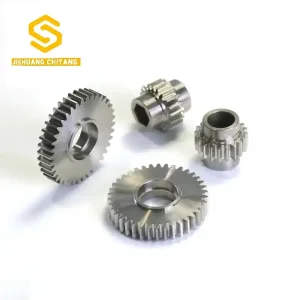
High-density sintered iron-nickel and iron-copper gears, Variable Valve Timing (VVT) rotors, oil pump gears, and turbocharger vanes operating under continuous high torque and elevated thermal cycles.
Biocompatible Medical Devices
MIM processed 17-4PH and 316L stainless steel surgical stapler jaws, laparoscopic instrument articulation joints, endoscopic handle mechanisms, and custom titanium implants requiring zero cytotoxicity.
Industrial Power Tools
Multi-stage planetary gearboxes, bevel gears, ratcheting pawls, and impact mechanism components case-hardened to withstand sudden shock loads and continuous frictional wear.
International Certifications & Regulatory Guarantees
Entering long-term OEM supply agreements requires non-negotiable compliance with international automotive, environmental, and metallurgical standards.
IATF 16949 & ISO 9001
Full implementation of Advanced Product Quality Planning (APQP), Production Part Approval Process (PPAP Level 3), Failure Mode and Effects Analysis (FMEA), and Measurement Systems Analysis (MSA).
RoHS, REACH & Conflict Minerals
Complete traceability of raw elemental metal powders. Material test certificates (MTCs) according to EN 10204 3.1 are provided with every shipment lot confirming heavy metal non-toxicity and CMRT compliance.
Global Logistics & Localized Logistics
Customized packaging protecting sintered parts from oxidation during ocean freight. DDP (Delivered Duty Paid) door-to-door shipping solutions, vendor-managed inventory (VMI), and local warehousing support.
Technology Roadmap: Powder Metallurgy 2025–2030
As advanced manufacturing moves toward higher integration, Chinese powder metallurgy pioneer suppliers are actively deploying next-generation processing technologies.
Binder Jetting Additive Manufacturing (BJAM)
Combining the design freedom of 3D printing with the high-throughput sintering efficiency of MIM. Binder jetting eliminates dedicated hard tooling costs for low-to-medium pilot productions while allowing topological optimization and internal fluid channels.
High-Entropy Alloys & Titanium MIM (Ti-MIM)
Breakthroughs in vacuum debinding and tight atmospheric furnace control now enable commercial production of Ti-6Al-4V titanium MIM parts, reducing component weight by up to 45% compared to steel while maintaining biocompatibility and extreme corrosion resistance.
Frequently Asked Questions by OEM Procurement Managers
Find engineering-grade answers to common technical, commercial, and quality questions regarding Chinese powder metallurgy suppliers.
Standard compacting die or MIM injection mold tooling production typically takes 25 to 35 calendar days depending on geometry complexity. Once the mold is complete, initial T1 sample parts are produced, inspected via CMM, and shipped with a preliminary FAI report within 5 to 7 days.
MIM components shrink by 15% to 20% during the thermal debinding and sintering phase. Qualified Chinese manufacturers utilize advanced CAD mold scale-up simulation software (such as Moldex3D or Simufact Welding) to pre-compensate mold dimensions. Continuous atmosphere and temperature zoning in continuous mesh-belt furnaces maintain isotropic shrinkage within ±0.3% to ±0.5% tolerances.
Yes. Sintered parts can undergo steam treatment (to seal internal porosity with black iron oxide Fe3O4), resin impregnation (to allow pressure-tight sealing for hydraulic components), case hardening/carburizing (to increase surface wear resistance up to HRC 60+), as well as electroplating (nickel, zinc, chrome) and PVD coatings.
Professional Chinese manufacturers sign standard Non-Disclosure Agreements (NDAs) subject to international or mutually agreed legal jurisdictions. Internal file encryption, restricted engineering access, and segregated manufacturing lines ensure complete protection of customer intellectual property.
Advanced Sintered Gears & Heavy-Duty Die Cast Components
Browse our extended catalog of sintered iron parts, high-torque engine oil pump rotors, precision zinc die castings, and complex automotive gears.