
Precision MIM & Medical Micro Components
Explore engineered sintered components, micro-gears, titanium MIM components, and die-cast structural assemblies produced in Ningbo, China.

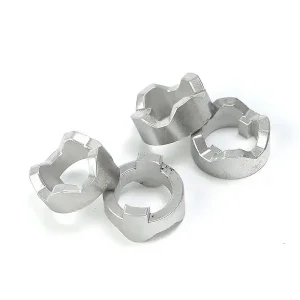






Executive Overview: Macro Industrial Status of Medical Micro MIM
The convergence of minimally invasive surgery (MIS), robotic-assisted surgical platforms (such as da Vinci micro-articulation instruments), and wearable bio-sensing hardware has created an unprecedented global demand for structural micro-metal parts. Medical OEM engineers face a persistent manufacturing trilemma: achieving sub-millimeter geometric complexity, ensuring 100% biocompatibility compliance under ASTM F2885, and scaling production without the exponential cost curves of traditional micro-CNC milling or Swiss lathe machining.
Minimally Invasive Surgery Focus
Micro MIM enables the economic mass production of complex surgical jaws, laparoscopic stapler levers, and articulation linkages with wall thicknesses down to 0.15 mm.
High Yield Material Efficiency
Unlike 5-axis micro milling which wastes up to 85% of high-grade raw titanium bar stock, MIM yields a 98%+ raw powder utilization rate, significantly lowering unit cost for medical implants and surgical tools.
ASTM F2885 Standardization
China’s leading MIM factories operate under ISO 13485 certified quality management systems, tailoring medical feedstocks (17-4PH, 316L, Ti-6Al-4V) to match or exceed international metallurgical parameters.
Technical Deep-Dive: Micro MIM Manufacturing & Feedstock Engineering
Micro Metal Injection Molding (Micro MIM) is not merely scaled-down conventional MIM. It requires fundamental modifications across all four core processing steps: spherical powder classification, binder formulation, micro-injection hydraulics, and atmosphere-controlled sintering thermal profiles.
1. Sub-Micron Powder Rheology & Particle Classification
Standard MIM utilizes gas-atomized powders with a $D_{50}$ median diameter of 10–15 $\mu$m. However, micro-features such as $0.10 \text{ mm}$ tooth pitches or sub-millimeter internal channels require specialized fine powders with $D_{50} = 3 \text{ to } 5 \mu\text{m}$.
- Prevents micro-void formulation in thin-walled sections.
- Increases solids loading up to 65% by volume.
- Yields ultra-smooth surface finishes ($Ra \le 0.8 \mu\text{m}$) directly after sintering.
2. Catalytic Debinding & Distortion Mitigation
China’s tier-1 medical MIM facilities utilize Polyoxymethylene (POM)-based binder systems. Under gaseous nitric acid ($HNO_3$) atmospheres at $110^\circ\text{C}$ to $130^\circ\text{C}$, the binder directly sublimates into formaldehyde vapor without entering a liquid state.
- Eliminates capillary liquid distortion in delicate micro-structures.
- Maintains structural integrity of "brown parts".
- Enables clean debinding rates up to $2 \text{ mm/hour}$.
Micro Machining Process Selection Matrix for Medical OEMs
Comparing Micro MIM against conventional fabrication routes for medical instruments:
| Engineering Parameters | Micro MIM (Sintered) | 5-Axis CNC Micro-Milling | Micro Wire EDM | Laser Powder Bed Fusion (3D) |
|---|---|---|---|---|
| Min. Wall Thickness | 0.12 – 0.15 mm | 0.25 mm | 0.10 mm | 0.30 mm |
| Geometric Complexity | 3D Arbitrary / Undercuts | Line-of-Sight Limited | 2.5D Prismatic Only | Complex / Needs Support Structure |
| Surface Roughness ($Ra$) | 0.8 – 1.6 µm (As Sintered) | 0.4 – 0.8 µm | 1.2 – 2.5 µm | 6.3 – 12.5 µm |
| Volume Cost Scalability | Exceptional (>5,000 pcs) | Poor (Linear Time per part) | Poor (Slow Machine Cycle) | Moderate (High Machine Cost) |
| Material Yield Efficiency | 95% – 98% | 15% – 30% | 40% – 50% | 85% – 90% |
China Supply Chain Resilience & Manufacturing Efficiency Hubs
The concentration of powder metallurgy expertise in China—specifically within the Ningbo and Yangtze River Delta industrial corridors—delivers unparalleled structural resilience, rapid DFM turnarounds, and systemic cost optimization for global healthcare brands.
Vertical Ecosystem Co-Location
Within a 50-kilometer radius in Ningbo, MIM plants co-exist alongside raw elemental powder atomizers, precision mold shops utilizing AgieCharmilles Wire EDM, and specialized electropolishing/PVD surface treatment facilities.
Rapid Tooling & Mold Cycles
Where European or North American mold build lead times range from 8 to 12 weeks, Chinese factories execute multi-cavity hardened steel (S136 / H13) micro-molds in 15 to 25 calendar days.
Total Cost Landed Efficiency
Combining automated continuous debinding-sintering furnaces with optimized energy tariffs yields a 30% to 50% unit cost reduction compared to Western counterparts without compromising ISO 13485 compliance.
Localized Application Scenarios in Medical Micro MIM
Micro metal injection molding solves intricate engineering challenges across specialized medical fields. Below are four key structural application scenarios:
1. Endoscopic Grasping Jaws & Biopsy Forceps
Endoscopic biopsy forceps require opposing micro-teeth with pitch profiles under $0.2 \text{ mm}$ and wall thickness of $0.18 \text{ mm}$ to clean-cut soft tissue without slipping.
Key Benefit: Sintered directly to near-net shape; eliminates secondary gear tooth EDM cutting; passes 100-cycle high-tensile torque testing.
2. Orthodontic Self-Ligating Brackets
Orthodontic brackets possess intricate internal archwire slots ($0.018" \text{ or } 0.022"$) requiring slot surface smoothness $Ra < 0.4 \mu\text{m}$ to minimize friction during wire movement.
Key Benefit: Integrated sliding doors and micro-locking mechanism molded in a single cavity mold at 100,000+ pcs/month volume.
3. Robotic Surgical Wrist Cable Pulleys & Links
Surgical robotic wrist mechanisms operate on 5.5mm or 8.5mm shaft outer diameters requiring multi-axis pitch/yaw pitch gears and miniature cable-routing pulleys.
Key Benefit: High fatigue limit (>900 MPa tensile strength) to handle intense mechanical cable traction without fracture.
4. Micro-Fluidic Implantable Pump Valves
Targeted drug delivery pumps require micro valve seats with zero internal porosity to avoid chemical entrapment and ensure precise dosing hermeticity.
Key Benefit: Ultra-clean HIP (Hot Isostatic Pressing) post-sintering reaching 99.8% absolute theoretical density.
Localized Support, Regulatory Compliance & Quality Validation
Medical micro metal components demand zero-defect quality systems. Leading Chinese MIM exporters combine ISO 13485 certification with full IQ/OQ/PQ machine validation protocols to assure regulatory approval under US FDA (21 CFR Part 820) and EU MDR frameworks.
ISO 13485 & Traceability
Every raw powder lot is tracked via LIMS software from chemical atomization certificate through debinding run logs, sintering furnace temperature graphs, to final packaging.
Sub-Micron Metrology
Quality control laboratories house ZEISS CMMs, Keyence 3D Optical Profilometers ($0.1\mu\text{m}$ resolution), and Industrial CT Scanners for non-destructive internal void detection.
Biocompatibility & Passivation
In-house chemical passivating per ASTM A967 ensures iron-free corrosion-resistant oxide layers ($Cr_2O_3$), passing ISO 10993-5 cytotoxicity and ISO 10993-11 systemic toxicity testing.
Micro MIM Technical Roadmap & Future Outlook (2025 – 2030)
As surgical platforms miniaturize toward sub-millimeter access channels, Chinese Micro MIM research institutes and advanced factories are pioneering three next-generation manufacturing pillars:
Phase 1: Nano-Powder Synthesis & Zero-Porosity HIP Integration (2025 – 2026)
Commercial adoption of plasma-atomized nano-powders ($D_{50} < 2 \mu\text{m}$) integrated inline with continuous Hot Isostatic Pressing (HIP) units. This approach elevates post-sinter density to 99.9% theoretical maximum, matching wrought metal fatigue resistance for weight-bearing orthopedic micro-anchors.
Phase 2: 2K Multi-Material Micro Molding (2027 – 2028)
Sequential micro-injection molding combining two distinct metal alloys into a single seamless green body—such as fusing bio-inert Titanium Grade 5 with radio-opaque Platinum-Iridium markers—eliminating downstream micro-welding processes.
Phase 3: AI-Driven Mold Flow & Sinter Shrinkage Simulation (2029 – 2030)
Deployment of generative AI mold design software that predicts non-linear sintering shrinkage vectors down to $2 \mu\text{m}$ accuracy based on feedstock thermal history. This advancement reduces trial-and-error tooling iterations from 3 revisions to Zero-Iteration First-Time-Right Mold Approval.
Frequently Asked Questions (Technical & Procurement FAQ)
Detailed answers to technical queries raised by medical device engineering managers and global procurement executives:
Additional OEM MIM & Die Casting Solutions
Review our specialized die casting, powder metallurgy gears, custom stainless steel MIM parts, and hardware assemblies.





