Featured Precision Metal Components & Machinery
Explore our ISO/IATF-certified sintered powder metallurgy parts, MIM components, and advanced high-temperature furnace hardware.
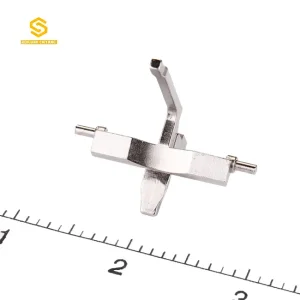
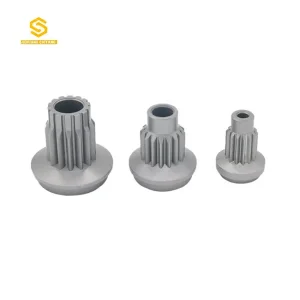
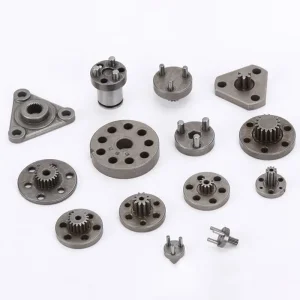
Engineering Authority: Sintered Helical Gear Metallurgy & Manufacturing
An in-depth industrial whitepaper on powder metallurgy helical gearing: kinematics, densification physics, tool kinematics, and macro supply-chain optimization.
Metallurgical Physics & Axial Vectoring
Helical powder metal gears represent the peak of powder metallurgy (PM) mechanical engineering. Unlike standard spur gears, helical gears feature teeth cut at an angle to the gear axis (helix angle β typically ranging from 15° to 30°). This angled orientation allows gradual tooth engagement, distributing mechanical loads continuously across multiple teeth. The consequence is a dramatic reduction in Noise, Vibration, and Harshness (NVH), essential for modern high-RPM electric vehicle (EV) powertrains and whisper-quiet industrial actuators.
Helical Rotary Compaction Dynamics
Compacting helical gears requires specialized multi-axis CNC hydraulic presses equipped with helical drive tooling modules. During the pressing phase, as the upper and lower punches enter the die cavity, they must rotate in exact synchronization with the lead of the helix angle. Releasing the green part requires precise counter-rotation during ejection to prevent tooth shearing—a precision process executed at Ningbo Jiehuang through closed-loop servo kinematics.
Surface Fatigue & Densification
Porosity is the defining physical characteristic of powder metallurgy. While micro-porosity provides natural sound-damping benefits, extreme contact stress demands targeted densification. Through high-temperature sintering followed by surface rolling (ausforming) or sinter-hardening, Jiehuang achieves skin densities exceeding 7.8 g/cm³ on the gear tooth flank, yielding bending strength and pitting resistance equal to wrought steel.
Comprehensive Manufacturing Process Matrix
Comparing Powder Metal Helical Gears against traditional gear hobbing and plastic injection molding.
| Performance Parameter | Powder Metallurgy (PM) Helical | Hobbed & Machined Wrought Steel | Plastic / Metal Injection Molding |
|---|---|---|---|
| Material Utilization Rate | 95% – 98% (Near-Net-Shape) | 40% – 60% (High Scrap Volume) | 90% – 95% (Runner Waste) |
| NVH & Damping Factor | Exceptional (Internal micro-pores damp resonance) | Poor (Transmits vibration unless ground) | Excellent (Low strength limits application) |
| Surface Densification Capability | Up to 7.85 g/cm³ (Selective rolling) | 7.85 g/cm³ (Full solid) | 1.2 – 7.5 g/cm³ (Dependent on polymer/MIM) |
| AGMA 2015 Precision Rating | Class 7 as-sintered / Class 9 ground | Class 8 – 11 (Post-heat treat grinding) | Class 5 – 7 |
| High-Volume Unit Cost | Lowest (Up to 50% lower than machining) | High (Long cycle time per tooth) | Moderate to High (MIM tooling cost) |
Global Powder Metallurgy Trends & Procurement Shift
How global OEMs are shifting procurement strategies toward Chinese powder metal factories to balance decarbonization targets and cost optimization.
1. EV Powertrain Electrification
As the automotive sector transitions from internal combustion engines (ICE) to electric drives, gear operating speeds have surpassed 18,000 RPM. High pitch-line velocities make tooth impact noise unbearable without advanced helical geometry. Powder metal helical planetary reduction gears provide natural acoustic absorption while meeting demanding torque-to-weight ratios.
2. Decarbonization & Scope 3
Manufacturing a helical gear via traditional bar-stock hobbing generates up to 50% steel chip waste, consuming massive electrical energy in steel remelting. Powder metallurgy uses atomized metal powders, consuming 40% less total energy from raw powder to finished sintered gear, aligning directly with Tier-1 ESG and carbon footprint mandates.
3. Supply Chain Resiliency
Global OEMs in North America and Europe demand consolidated manufacturing partners capable of handling raw material atomization blending, tool design, helical pressing, sintering, machining, and heat treatment under one roof. Ningbo Jiehuang provides total internal process control, eliminating multi-vendor logjams.
Procurement Insight: Total Cost of Ownership (TCO) Optimization
By converting multi-piece assembled gear shafts into single-piece sintered PM helical gear assemblies, global procurement teams realize an immediate unit cost reduction of 35% to 52%, while reducing quality non-conformance rates to less than 15 PPM.
Macro Industry Solutions & Vertical Applications
Tailored sintered helical gear solutions designed for stringent operational demands across global manufacturing sectors.
Automotive e-Axles & Auxiliary Actuators
In electronic power steering (EPS), electronic park brakes (EPB), and HVAC blend doors, noise elimination is mandatory. Jiehuang designs low-noise PM helical gears utilizing MPIF FLN2-4408 alloy steel, heat-treated for extreme core toughness and flank durability.
- Helix Angles up to 35° with custom tooth modification
- Sinter-hardened to HRC 35–45 without post-quenching distortion
- 100% automated acoustic inspection compliance
Industrial Power Tools & Precision Robotics
Handheld cordless power tools demand maximum torque in extremely compact gearbox envelopes. Our planetary helical gear sets deliver ultra-high power density, featuring high copper-steel compositions (MPIF FC-0208) that withstand stall torque shock loads.
- Tensile strengths exceeding 850 MPa after oil quenching
- Integrated oil-impregnation for self-lubricating lifetime operations
- Custom tooth root fillet profiles to mitigate fatigue cracking
Smart Home Appliances & Automation
From robotic vacuum cleaners to high-end kitchen appliances, precise motion control and zero customer complaints are critical. Our helical micro-gears utilize hybrid iron-nickel formulations to ensure smooth engagement and sub-35dB acoustic operational profiles.
- Modules as small as m=0.3 with high-aspect teeth
- Net-shape teeth eliminate costly gear shaping operations
- RoHS and REACH compliant raw powder metallurgy chemical blends
Medical Equipment Drive Trains
Surgical beds, infusion pumps, and imaging devices require fail-safe torque transmission with zero backlash accumulation. We leverage stainless steel helical PM processes (MIM and Press-Sinter 316L/17-4PH) to combine corrosion resistance with high mechanical integrity.
- High bio-compatibility and resistance to sterilization fluids
- Full material traceability from atomization lot to batch box
- CMM verification with 3D profile scan reports included
Technology Roadmap & Future Metallurgy (2025–2035)
Pioneering next-generation powder metallurgy innovations to push the boundaries of density, torque density, and gear precision.
High-Density Warm Compaction
Heating powder and tooling to 130°C to achieve single-press densities of 7.4 g/cm³ without double-sintering.
CNC Helical Tooling Kinematics
Direct-drive electronic gear coupling for real-time lead adjustment during pressing cycle.
Selective Surface Rolling
Cold rolling tooth flanks post-sintering to reach 7.85 g/cm³ theoretical solid steel density on contact zones.
AI Sintering Shrinkage Control
Closed-loop optical sensing inside atmosphere furnaces to regulate thermal zones dynamically.
Hybrid PM Additive Integration
Combining 3D printed internal cooling channels with high-volume PM gear bodies for extreme duty applications.
Localization Support & Global Quality Guarantee
Navigating international procurement requires more than just manufacturing; it requires stringent quality control, regulatory compliance, and seamless global logistics.
- IATF 16949:2016 Certification: Complete automotive-grade Quality Management System compliance, including PPAP Level III documentation, FMEA, and SPC tracking.
- Advanced Inspection Metrology: Equipped with Zeiss 3D CNC Coordinate Measuring Machines (CMM), Gleason Gear Inspection Centers, and metallographic micro-hardness testers.
- Global Logistics & DDP Delivery: Seamless customs handling, DDP/DAP terms delivered directly to European, North American, and Asian OEM assembly facilities.
- In-House Tool Design & Engineering: 15+ senior powder metallurgy engineers providing free DFM (Design for Manufacturability) analysis within 48 hours.
Engineered Quality System Framework
1. Powder Inspection: Laser particle size distribution & hall flow testing.
2. Green Compact Inspection: Weight consistency and green density check.
3. Sintering Audit: Carbon potential control & microstructural analysis.
4. Gear Geometry Verification: Total composite error & pitch variation checks.
5. 100% Sorting: Automated vision sorting for dimensional critical features.
Frequently Asked Questions (FAQ) – Engineering & Sourcing
Expert insights addressing common engineering, procurement, and technical queries regarding powder metal helical gear production.
Additional OEM Powder Metallurgy & Die Casting Product Catalog
Review our complete capabilities in custom metal injection molding, titanium metallurgy, precision gears, and structural casting hardware.