
Featured Sintered & Cast Precision Components
Explore our primary OEM manufacturing line items engineered with tight metallurgical tolerances and optimized microstructures.





The Technical Evolution of China's Powdered Metal Manufacturing
Demystifying near-net-shape metallurgy, high-density sintering kinetics, and the strategic cost advantages of sourcing from tier-1 Chinese manufacturers.
High-Density Sintering Kinetics
Modern powder metallurgy (PM) has evolved beyond basic press-and-sinter boundaries. By deploying vacuum sintering and hot isosatic pressing (HIP) protocols, leading factories in China achieve relative component densities exceeding 98.5% of theoretical density. This eliminates internal voids, boosting tensile strength and fatigue life to levels comparable to wrought alloys.
Complex Metal Injection Molding (MIM)
When design requirements demand three-dimensional geometric complexity, sub-millimeter wall thicknesses, or micro-internal threads, MIM combines the design freedom of plastic injection molding with the structural integrity of high-grade stainless steel (17-4PH, 316L), titanium (Ti-6Al-4V), and soft magnetic materials.
Hybrid Material Synthesis
By blending ultra-fine spherical powders (gas-atomized or water-atomized) with proprietary binder formulations, Chinese factories can customize mechanical characteristics—ranging from ultra-hard tungsten carbide wear inserts to thermally conductive aluminum-copper matrix compounds.
Powder Metallurgy 4.0: Technology & Future Outlook
How advanced material science, binder jetting hybrids, and AI-driven sintering furnaces are shaping global manufacturing supply chains.
Phase 1: Precision Powder Atomization & Rheology
Transitioning to plasma-atomized spherical titanium and high-entropy alloy powders. Micro-spherical grain distribution ensures optimal packing density, enabling uniform thermal shrinkage (+/- 0.3%) during thermal debinding and high-temperature sintering phases.
Phase 2: Hybrid MIM & Binder Jet Additive Synergy
Bridging low-volume rapid prototyping with high-volume MIM tooling. Direct Binder Jetting allows functional testing of complex geometry in 316L or Inconel 718 prior to hard steel mold fabrication, slashing initial R&D cycle times by up to 65%.
Phase 3: Atmosphere-Controlled Continuum Sintering
Deployment of continuous belt sintering furnaces equipped with multi-zone closed-loop hydrogen/argon gas atmosphere control. In-line mass spectrometers dynamically adjust carbon potential to eliminate surface decarburization and maintain strict microstructural homogeneity.
Key Engineering Advancements
- Titanium MIM (TiMIM): Achieving tensile strength ≥ 850 MPa with oxygen content controlled under 0.20 wt%.
- Micro-MIM Micro-Feature Resolution: Wall thicknesses down to 0.18 mm and internal radii under 0.05 mm.
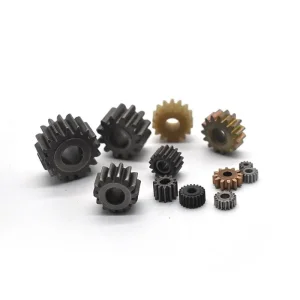
- Ultra-High Density PM: High-tonnage CNC compaction presses achieving sintered densities of 7.65 g/cm³ for heavy-duty automotive planetary gears.
- Zero-Secondary Machining Near-Net Shape: Tooth profile tolerances conforming to AGMA Class 9 standards right out of the sintering furnace.
Tailored Metallurgical Systems by Industrial Sector
From automotive powertrain reliability to surgical instrument biocompatibility, customized material selection drives functional success.
Automotive & EV Drivetrains
Engineered for high-torque loading, continuous thermal stress, and strict weight targets. Key applications include:
- Variable Valve Timing (VVT) rotor & stator components
- Electric Parking Brake (EPB) high-density gearboxes
- Turbocharger wastegate actuators in heat-resistant Ni-Cr alloys
- Powder metal tensioners and oil pump gears
Medical & Surgical Hardware
Biocompatible, corrosion-resistant components engineered for sterilizable surgical instruments and minimally invasive devices:
- 316L and 17-4PH endoscopic surgical graspers and scissor jaws
- Titanium scalpels, needle drivers, and medical knife handles
- Orthopedic tool gears with passivated mirror surface finishes
- Dental implant positioning jigs and surgical fixtures
Consumer Electronics & Wearables
Delivering high aesthetic appeal, ultra-thin profiles, and exceptional mechanical toughness for smart devices:
- Foldable smartphone complex multi-axis hinge assemblies
- Smartwatch metal bezels, titanium crowns, and strap links
- AR/VR headset optical mounting frames and micro-fasteners
- Tactile feedback vibration motor eccentric weights
Industrial Tools & Fluid Handling
Heavy-duty sintered components designed for extreme impact resistance, abrasion resistance, and high-pressure fluid flow:
- Cordless power tool planetary gear trains (MPIF FL-4405)
- Stainless steel mini ball valve cores and pump impellers
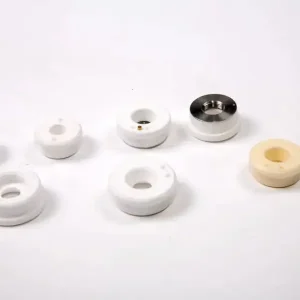
- Wear-resistant tungsten-carbide nozzles and ceramic connectors
- Lock hardware cylinders, latches, and high-security keyways
Benchmarking MIM, PM, Die Casting & CNC Machining
Compare structural density, surface finish, design flexibility, and unit costs to select the optimal manufacturing path.
| Manufacturing Process | Optimal Part Weight | Dimensional Tolerance | Geometric Complexity | Material Utilization | Economic Volume Threshold |
|---|---|---|---|---|---|
| Metal Injection Molding (MIM) | 0.1g – 250g (Ideal <100g) | ±0.3% to ±0.5% (Down to ±0.01mm) | Extremely High (Undercuts, 3D Curves) | > 95% (Near-Zero Scrap) | 2,000 – 1,000,000+ pcs |
| Powder Metallurgy (PM Press & Sinter) | 5g – 5,000g (Up to 150mm Dia) | ±0.1% to ±0.3% (IT 8–11) | Moderate (2.5D Axial Profiles) | > 97% (Self-Lubricating Porous) | 5,000 – 500,000+ pcs |
| Aluminum / Zinc Die Casting | 10g – 15,000g | ±0.05mm to ±0.15mm | High (Thin-wall Cavities, Ribs) | ~ 90% (Runners Recyclable) | 2,000 – 100,000+ pcs |
| 5-Axis CNC Machining | Unrestricted | ±0.005mm to ±0.02mm | High (Tool Access Dependent) | 15% – 50% (High Chip Waste) | 1 – 1,000 pcs (Low Volume) |
| Metal 3D Printing (SLM / DMLS) | 0.5g – 2,000g | ±0.1mm to ±0.2mm | Infinite (Internal Channels) | ~ 90% (Powder Reusable) | 1 – 100 pcs (Rapid Prototypes) |
Supply Chain Resilience, Scale & Efficiency Advantages
Inside Ningbo's premier powder metal manufacturing hub: Automated presses, MES lot-traceability, and integrated raw material ecosystems.
1,000-Ton Automated CNC Presses
Our facility houses high-tonnage hydraulic and electric CNC compaction presses ranging from 15 tons to 1,000 tons (10,000 kN) force. Multi-level tooling adaptors allow multi-stage pressing for complex multi-tier gears and structural flanges without density gradients.
Digital MES & SPC Quality Control
Every batch of raw powder undergoes X-ray fluorescence (XRF) elemental spectrum analysis, particle size distribution testing, and apparent density measurement. Our MES tracking tags each sintering boat with barcode traceability across debinding, sintering, heat treatment, and secondary sizing.
Localized Raw Powder Ecosystem
Located near major metallurgical innovation corridors and Ningbo port infrastructure, our factory sources high-purity atomized stainless steel, iron-nickel, and pre-alloyed powders domestically. This ensures stable raw material cost structures and guards global buyers against raw material supply shocks.
Localization Support, Compliance & IP Protection
Seamless engineering collaboration, robust legal non-disclosure agreements, and rigorous international certification standards.
Certifications & Standards
Production facilities operate strictly under certified quality management frameworks:
- IATF 16949:2016: Automotive Quality Management System
- ISO 9001:2015: General Industrial Quality Standard
- MPIF Standard 35: Materials Standards for PM Structural Parts
- RoHS & REACH Compliance: Full heavy metal and chemical safety assurance
Intellectual Property & NDA
We enforce strict multi-level data protection protocols for global OEM clients:
- Bilingual Non-Disclosure Agreements (NDA) signed prior to file transfer
- Isolated CAD/CAM server infrastructure with access control logs
- Custom tooling ownership fully assigned to the customer upon mold payment
- Encrypted secure file sharing for STEP, IGES, and DWG project files
Engineering DFM Review
Every drawing shared with our engineering team undergoes a complimentary Design for Manufacturability analysis:
- Identification of sharp internal corners, wall variance, and ejection draft angles
- Mold flow simulation to predict feedstock fill patterns and weld line placement
- Comprehensive 48-hour commercial quotation detailing tooling vs unit price
- First Article Inspection (FAI) reports with full CMM dimensional data
Custom MIM & Molded Component Catalog
Discover specialized powder injection molded hardware, medical knife handles, auto tee tubes, and micro gear assemblies.






Frequently Asked Questions by Procurement Engineers
In-depth technical answers addressing material selection, shrinkage calculations, prototyping options, and quality control.
Ready to Optimize Your Metal Component Costs?
Submit your 2D/3D CAD drawings today for a free Design for Manufacturability (DFM) analysis and transparent 48-hour commercial quotation.