
Featured OEM Powder Metallurgy & Ceramic Components
Explore our top-tier precision sintered components engineered with microscopic tolerance controls (+/- 0.001mm), exceptional dielectric strength, and high thermal resistance.






Industry Development Trends in Ceramic Powder Metallurgy (CIM)
As industrial applications push operational limits across high temperatures, corrosive environments, and extreme mechanical friction, conventional metallurgy and polymer injection reach physical boundaries. Ceramic Powder Metallurgy (CIM) has emerged as the definitive engineering paradigm shift for global Tier-1 OEMs.
The Technological Frontier: Advanced Zirconia ($ZrO_2$) and Alumina ($Al_2O_3$) Formulations
The modern industrial ecosystem demands components that exhibit a combination of zero electrical conductivity, hyper-wear resistance, chemical inertness, and extreme fracture toughness. Ceramic Powder Metallurgy synthesizes sub-micron ceramic powders with tailored thermoplastic binder systems, subjecting green bodies to controlled multi-stage thermal debinding and high-temperature liquid/solid phase sintering.
Key drivers re-shaping the global Ceramic Powder Metallurgy market include:
- Miniaturization of Micro-Mechanical Assemblies: Medical surgical handheld units, optical fiber ferrules, and micro-planetary gearboxes require complex 3D net-shape geometries that traditional diamond-tool CNC grinding cannot achieve economically.
- Extreme Thermal Management & Dielectric Isolation: Next-generation EV power electronics, semiconductor wafer chucks, and aerospace sensors leverage technical ceramics for dielectric breakdown strengths exceeding 15 kV/mm alongside thermal stability beyond 1200°C.
- Sub-Micron Grain Refinement: Yttria-stabilized Tetragonal Zirconia Polycrystals (Y-TZP) integrated with alumina-toughened matrices deliver bending strengths exceeding 1,200 MPa, preventing catastrophic brittle failure under shock loading.
Technical Engineering Matrix: Material Rheology & Process Science
Achieving zero-defect mass production in ceramic powder metallurgy requires rigorous cross-disciplinary mastery of powder chemistry, organic binder rheology, mold flow kinetics, and thermal shrinkage prediction.
Powder Preparation & Characterization
We source ultra-pure nanoscale powders ($Al_2O_3$, $ZrO_2$, $Si_3N_4$, $SiC$) characterized by tight spherical particle size distributions (D50 = 0.3 - 0.8 μm). Powder surfaces undergo acoustic dispersion and silane coupling agent treatment to maximize solid loading capacity up to 65 vol% in organic binders.
Thermoplastic Multi-Component Binders
Our proprietary binder systems combine Paraffin Wax (PW), Polypropylene (PP), Ethylene-Vinyl Acetate (EVA), and custom surfactants. Designed for pseudo-plastic shear-thinning flow behavior during injection molding, ensuring smooth cavity fill without jetting, powder-binder separation, or residual strain.
Solvent & Catalytic Thermal Debinding
Green bodies pass through environmental-friendly solvent extraction units to open interconnected micro-porosity networks. Subsequent thermal debinding breaks down residual backbone polymers without inducing micro-cracks, blistering, or distortion before final phase densification.
China Factory 4.0: Supply Chain Resilience & Cost-Efficiency Advantages
At Ningbo Jiehuang Chiyang Electronic Tech Co., Ltd. (JHMIM), we integrate fully automated Industry 4.0 powder metallurgy ecosystems, providing global procurement directors with uncompromised quality, ultra-fast NPI lead times, and substantial cost advantages.
End-to-End Vertical Integration
From in-house mold tooling design (EDM, high-speed CNC milling) to feedmixing, ceramic injection molding, debinding, vacuum sintering furnaces, and secondary diamond machining, all processes take place within our 28,000 m² facility under strict IATF 16949 oversight.
Digital Twin & Automated Optical Inspection (AOI)
Real-time cavity pressure sensing and thermal digital-twin mapping optimize mold parameters continuously. 100% automated 3D vision inspection systems verify micro-geometries, eliminating human error across multi-million piece annual contracts.
Supply Chain Agility & Dual-Sourcing Safeguards
Located in Ningbo’s world-class high-tech industrial corridor, JHMIM enjoys immediate proximity to strategic raw material reserves, specialized thermal processing equipment manufacturers, and deepwater container ports (Ningbo-Zhoushan), guaranteeing uninterrupted supply chains.
Comparative Manufacturing Process Benchmark Matrix
When selecting the optimal manufacturing route for high-precision components, engineering teams must weigh geometry complexity, raw material yield, tooling investments, and unit piece economics.
| Evaluation Parameter | Ceramic Injection Molding (CIM) | Metal Injection Molding (MIM) | Conventional Die-Press PM | Diamond Tool CNC Machining |
|---|---|---|---|---|
| Geometric Complexity | Extreme (3D Undercuts, Micro-Holes) | Extreme (Complex Internal Threads) | Moderate (2.5D Axial Symmetry) | Limited by Tool Accessibility |
| Material Hardness (Mohs) | 8.5 - 9.0 (Ultra-Hard) | 5.5 - 7.0 (Hardened Steel) | 5.0 - 6.5 (Sintered Alloys) | Work-Hardens Ceramic/Metal |
| Electrical & Thermal Isolation | Outstanding Dielectric Isolation | Electrically Conductive | Electrically Conductive | Varies by Workpiece Stock |
| Raw Material Utilization | 95% - 98% (Near-Net Shape) | 95% - 98% (Near-Net Shape) | 85% - 90% (Press Waste) | 15% - 40% (Heavy Scrap Loss) |
| As-Sintered Tolerances | ± 0.3% to ± 0.1% Nominal | ± 0.3% to ± 0.5% Nominal | ± 0.5% Nominal | ± 0.005mm (High Labor Cost) |
| High-Volume Unit Cost | Lowest at Scale (>2k pcs) | Very Low at Scale | Low for Simple Shapes | Prohibitively High |
Localized Application Scenarios & Engineering Innovations
Ceramic powder metallurgy and specialized MIM components serve critical failure-zero functions across diverse high-tech manufacturing sectors.
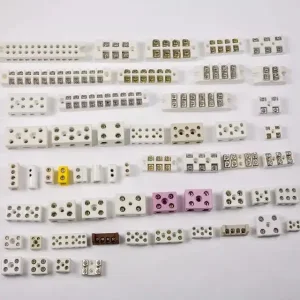
1. High-Voltage Ceramic Terminal Blocks
Engineered for extreme dielectric isolation in industrial kilns, HVAC power feeds, and high-voltage EV distribution units. These terminal blocks utilize high-purity alumina ($Al_2O_3 \ge 95\%$) to withstand continuous dielectric stresses over 25 kV/mm without flashover or thermal degradation.
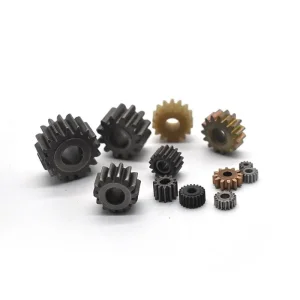
2. Automotive Actuators & Window Gear Assemblies
Sintered stainless steel (MIM 17-4PH / 316L) micro gears and planetary gear trains deliver extreme mechanical strength, fatigue resistance, and low acoustic noise. Precision sintering ensures AGMA Quality Class 8 tolerances directly out of the sintering furnace.
3. Wearables & Medical Surgical Hardware
Combining biocompatible Titanium MIM (TiMIM) and Zirconia ceramic components for smartwatches, surgical scalpel handles, endoscopic articulation hinges, and wireless headphone enclosures where skin-contact safety, lightness, and mirror-finish aesthetics are non-negotiable.
Precision OEM Customization Product Series
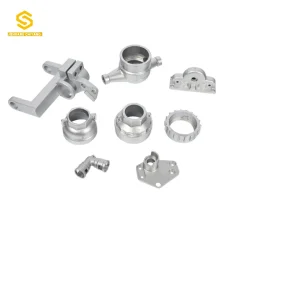
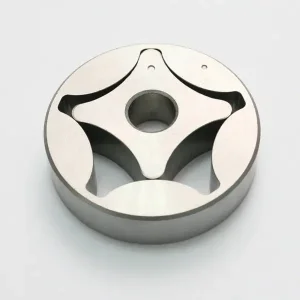
Browse our extended portfolio of OEM die-casting, metal powder injection, micro gear transmissions, and custom sintered industrial valves built according to client CAD specifications.




Technical FAQ: Ceramic Powder Metallurgy Procurement
Direct engineering insights answering critical procurement and design queries regarding Ceramic Injection Molding (CIM), tool life, debinding kinetics, and material properties.
Partner with China's Premier Ceramic Powder Metallurgy OEM
Send us your 2D engineering drawings (PDF) and 3D CAD files (STEP/IGES). Our senior engineering team will provide a complimentary Design for Manufacturability (DFM) analysis and transparent quotation within 48 hours.
Request Technical DFM & Quotation