
Featured Sintered Metallurgy & Precision Components
Explore OEM manufacturing solutions engineered for high-torque transmissions and industrial hardware.

Wholesale OEM China Sintered Bronze Bush PM Bearings & Metal Sintering Gears
View Details & Inquiry
China ODM Custom High Precision CNC Machining & Die Casting Aluminum Parts
View Details & Inquiry
Custom Sintered Hardware & Metal Injection Molding CNC Engine Components
View Details & Inquiry
High Precision 304 Stainless Steel OEM China Metal Fabrication Parts
View Details & Inquiry
Die Cast Aluminum & Zinc Alloy Precision Components for Medical Devices
View Details & Inquiry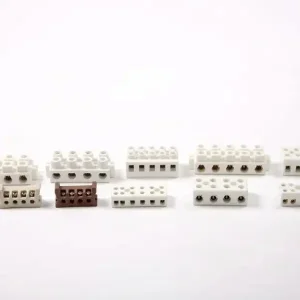
High Temperature Ceramic Terminal Block Wire Connectors Factory Direct
View Details & Inquiry
Custom Zinc Die Casting & Precision Aluminum Casting OEM Parts Manufacturer
View Details & Inquiry
CE Certified Sintered Metal Parts Powder Metallurgy Gear Assemblies
View Details & InquiryFLN2-4405 Alloy Mechanics & Sintered Gear Engineering
An analytical breakdown of material composition, microstructural kinetics, and mechanical performance under extreme cyclic dynamic stress.
Core Metallurgical Definition: What is FLN2-4405?
In accordance with MPIF Standard 35 (Metal Powder Industries Federation), FLN2-4405 represents a sintered hybrid iron-nickel-molybdenum alloy steel. Formulated specifically for ultra-high strength structural gears, the designation decodes into: FL (Pre-alloyed iron powder with Molybdenum), N2 (2.0% admixed Nickel), and 4405 (0.4% to 0.6% combined carbon content). Through vacuum high-temperature sintering, FLN2-4405 achieves a heterogeneous microstructure consisting of hard martensite, tough bainite, and nickel-rich austenite pockets, imparting extraordinary rolling contact fatigue strength and impact resistance.
| Property Designation | As-Sintered State | Heat-Treated / Sinter-Hardened | Unit / Standard |
|---|---|---|---|
| Sintered Density | 7.00 – 7.25 | 7.20 – 7.45 | g/cm³ (Archimedes Method) |
| Ultimate Tensile Strength (UTS) | 650 – 780 | 1,050 – 1,350 | MPa (ASTM E8) |
| Yield Strength (0.2% Offset) | 450 – 550 | 850 – 1,100 | MPa |
| Apparent Hardness | 85 – 95 HRB | 32 – 45 HRC | Rockwell Hardness Scale |
| Particle Hardness (Microhardness) | 250 – 350 HV0.1 | 550 – 700 HV0.1 | Vickers Hardness (Martensitic phase) |
| Impact Energy (Charpy Unnotched) | 18 – 24 | 12 – 18 | Joules @ 21°C |
| Fatigue Limit (Cyclic Bending) | 260 – 310 | 400 – 480 | MPa ($R = -1$, $10^7$ cycles) |
Nickel-Rich Austenite Pockets
Diffusion-bonded nickel creates crack-arresting austenitic micro-zones. When subjected to surface contact strain, these zones work-harden dynamically, absorbing shock loads that would fracture conventional carbon steels.
Rapid Sinter-Hardening Response
With pre-alloyed molybdenum ($0.85\text{ wt}\% \text{ Mo}$), FLN2-4405 exhibits exceptional hardenability. Accelerated gas cooling ($>2.5^\circ\text{C/s}$) inside sintering furnaces transforms the matrix into martensite without requiring secondary liquid quenching.
Dimensional Accuracy (ISO Class 7-9)
Sintering shrinkage is ultra-predictable ($0.15\% \pm 0.03\%$). Near-net-shape compaction preserves AGMA 10 / ISO 1328 tooth profile integrity directly out of the sintering mesh belt furnace.
Industrial Demands & Transition to Sintered Powder Metal
Why tier-1 global automotive OEMs and industrial machine manufacturers are replacing wrought/cut gears with FLN2-4405 powder metal solutions.
TCO Optimization & Material Conservation
Traditional gear manufacturing relies on subtractive metal cutting (hobbing, shaping, shaving) from bar stock, wasting 35% to 55% of expensive alloy steel as chips. FLN2-4405 high-strength gears engineered through powder metallurgy (PM) or metal injection molding (MIM) achieve near-net-shape geometries in a single pressing stroke. Material yield exceeds 95%, drastically insulating tier-1 procurement managers from raw steel price fluctuations while cutting unit manufacturing costs by up to 45%.
Acoustic Damping & NVH Performance in Electric Drives
With the global shift toward electric vehicles (EVs) and smart robotics, Noise, Vibration, and Harshness (NVH) has become a primary engineering hurdle. Micro-porosity inherently present in sintered FLN2-4405 matrix acts as a natural sound-dampening mesh. Compared to dense solid wrought steel gears, FLN2-4405 gears exhibit superior internal vibration attenuation, reducing high-frequency gear whine in high-RPM electric power tools and e-axle gearboxes.
China's Manufacturing Ecosystem & Production Scalability
Leveraging advanced tooling speed, integrated metallurgical testing, and automated continuous sintering infrastructure.
Automated 1,000-Ton Compaction
Our facilities deploy state-of-the-art multi-level hydraulic and mechanical press systems capable of uniform density distribution across multi-tier gear steps.
Rapid Tooling & DFM in 48 Hours
Engineers utilize FEA compaction modeling and mold-flow simulations to deliver Design for Manufacturability feedback and transparent quotes within 48 hours.
Atmosphere-Controlled Sintering
Continuous belt mesh and vacuum furnace systems utilize high-purity Nitrogen-Hydrogen gas blend ($90\% \text{N}_2 / 10\% \text{H}_2$) to prevent intergranular oxidation.
Complete Secondary Processing
In-house CNC gear honing, resin impregnation, surface rolling, passivation, and automated optical vision sorting ensure 0-PPM defect delivery targets.
FLN2-4405 High Strength Gears in Action
Tailored gear configurations serving demanding motion control systems worldwide.
Automotive Variable Valve Timing (VVT)
Operating Conditions: Continuous contact with engine oil, high cyclic thermal fluctuations ($-40^\circ\text{C}$ to $+150^\circ\text{C}$), rapid reversing torque.
Why FLN2-4405: Sinter-hardened FLN2-4405 provides high fatigue resistance against tooth root bending while maintaining micro-geometrical stability across millions of engine cycles.
Heavy-Duty Electric Power Tools
Operating Conditions: High RPM impact loads, instantaneous stall torque, compact gear envelope (Power Drills, Rotary Hammers).
Why FLN2-4405: Admixed nickel phase toughness prevents tooth stripping during sudden motor lockup, offering over $2.5\times$ impact resistance compared to standard atomized iron gears.
Industrial Robotics & Actuators
Operating Conditions: Precision backlash demands, planetary gear reduction systems, continuous heavy payload positioning.
Why FLN2-4405: High surface microhardness (up to $650\text{ HV0.1}$) limits wear over time, preserving low backlash metrics throughout automated robotic service lifetimes.
Global OEM Procurement & Verification Protocol
Strict metallurgical verification standard operating procedures engineered to surpass international compliance metrics.
Comprehensive Material Certification
Every batch of FLN2-4405 gears shipped includes full spectroscopic powder chemical analysis, MPIF 35 density validation reports, macro/micro hardness profiles, and batch-level tensile test bars pulled in accordance with ASTM E8 standards.
Advanced Metrology Inspection
Our quality inspection laboratories utilize Zeiss 3D Coordinate Measuring Machines (CMM), gear analytical inspection centers for pitch/profile deviation measurement, optical profilometers, and non-destructive magnetic particle crack detection testing.
PPAP Level III & ISO Compliance
For Tier-1 automotive and aerospace procurement, we provide full Production Part Approval Process (PPAP) Level III documentation packages including Process Flow Diagrams, PFMEA, Control Plans, Measurement System Analysis (MSA), and Dimensional Layout Inspection results.
Emerging Powder Metallurgy Gear Innovations
Pioneering warm compaction, surface rolling densification, and hybrid additive technologies.
Surface Rolling Densification
By cold-rolling tooth roots and flanks post-sintering, surface density reaches $7.80\text{ g/cm}^3$ (equivalent to wrought steel). This eliminates surface pores, multiplying tooth bending fatigue strength by up to $300\%$.
Warm Compaction Systems
Heating both powder and die to $120^\circ\text{C} - 150^\circ\text{C}$ during pressing increases single-press green density up to $7.40\text{ g/cm}^3$, unlocking ultra-high strength capabilities for heavy diesel powertrain gears.
Hybrid 3D Metal Prototyping
Combining selective laser melting (SLM) metal 3D printing with final FLN2-4405 powder compaction allows rapid functional prototype validation within 7 business days prior to hard tooling investment.
Custom OEM & Specialty Metal Components
Precision engineered parts covering metal injection molding, ceramic molding, and custom die casting.

Wholesale Medical Dental Orthodontic Bracket Manufactured by MIM
View Details & Inquiry
High Performance PM Motorcycle Sintered Gear Wheel Parts by Iron Alloy Sintering
View Details & Inquiry
Aluminium Alloy Die Casting with High Precision CNC Machining Services
View Details & Inquiry
Wholesale Ceramic Injection Molding (CIM) Precision Structural Components
View Details & Inquiry
Precision Stainless Steel Machining for Automotive Turbo VNT Nozzle Ring
View Details & Inquiry
Customized Zinc Alloy & Aluminum Precision Die-Casting Metal Castings
View Details & Inquiry
OEM Metal Injection Molding (MIM) Stainless Steel Complex Components
View Details & Inquiry
Customized ATV Parts & Auto Aluminum Die Casting Fan Housing Assemblies
View Details & InquiryFrequently Asked Questions: FLN2-4405 Gear Engineering
In-depth engineering insights covering design, tolerances, heat treatment, and purchasing parameters.
How does FLN2-4405 compare against AISI 8620 or 4140 wrought alloy gear steel?
While solid wrought steels like 8620 or 4140 require complete CNC cutting from solid bar stock, FLN2-4405 is pressed directly near-net-shape. In terms of mechanical strength, heat-treated FLN2-4405 achieves tensile strength up to 1,350 MPa, closely matching heat-treated 8620 carburized steel. Additionally, FLN2-4405 delivers superior acoustic damping (NVH reduction) and cuts unit part costs by 30% to 50% at high production volumes.
What dimensional tolerances can be held directly from the powder metallurgy sintering process?
Standard press-and-sinter FLN2-4405 gears achieve IT 8 to IT 10 tolerance grades (AGMA 7-8). Radial runout and tooth-to-tooth pitch errors can be held within $\pm 0.025\text{ mm}$. When combined with secondary sizing (coining) or precision CNC gear honing, tolerances can be tightened to IT 6 (AGMA 10-11).
Is secondary heat treatment mandatory for FLN2-4405 gears?
It depends on your torque requirement. In the as-sintered state, FLN2-4405 yields ~85-95 HRB hardness, which is sufficient for light-duty actuators. However, for high-torque powertrains, sinter-hardening (rapid furnace gas cooling) or post-sinter carburizing/tempering elevates apparent hardness to 35-45 HRC with microhardness exceeding 600 HV0.1.
What is the typical Minimum Order Quantity (MOQ) and tooling lead time?
For custom powder metallurgy gears, standard tooling lead time is 25 to 30 days for initial T1 sample delivery. Production MOQ starts at 5,000 pieces per run to maximize compaction press efficiency, although smaller pilot production runs are supported under specific engineering development agreements.
How does internal porosity affect gear lubrication and fluid sealing?
Interconnected surface pores in sintered steel can be advantageous or challenging depending on application. For oil-lubricated transmissions, micro-pores retain oil films, reducing dry-start wear. For high-pressure hydraulic fluid gears, vacuum resin impregnation or copper infiltration is applied to 100% seal interconnected porosity.
What documentation and Quality Assurance certifications accompany international orders?
All export shipments include Certificate of Analysis (CoA) for chemical composition, CMM dimensional measurement records, microhardness depth profiles, and density test certifications. Full IATF 16949 compliant PPAP Level III packages are available upon customer request prior to mass production release.