
Featured OEM Medical & Precision Injection Components
Explore our high-density sintered structural components, medical hardware, and complex powder metallurgy parts manufactured under ISO 13485 & IATF 16949 quality management protocols.

China Discount wholesale China Powder Metallurgy Customized Components Sintered Spare Parts Manufacturers, Suppliers
View Product Details
China Good quality Powdered Metallurgy Metal Part Powder Metallurgy Manufacturer, Suppliers
View Product Details
Wholesale Wholesale Dealers of OEM Alloy Powder Metallurgy Gear Supplier, Factory
View Product Details
China Good User Reputation for Custom Design Precision CNC Mold Part Powder Metallurgy Spare Hardware Machinery Part for Medical Machine Use Manufacturer, Factory
View Product Details
China Professional China China Metal Injection Molding (MIM) Parts for Complex Structural Components Machinery Parts Manufacturers, Factories
View Product Details
Wholesale Cheap PriceList for China Precision Aluminum Vacuum Casting Die Casting A380 Gravity Casting ADC12 Motor Housing Manufacturer, Manufacturers
View Product Details
China 2019 wholesale price China Precision Sinter MIM 3c Industrial Supplier, Suppliers
View Product Details
China Powder Metal Parts Medical Surgical Handle Supplier, Factory
View Product DetailsGlobal Procurement Architecture for Medical Injection Parts
Analyzing shifting buyer behaviors, total cost of ownership (TCO) drivers, and quality mandates across North American, European, and Asia-Pacific healthcare manufacturing sectors.
Precision Demand Shifts in MedTech
The global market for medical device components is experiencing a paradigm shift toward extreme miniaturization, complex internal geometries, and multi-functional integration. Sourcing executives and biomedical design engineers are increasingly replacing traditional multi-axis CNC machining with Metal Injection Molding (MIM) and Ceramic Injection Molding (CIM). This transition is driven by the need to scale production of endoscopic articulators, surgical stapler components, and dental implants while maintaining tolerances as tight as ±0.03mm without incurring cost-prohibitive machining time.
Total Cost of Ownership (TCO) Realities
When evaluating high-volume medical components exceeding 5,000 units per batch, raw material utilization becomes a primary financial metric. Conventional machining yields material scrap rates up to 75% on intricate titanium (Ti-6Al-4V) or stainless steel (316L/17-4PH) parts. MIM near-net-shape manufacturing achieves over 98% raw material utilization, reducing unit prices by 30% to 50% for complex 3D shapes. Global OEM buyers leverage qualified contract manufacturing facilities in China to optimize capital expenditure on tooling while securing validated, repeatable quality.
Regulatory and Supply Resilience
Medical procurement is no longer driven purely by unit cost; risk mitigation and regulatory alignment (FDA 21 CFR Part 820, EU MDR 2017/745) dictate vendor selection. Tier-1 MedTech manufacturers require complete material traceability, heat-lot tracking, biocompatibility certifications (ISO 10993), and robust Change Control Notifications (CCN). Partnering with certified manufacturers guarantees seamless regulatory dossier filings, shortens product launch timelines, and prevents supply chain disruptions in clinical assembly lines.
Procurement Insight: Material Utilization & Cost Efficiency Ratio
In high-grade medical device manufacturing, switching from traditional CNC milling to high-density Metal Injection Molding for 316L stainless steel surgical jaws reduces raw material waste from 68% down to under 2.5%, delivering up to 45% net unit cost reduction at volumes exceeding 10,000 pieces annually.
Macro Industry Solutions & Precision Manufacturing Roadmap
Deep technical examination of powder metallurgy, feedstock binder formulations, debinding stages, and high-vacuum sintering furnace profiles.
1. Feedstock Formulation & Micro-Molding
The manufacturing sequence begins with compounding spherical metal powders (median particle size D50 ranging between 4 to 15 microns) with a multi-component polymer-wax binder system. High-precision electric injection molding machines inject the homogeneous feedstock into multi-cavity hardened tool steel molds (NAK80 or S136) maintained at strict thermal equilibrium. This step forms "green parts" with uniform density and zero micro-voids, essential for critical medical components like laparoscopic scissors and needle holders.
2. Solvent & Catalytic Debinding
The green parts undergo a multi-stage debinding process to extract the primary binder matrix without altering structural integrity. Catalytic debinding utilizes gaseous nitric acid (HNO3) environment at elevated temperatures to break down polyoxymethylene (POM) binders directly into formaldehyde gas. Alternatively, solvent immersion tanks dissolve paraffin wax fractions. The resulting "brown parts" feature an interconnected network of open pores, prepared for metallurgical bonding during high-temperature consolidation.
3. High-Vacuum Sintering & HIPing
Brown components are transferred to computer-controlled vacuum sintering furnaces operating at temperatures between 1,280°C and 1,380°C under partial hydrogen or argon atmospheres. During sintering, linear shrinkage of 14% to 20% occurs predictably as metal particles fuse. To eliminate micro-porosity for fatigue-critical implants or surgical handles, Hot Isostatic Pressing (HIP) is applied at high pressure (up to 150 MPa), elevating physical density to near 100% of theoretical limits.
| Medical Material Grade | Tensile Strength (MPa) | Yield Strength (MPa) | Hardness (HRC / HV) | Primary Medical Applications |
|---|---|---|---|---|
| MIM 316L (UNS S31603) | 520 - 580 MPa | 220 - 260 MPa | 150 - 190 HV | Endoscopic tools, biopsy forceps, housing covers |
| MIM 17-4PH (AISI 630) | 1,150 - 1,300 MPa | 1,000 - 1,150 MPa | 38 - 44 HRC | Surgical stapler anvils, bone drills, gear mechanisms |
| TiMIM Ti-6Al-4V ELI (Grade 23) | 890 - 960 MPa | 820 - 880 MPa | 300 - 340 HV | Orthopedic trauma plates, spinal cages, dental implants |
| Co-Cr-Mo (ASTM F75) | 900 - 1,050 MPa | 600 - 700 MPa | 25 - 35 HRC | Joint arthroplasty, femoral heads, structural implants |
Technology Roadmap & Future Outlook (2025–2035)
Pioneering advancements in Micro-MIM, bioresorbable metals, and closed-loop smart manufacturing for next-generation medical technology.
Micro-MIM for Robotic Surgery
As robotic-assisted surgical platforms (such as Da Vinci and Hugo RAS) expand globally, the demand for sub-millimeter metal parts with sub-micron features is soaring. Micro-Metal Injection Molding utilizes nano-scale metal powders and ultra-precise micro-cavity tooling to manufacture wrists, grippers, and cable-driven pulleys weighing less than 0.05 grams with features down to 50 microns.
Bioresorbable Metal Injection Molding
Next-generation implantology is shifting toward bioresorbable alloys (Magnesium WE43 and pure Iron alloys) that gradually dissolve inside the human body after bone fractures heal. Bioresorbable PIM technology eliminates the necessity for secondary surgical implant removal procedures, representing a breakthrough for pediatric orthopedics and cardiovascular vascular stents.
AI-Driven Defect Detection & In-Line Vision
Industry 4.0 integration across powder injection factories now employs real-time pressure sensor feedback in cavity walls and automated high-resolution optical cameras. Deep learning vision models inspect 100% of sintered components for micro-cracks, flashing, and wall thickness variance before secondary processing, guaranteeing zero-defect shipments to sterile medical device packaging plants.
Global Industrial Landscape & Manufacturing Advantage
Evaluating China's manufacturing ecosystems, tooling speed, cost structures, and global logistics integration for OEM healthcare brands.
China's Integrated Supply Chain Eco-System
China's Yangtze River Delta and Pearl River Delta manufacturing clusters offer an unparalleled concentration of precision tooling shops, raw powder suppliers, specialized debinding equipment vendors, and surface treatment facilities. Overseas medical OEMs partnering with Chinese manufacturers benefit from rapid prototyping cycles, where custom mold design, fabrication, and initial sample inspection (FAI) are completed in 25 to 30 business days—nearly half the lead time of traditional Western toolmakers.
Comparative Tooling & Engineering Overhead
Medical injection mold tooling requires high-grade stainless steel inserts, EDM wire-cut tolerances under 0.005mm, and complex multi-slide side action. In North America or Western Europe, custom multi-cavity MIM molds frequently cost between $35,000 and $80,000. Certified OEM factories in China deliver identical mold durability (rated for 500,000+ shots) at $12,000 to $28,000, significantly lowering initial NPI (New Product Introduction) capital barriers.
Localization, Regulatory Compliance & Quality Protocols
Adhering to strict international standard specifications, cleanroom protocols, IQ/OQ/PQ validation, and comprehensive risk management frameworks.
ISO 13485:2016 Certified QMS
Our Quality Management System is built specifically for medical device contract manufacturing. Every batch produced undergoes rigorous lot-level traceability, root-cause CAPA workflows, continuous statistical process control (SPC), and strict document retention protocols aligned with FDA audit standard guidelines.
ISO Class 7 / Class 8 Cleanroom Operations
To eliminate bioburden and particulate contamination, secondary operations such as ultrasonic cleaning, passivation (ASTM A967 / A380), laser etching, and primary pouch sealing take place inside controlled ISO Class 7 and Class 8 cleanrooms equipped with continuous HEPA air filtration and environmental monitoring.
IQ / OQ / PQ Equipment Validation
All automated injection presses, debinding units, and vacuum sintering furnaces undergo formal validation protocols: Installation Qualification (IQ), Operational Qualification (OQ), and Performance Qualification (PQ). Process parameters (temperature profiles, pressure ranges, gas flow rates) are locked to maintain batch-to-batch repeatability.
ISO 10993 Biocompatibility Testing
Raw materials and finished parts undergo full biological evaluation according to ISO 10993 standards. Testing suites include Cytotoxicity (ISO 10993-5), Sensitization & Irritation (ISO 10993-10), Systemic Toxicity (ISO 10993-11), and Hemocompatibility for direct blood-contact surgical instruments.
Technical Q&A: Engineering & Procurement FAQ
Expert insights addressing key design rules, tolerance limits, debinding mechanics, and tooling validation inquiries.
1. What are the key design rules for medical parts manufactured via Metal Injection Molding (MIM)?
Designing for MIM requires maintaining uniform wall thickness (ideally between 0.5mm and 3.0mm) to prevent sink marks and internal distortion during sintering. Draft angles of 0.5° to 1.0° facilitate part ejection. Internal radii should be at least 0.2mm to eliminate stress concentrations. Undercuts and internal threads can be molded directly using multi-slide tooling, eliminating expensive secondary machining operations.
2. How does MIM compare to Investment Casting for small surgical components?
While Investment Casting (Lost Wax Casting) is suitable for larger structural parts, MIM is far superior for small, complex components (under 50 grams). MIM delivers tighter dimensional tolerances (±0.3% vs ±0.7%), significantly better surface finish (Ra 0.8–1.6µm as-sintered vs Ra 3.2–6.3µm cast), thinner achievable walls (down to 0.3mm), and substantially lower unit costs at production volumes over 2,000 units.
3. What dimensional tolerances can be achieved as-sintered versus post-coining?
Standard as-sintered dimensional tolerances for MIM parts range from ±0.3% to ±0.5% of the nominal dimension. For critical medical dimensions requiring tighter control (e.g., hinge pin holes or mating alignment slots), secondary coining (re-pressing in a precision die) or CNC finish machining can tighten tolerances down to ±0.015mm (±15 microns).
4. How is density controlled to ensure high mechanical strength and corrosion resistance?
Density is controlled through precise powder particle size distribution selection, high-solid-loading feedstock compounding, complete binder extraction, and vacuum sintering at optimal thermal plateaus. Densities exceeding 98% of theoretical maximum yield mechanical properties (yield strength, elongation, fatigue limits) comparable to wrought stainless steel and titanium alloys.
5. Can MIM medical components undergo passivation and electropolishing?
Yes. MIM stainless steels such as 316L and 17-4PH undergo standard citric or nitric acid passivation in accordance with ASTM A967 to remove free iron and generate a uniform chromium oxide passive layer. Electropolishing can further enhance surface finish down to Ra < 0.2µm, creating a mirror-like finish ideal for surgical instruments contact with human tissue.
6. What lead times are typical for medical tooling development and FAI sampling?
Standard prototype tooling and First Article Inspection (FAI) sample submission takes approximately 25 to 35 calendar days after 3D CAD drawing approval. Full PPAP (Production Part Approval Process) Level 3 documentation, including CMM dimensional reports, material heat certificates, and capability studies (Cpk > 1.33), is provided with initial sample submission.
7. How do you prevent internal voids and cross-contamination during production?
Internal voids are eliminated using X-ray non-destructive testing (NDT) and micro-CT scanning during process validation. Cross-contamination is managed by dedicating specific mixing, molding, and furnace lines exclusively to medical-grade alloys (e.g., separating carbon steel powder processing entirely from medical stainless steel and titanium processing).
8. What are the Minimum Order Quantities (MOQ) for custom OEM medical parts?
Our standard production MOQ is 2,000 pieces per batch for custom MIM parts. However, for initial clinical trial lots, low-volume high-value implants, or qualification runs, flexible batch sizing can be arranged during the DFM review stage.
Additional Specialized Sintered & Molded Metal Products
Review our extended portfolio of titanium MIM, stainless steel hardware, custom gears, and high-precision sintered structural solutions.
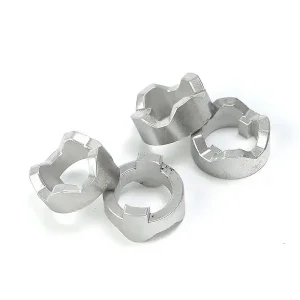
Wholesale Custom titanium mim auto parts Suppliers, Factories
View Product Details
Wholesale Low price for High Precision Customized Sintered Parts for Garden Tool Accessories Manufacturer, Supplier
View Product Details
Wholesale Fast delivery Metal Injection Molding MIM Sintering Metal Parts for SS304 SS316 Stainless Steel Components Manufacturers, Factories
View Product Details
Wholesale Special Price for China High Quality Cheap Price OEM/ODM Service ISO9001 Standard Metal Injection Molding Companies Manufacturer, Supplier
View Product Details
China Chinese Professional OEM Metal Injection Molding Process for Stainless Steel Parts Customized Hardware Suppliers, Factories
View Product Details
China Massive Selection for China Powder Metallurgy (PM) Sintering Steel Parts with OEM Service Supplier, Factories
View Product Details
China Quality Inspection for China SUS 304 Small Size Metal Parts Made by Powder Metallurgy Manufacturers, Suppliers
View Product Details
Wholesale OEM China China OEM Sintered Bronze Bush Pm Copper Powdered Metallurgy Bearings Metal Sintering Gear Parts Manufacturer, Manufacturers
View Product DetailsInitiate Your Engineering DFM Review Today
Submit your 2D and 3D CAD drawings (STEP, IGES, or PDF) for a complimentary Design for Manufacturability (DFM) analysis and mold flow simulation from our senior metallurgical engineering team within 48 hours.