
Featured Precision MIM & Powder Metallurgy Products (Catalog Batch A)
Explore our high-precision sintered components engineered to strict dimensional tolerances for global OEM buyers.





Understanding Metal Injection Molding (MIM) Tolerances
Metal Injection Molding (MIM) combines the design freedom of plastic injection molding with the structural integrity of wrought metals. However, controlling Metal Injection Molding Tolerances requires a rigorous understanding of binder-to-powder formulation, thermal debinding kinetics, and sintering shrink mechanics.
Standard vs. Fine Tolerance Thresholds
In wholesale MIM manufacturing, standard dimensional tolerances are typically maintained at ±0.3% to ±0.5% of the nominal dimension ($T = \pm 0.003L$ to $\pm 0.005L$). For small dimensions under 5 mm, absolute tolerances of ±0.03 mm (±0.0012 in) are routinely achieved without post-sintering operations.
With secondary precision sizing (coining), CNC finish machining, or grinding, tolerances can be tightened to ±0.1% or down to ±0.005 mm for critical assembly interfaces like bearing bores and valve spools.
Physics of Volumetric Sinter Shrinkage
During the thermal debinding and sintering cycles, the green component undergoes a volumetric shrinkage ranging between 14% and 22% (linear shrinkage of 15% to 18%). This shrinkage occurs as the organic binder matrix (wax, polymers) vaporizes and fine metal powders (typically 4–22 μm diameter) fuse via solid-state diffusion.
Minimizing dimensional variance across large wholesale production lots demands hyper-consistent powder bed density, uniform mold cavity filling, and multi-zone vacuum furnace temperature control within ±1°C.
Geometric Dimensioning & Tolerancing (GD&T)
Controlling feature-to-feature relationships in MIM requires balancing isotropic shrink factors. Key GD&T achievements include:
- Flatness: 0.05 mm per 25 mm (can be improved with ceramic sintering setters).
- Concentricity & Roundness: 0.03 mm to 0.08 mm depending on core pin alignment.
- Angularity: ±0.5° for molded draft angles.
- Hole Location Accuracy: ±0.05 mm relative to datum features.
Comparative Manufacturing Tolerances Matrix
| Manufacturing Process | Standard Linear Tolerance | Min Wall Thickness | Surface Roughness (Ra) | Material Utilization | Cost at High Volume |
|---|---|---|---|---|---|
| Metal Injection Molding (MIM) | ±0.3% - ±0.5% (±0.03 mm min) | 0.4 mm | 0.8 - 1.6 μm | > 95% | Very Low (Near-Net Shape) |
| CNC Precision Machining | ±0.005 mm - ±0.02 mm | 0.5 mm | 0.4 - 0.8 μm | 15% - 40% | High (Machine time bound) |
| Investment Casting (Lost Wax) | ±0.7% - ±1.0% | 1.5 mm | 3.2 - 6.3 μm | 60% - 70% | Medium |
| Conventional Powder Metallurgy (Press & Sinter) | ±0.2% - ±0.4% (Length variable) | 1.5 mm | 1.6 - 3.2 μm | > 90% | Low (Geometrically limited) |
DFM Engineering Guidelines for Minimizing MIM Tolerance Deviations
Achieving strict dimensional repeatability across 100,000+ unit factory production runs starts at the drawing board. Our senior metallurgists mandate the following DFM parameters during mold design:
1. Wall Thickness Uniformity
Non-uniform walls create differential cooling rates during molding and uneven density gradients during debinding, causing part warp and dimensional skew. Maintain nominal wall thickness between 1.0 mm and 4.0 mm. Transition between thick and thin sections gradually using 3:1 taper ratios.
2. Radius & Corner Optimization
Sharp internal corners create stress concentration points that propagate thermal cracking and dimensional distortion during vacuum sintering. Always design internal radii of at least 0.5 mm (0.020 in). Generous fillets facilitate smooth feedstock flow during injection.
3. Sintering Setters & Support Surfaces
During sintering near the solidus temperature (1250°C–1380°C), metal parts become semi-plastic. Designing flat datum planes or custom ceramic setters prevents sagging, ovality of internal threads, and beam deflection across long unsupported spans.
Localization Support, Quality Assurance & Global Regulatory Compliance
Navigating global supply chains requires robust local compliance and rigorous quality controls. We provide complete technical and regulatory documentation to ensure seamless cross-border integration for Western OEMs.
Certified Quality Systems
Our manufacturing facilities operate under strict IATF 16949 (Automotive Quality Standard) and ISO 9001:2015 certifications. Every batch undergoes full PPAP Level 3 documentation, including FMEA, Control Plans, and Measurement System Analysis (MSA).
Environmental & Chemical Compliance
All raw powders and binder formulations strictly adhere to RoHS Directive 2011/65/EU and REACH (EC 1907/2006) standards. Complete material traceability certificates (EN 10204 3.1) and heavy metal test reports are provided with every shipment.
Localized Engineering Support
We provide localized engineering support across North America, Europe, and Asia. Our dual-language technical sales managers, real-time DFM portal, and local inventory warehousing buffer against lead-time volatility and simplify customs clearance.
China Factory Supply Chain Advantages & Global Procurement Dynamics
Sourcing wholesale MIM components from specialized Chinese manufacturers offers unprecedented cost efficiency without compromising precision tolerances.
Integrated Industrial Cluster (Ningbo Hub)
Located in Ningbo's high-tech manufacturing zone, our facility benefits from an ultra-compact supply chain radius. Raw carbonyl iron powders, masterbatch binder synthesizers, precision EDM tooling shops, and surface treatment facilities are located within a 50 km radius, reducing prototype lead times by 60%.
In-House Tooling & Rapid Iteration
Unlike Western suppliers outsourcing tooling to third-party mold shops, we maintain an in-house CNC wire-EDM and high-speed milling mold division. MIM tooling lead time is reduced from 10 weeks to 21–25 days, with prototype tooling modifications executed in hours.
Total Cost of Ownership (TCO) Optimization
Wholesale buyers leverage up to 40% to 60% unit cost savings over fully machined steel components. High raw material utilization (>95%), automated multi-cavity injection machines, and continuous belt debinding-sintering furnaces maximize throughput and minimize labor costs.
Industry Development Trends & Localized Application Scenarios
The Metal Injection Molding sector is evolving rapidly toward micro-miniaturization, exotic alloys, and AI-driven process optimization.
Automotive & Powertrain
Demand for high-strength, wear-resistant MIM parts in Variable Valve Timing (VVT) systems, turbocharger vanes, transmission shift fingers, and seat-belt lock mechanisms. Materials like 4605 Fe-Ni steel heat-treated to 45–55 HRC deliver high fatigue resistance under heavy mechanical loads.
Medical & Surgical Devices
Biocompatible 316L and 17-4PH stainless steel MIM components are replacing costly machined forgings in laparoscopic graspers, stapler jaws, orthodontic brackets, and orthopedic trauma plates. Micro-MIM capabilities allow feature wall thicknesses under 0.25 mm.
Consumer Electronics & Wearables
Foldable smartphone hinges, smart-watch housing frames, and TWS earbud charging pins require cosmetic surface finishes (Ra < 0.4 μm after PVD coating) paired with ultra-tight dimensional stability (±0.02 mm) to prevent assembly gaps.
Advanced OEM Engineering Solutions & Precision Components (Catalog Batch B)
Complete line of custom sintered metal, ceramic injection molded, and precision die-cast hardware components.




Frequently Asked Questions: Technical & Procurement Intelligence
In-depth answers from our Chief Metallurgist regarding Metal Injection Molding Tolerances, secondary sizing, and OEM order logistics.
Q1: What standard tolerance grade does your factory guarantee for wholesale MIM orders?
We guarantee standard linear tolerances of ±0.3% of the nominal dimension for stainless steel (17-4PH, 316L) and low-alloy steel components under ISO 2768-mK standards. For dimensions below 10 mm, our standard baseline limit is ±0.03 mm. Tight tolerances down to ±0.1% are achieved via secondary sizing or CNC machining.
Q2: How do you compensate for the 15%-22% shrinkage during sintering?
Shrinkage control is engineered during mold tool design. Using advanced CAD mold-flow software and empirical shrinkage coefficients calculated from raw powder lot pycnometer density tests, tool cavities are oversized by exact shrink factors (e.g., 1.185× to 1.220×). Multi-zone temperature control during sintering maintains consistent density across batch lots.
Q3: What secondary processes are used if a drawing requires tolerances under ±0.01 mm?
For ultra-precision features like internal valve spools or bearing press fits, we utilize post-sintering secondary operations: 1) Precision Coining/Sizing (re-pressing in hardened carbide dies), 2) CNC 5-Axis Milling, 3) Centerless External Grinding, or 4) Wire EDM. This delivers near-net shape economy with CNC-grade precision.
Q4: What is the Minimum Order Quantity (MOQ) and lead time for custom MIM tooling?
Our standard MOQ for wholesale production is 2,000 pieces per batch. Custom mold tooling requires 21 to 28 calendar days from approved DFM drawings to T1 prototype sample delivery. Production lead time is typically 3 to 4 weeks depending on order volume and required surface finishes.
Q5: Which industries benefit most from transitioning from CNC to MIM manufacturing?
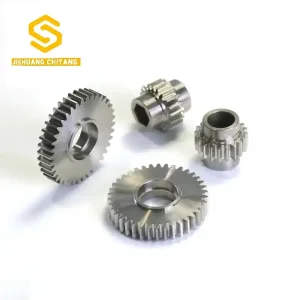
Industries requiring small, intricate metal components in annual volumes exceeding 5,000 units benefit most. Key sectors include Automotive (VVT parts, door latches), Medical Devices (surgical shears, endoscope jaws), Consumer Electronics (hinge assemblies, earphone housings), and Power Tools (planetary gears, lock pawls).
Q6: How do you handle Quality Control and Material Certification for international orders?
Every production batch includes full material test reports (MTR) verifying chemical composition via optical emission spectroscopy, microstructural analysis, density tests (Archimedes method >96.5%), CMM dimensional inspection reports, and salt spray corrosion test data under IATF 16949 quality protocols.