
Precision Powder Metallurgy & Metal Injection Molding Components
Explore our engineered structural components, precision sintered gears, custom MIM hardware, and die-cast solutions delivered with ISO 9001 and IATF 16949 quality assurance.






Wholesale Metal Powder Products: Industrial Architecture & Global Market Shifts
Evaluating the paradigm shift from subtractive CNC machining to high-density net-shape powder metallurgy across automotive, aerospace, medical micro-instrumentation, and industrial automation.
The Economics of Advanced Metal Powder Sourcing
In modern industrial manufacturing, selecting a high-volume wholesale metal powder product supplier represents a core procurement strategy for reducing total cost of ownership (TCO) without sacrificing structural integrity. Metal Injection Molding (MIM) and conventional Press-and-Sinter Powder Metallurgy (PM) have evolved beyond niche fabrication routes into primary manufacturing pillars for complex, high-precision geometry components.
By leveraging ultra-fine elemental and pre-alloyed metal powders—atomized via gas or water processing down to micro-scale distributions (D50 < 10–22 µm for MIM; D50 45–150 µm for conventional PM)—tier-1 OEMs can produce structural geometries achieving 95% to 99.5% theoretical density. This near-net-shape capability eliminates up to 85% of secondary subtractive machining operations, delivering substantial material utilization efficiencies (up to 98% raw material yield) compared to traditional bar stock turning or milling.
Macro Demand Drivers & Industry Benchmarks
Global demand for high-performance metal powder parts is accelerating across three key pillars: electrification in automotive powertrains, miniaturization in medical devices and personal electronics, and weight-to-strength ratio maximization in industrial actuation systems.
Leading wholesale suppliers must maintain stringent batch-to-batch consistency in apparent density, tap density, flowability (Hall flow rate), and chemistry. As global supply chains prioritize resilience and material traceability, establishing direct manufacturer partnerships equipped with continuous sintering furnaces, vacuum debinding tech, and automated optical inspection (AOI) has become a key competitive differentiator.
Conventional press-and-sinter powder metallurgy yields mechanical densities between 88% and 94%, making it ideal for self-lubricating bushings, oil pump rotors, and medium-load structural gears. Conversely, Metal Injection Molding (MIM) utilizes liquid-phase or fine-grain solid-state sintering to reach 96%–99.5% density, achieving mechanical performance, corrosion resistance, and fatigue life virtually identical to wrought metals.
High-Performance Powder Alloy Chemistries & Engineering Specs
Matching custom alloy chemistry to working environments: yield strength, hardness, corrosion resistance, and magnetic permeability optimization.
| Material Category | Standard Alloy Grade | Density (g/cm³) | Tensile Strength (MPa) | Hardness (HRC/HRB) | Primary Industrial Application |
|---|---|---|---|---|---|
| Austenitic Stainless Steel | MIM 316L / PM 316 | 7.80 – 7.90 | 520 – 600 | 65 – 75 HRB | Medical instruments, marine valves, watch cases, chemical fittings |
| Martensitic Stainless Steel | MIM 17-4PH / AISI 630 | 7.60 – 7.78 | 1,150 – 1,350 | 38 – 45 HRC | Aerospace actuators, surgical shears, automotive door latches |
| Fe-Ni Low-Alloy Steels | Fe-2Ni, Fe-8Ni (FN-0208) | 7.40 – 7.65 | 600 – 950 | 25 – 35 HRC | Automotive transmission gears, power tool pinions, timing sprockets |
| Soft Magnetic Alloys | Fe-3Si, Fe-50Ni, Permalloy | 7.60 – 7.75 | 400 – 500 | 50 – 65 HRB | Solenoid valves, magnetic sensors, electric vehicle relays |
| Titanium Alloys | Ti-6Al-4V (Grade 5 MIM) | 4.35 – 4.43 | 880 – 970 | 32 – 38 HRC | Biomedical implants, lightweight aerospace hinges, sporting goods |
| Tungsten Heavy Alloys | W-Ni-Fe (95W) | 17.8 – 18.2 | 900 – 1,050 | 28 – 36 HRC | Vibration dampeners, inertial balance weights, radiation shielding |
Atomization Technology Choice
Gas Atomization (GA): Produces spherical particles with superior tap density and smooth flowability, ideal for micro-MIM and additive manufacturing.
Water Atomization (WA): Generates irregular, micro-porous powders providing exceptional green strength during compaction press cycles.
Custom Binder Formulations
Multi-component polymer binders (wax-based, catalytic polyacetal, or water-soluble polymer systems) ensure uniform solids loading (60–65 vol%) without binder separation, eliminating molded part distortion and sink marks during thermal debinding.
Controlled Atmosphere Sintering
Sintering furnaces utilize pure Hydrogen (H₂), Nitrogen-Hydrogen cracked gas mixtures, or high-vacuum environments (up to 10⁻⁵ mbar) to prevent interstitial oxidation, decarburization, and surface nitriding on sensitive stainless steels.
End-to-End Metal Powder Component Manufacturing Process
Deconstructing the engineering phases required to convert raw metallic powders into net-shape structural parts with micron-level tolerances.
Powder Synthesis & Feedstock Compounding
Precision blending of gas/water atomized metal powders with thermoplastic and wax binders at elevated temperatures to form homogenous feedstock pellets.
Precision Injection Molding / Compaction
Injecting feedstock into complex multi-cavity tooling under high pressure (MIM) or pressing raw powder in 1000-ton CNC presses to create "Green Parts".
Catalytic / Solvent Debinding
Extracted primary binder matrix via nitric acid vapor (catalytic debinding) or solvent immersion, producing an open-pore "Brown Part" network.
High-Temperature Vacuum Sintering
Thermal processing up to 1380°C (85-90% of melting point). Solid-state diffusion shrinks parts predictably by 12–20% to achieve full density.
Secondary Operations & Surface Finishing
HiP (Hot Isostatic Pressing), heat treatment (case hardening, nitriding), CNC secondary coining, electropolishing, or PVD plating.
Macro Application Solutions across Key Industrial Sectors
How leading OEM engineering teams utilize custom powder metal formulations to solve severe wear, fatigue, corrosion, and weight restrictions.
Automotive Powertrain & Chassis
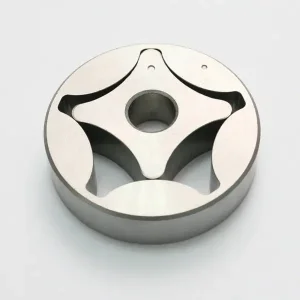
Sintered oil pump rotors (gerotors), variable valve timing (VVT) vanes, transmission synchronizer rings, and turbocharger wastegate actuation levers manufactured in high-volume Fe-Ni and stainless alloys.
Medical & Surgical Instrumentation
Biocompatible 316L and 17-4PH micro-jaw articulators, laparoscopic grasper heads, endoscopic cutters, and custom titanium orthopaedic implant fasteners featuring mirror-finish electropolishing.
Consumer Electronics & Wearables
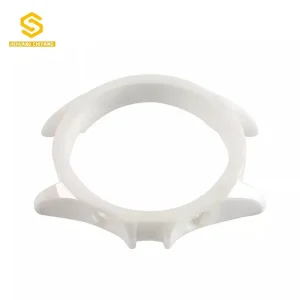
Ultra-thin smartphone folding screen hinges, smart watch outer frames, camera module actuation brackets, and high-density tungsten weight inserts for haptic feedback modules.
Industrial Power Tools & Hydraulics
Heavy-duty planetary gearboxes, impact driver anvils, hydraulic valve spools, and pneumatic nailer driver blades hardened to 58–62 HRC via secondary vacuum heat treatment.
Aerospace & Defense Actuation
High-strength titanium (Ti-6Al-4V) and Inconel 718 MIM brackets, fuel injection nozzles, and flight-control lock pins engineered to withstand extreme vibration and thermal cyclic loading.
Green Energy & EV Infrastructure
High-conductivity copper (Cu-HCP) terminal connectors for EV battery management systems, solar tracker gear drives, and wind turbine pitch control actuators.
Quality Control Protocols, Metallurgical Testing & Compliance
Ensuring 100% defect-free delivery through standardized physical, chemical, and dimensional verification procedures.
Standardized Quality Management Systems
- IATF 16949:2016 Certified: Automotive-grade APQP, PPAP (Level 3 documentation), FMEA, and SPC tracking on critical dimensions.
- ISO 9001:2015 & ISO 13485: Complete medical-device class traceability from raw powder batch certificate to final shipment packaging.
- MPIF Standard 35 Compliance: Conforming to Materials Standards for PM Structural Parts published by Metal Powder Industries Federation.
- RoHS & REACH Compliant: Zero heavy metal contamination (Pb, Cd, Hg, Cr6+, PBB, PBDE) across all binder formulations and plating finishes.
In-House Metallurgical & Metrology Lab Testing
- Optical Emission Spectrophotometer (OES): Verification of chemical composition per heat lot prior to molding.
- 3D Coordinate Measuring Machines (CMM) & Vision Systems: Automated 100% key-dimension inspection capability.
- Microstructural Density & Hardness Testers: Archimedian fluid displacement density testing and Rockwell/Vickers micro-hardness profiling.
- Salt-Spray & Tensile Testing: ASTM B117 salt-spray corrosion chamber testing and universal material tensile strength validation.
Future Engineering Trends in Metal Powder Manufacturing
Pioneering next-generation binder jet additive manufacturing, micro-MIM, and sustainable net-zero powder synthesis.
Binder Jet 3D Printing Integration
Combining tool-less additive flexibility with standard metal powders and MIM sintering infrastructure to produce low-volume, highly customized structural prototypes without tooling lead times.
Micro-MIM (< 0.1 g Components)
Scaling particle sizes down to sub-micron scales (D50 < 3–5 µm) to achieve feature resolutions below 50 µm for next-gen minimally invasive surgical tools and micro-robotics.
Green Sintering & Zero-Carbon Powders
Transitioning sintering furnaces from fossil-fuel cracking gas to 100% green hydrogen heating, coupled with recycled alloy powders to reduce lifecycle carbon intensity by over 60%.
Frequently Asked Sourcing & Engineering Questions
Clear technical guidance to help buyers and design engineers choose between MIM, PM, Die Casting, and CNC.
Metal Injection Molding (MIM) is economically superior when annual production volume exceeds 2,000–5,000 pieces, part mass is under 250 grams, and part geometry requires complex 3D shapes (undercuts, cross-holes, internal threads, splines) that require multi-axis CNC milling setups. MIM yields a 30% to 60% unit cost reduction in these scenarios.
Standard standard as-sintered tolerances for MIM are ±0.3% to ±0.5% of nominal dimension (e.g., ±0.03 mm on a 10 mm dimension). By implementing secondary sizing, coining, or precision CNC post-machining, critical tolerances can be tightened to ±0.005 mm (±5 µm).
Depending on feedstock solids loading, linear shrinkage during debinding and sintering ranges between 12% and 20%. Tooling cavities are precisely oversized using proprietary CAD scale factors derived from lot-specific powder density tests, ensuring final sintered dimensions match drawing specs.
Tooling manufacture and first-article sample (FAI) submission typically require 25 to 35 days. Rapid prototyping via metal 3D printing can provide design validation samples in 5–7 days. Mass production lead time following sample approval is usually 3 to 4 weeks depending on order volume.
More OEM/ODM Metal Powder & Casting Precision Components
Custom die casting, aluminum alloy parts, sintered pump rotors, and specialized power mechanical hardware.






