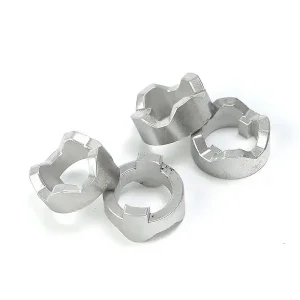
Wholesale Big Discount Factory OEM Custom China Aluminum Die Casting Service Manufacturer, Supplier
View Product Specs
Explore our primary factory-direct catalog featuring high-density sintered parts, custom MIM components, and precision aluminum/zinc die-castings.





In modern precision manufacturing, selecting high-performance **wholesale metal sintered suppliers** is pivotal to reducing component production costs while optimizing mechanical strength. Metal sintering is a thermal treatment process applied to consolidated metal powders to bond the metallic particles via solid-state atomic diffusion below the base metal’s melting point.
Unlike subtractive CNC machining—which generates up to 50% scrap material—powder metallurgy (PM) and Metal Injection Molding (MIM) achieve near-net-shape (NNS) geometry with raw material utilization exceeding 95%. As industrial automation, automotive electrification, and medical technology demand miniaturized components with intricate geometry, custom metal sintering has evolved into the cornerstone technology for cost-efficient mass manufacturing.
Procurement directors and engineering leads must carefully balance part complexity, production volume, material specifications, and unit cost when choosing a manufacturing route.
| Manufacturing Process | Optimal Part Weight | Geometrical Complexity | Material Options | Dimensional Tolerance | Annual Production Scale |
|---|---|---|---|---|---|
| Powder Metallurgy (PM) Sintering | 10g – 2.5kg | Medium (2.5D press-direction shapes) | Fe-Ni, Cu-Steel, Bronze, Stainless Steel | ±0.03 mm to ±0.08 mm | > 5,000 units (High Volume) |
| Metal Injection Molding (MIM) | 0.2g – 250g | Very High (Complex 3D undercuts, micro-threads) | 17-4PH, 316L, Ti-6Al-4V, Tungsten Alloy | ±0.003 mm/mm (up to ±0.02 mm) | > 2,000 units (Medium to Mass Volume) |
| Aluminum / Zinc Die Casting | 15g – 5.0kg | High (Thin-walled housings, complex ribs) | A380, ADC12, Zamak 3, Zamak 5 | ±0.05 mm to ±0.15 mm | > 2,000 units (Medium to High Volume) |
| 5-Axis CNC Machining | 1g – 50kg+ | High (Tool access constrained) | Virtually All Metals & Plastics | ±0.005 mm (High Precision) | 1 – 1,000 units (Low Volume / Prototypes) |
PM compacts fine metal powders under high pressure (up to 800 MPa) using mechanical or hydraulic presses before entering a belt sintering furnace. It is the premier choice for spur gears, timing belt pulleys, oil-impregnated self-lubricating bronze bushings, and structural automotive flanges where cross-sectional geometry remains uniform along the pressing axis.
MIM combines fine metal powders (<20 µm) with a thermoplastic binder system to form a injectable feedstock. Molded into complex multi-cavity dies, the "green part" undergoes solvent and thermal debinding followed by high-temperature vacuum sintering. Ideal for surgical handles, watch cases, miniature automotive actuator gears, and aerospace brackets.
China has solidified its position as the world's leading hub for advanced powder metallurgy and metal sintering technology. Global buyers sourcing from Tier-1 Chinese suppliers (such as Ningbo Jiehuang / JHMIM) unlock critical structural cost and engineering advantages.
China commands the global refinement of elemental metal powders, atomized stainless steel powders, carbonyl iron powders, and rare-earth magnetic alloys. Direct access to domestic gas and water atomization facilities drastically reduces raw material lead times and transportation surcharges.
Chinese OEM facilities integrate multi-axis CNC EDM, high-speed wire cutting, and mirror polish tooling production directly within the plant. Comprehensive Design for Manufacturability (DFM) simulation reports are provided within 24–48 hours, eliminating costly mold iteration delays.
State-of-the-art Chinese plants feature automated vacuum sintering furnaces, continuous hydrogen atmosphere walking-beam furnaces, and 1,000-ton compaction presses. Quality assurance is backed by IATF 16949 and ISO 9001 certifications with 100% CMM and optical inspection protocols.
Selecting the proper alloy composition is vital to achieving required mechanical properties such as yield strength, elongation, magnetic permeability, and corrosion resistance. Sintered metals comply with international standards including **MPIF Standard 35**, **ASTM B883**, and **DIN ISO 22068**.
| Material Designation | Composition Breakdown | Tensile Strength (MPa) | Yield Strength (MPa) | Hardness (HRC / HRB) | Primary Industrial Applications |
|---|---|---|---|---|---|
| MIM 17-4PH (SUS 630) | Fe-17Cr-4Ni-4Cu-Nb | 1,150 – 1,300 | 1,000 – 1,150 | 36 – 42 HRC | High-strength medical jaws, aerospace fasteners, automotive latches |
| MIM 316L (SUS 316L) | Fe-17Cr-12Ni-2.5Mo (Low C) | 520 – 600 | 200 – 250 | 65 – 75 HRB | Biocompatible medical scalpels, marine hardware, smartwatch cases |
| FN-0205 (Sintered Steel) | Fe-2.0Ni-0.5C-balance Fe | 450 – 650 | 350 – 500 | 20 – 30 HRC | Automotive transmission gears, power tool pinions, oil pump rotors |
| TiMIM (Ti-6Al-4V Grade 5) | Ti-6Al-4V | 880 – 970 | 790 – 860 | 30 – 36 HRC | Lightweight automotive race components, surgical implants, aerospace fittings |
| Fe-Ni Soft Magnetic Alloys | Fe-50Ni / Fe-50Fe | 400 – 500 | 160 – 220 | 50 – 60 HRB | Solenoid cores, fuel injector valves, electromagnetic actuators |
Custom metal sintering solves critical engineering challenges across high-tech industries by consolidating multi-piece assemblies into single complex sintered parts.
Automotive OEMs utilize sintered components for Variable Valve Timing (VVT) rotors, oil pump gears, transmission planetary carriers, and electric vehicle steering lock assemblies. Sintered iron-nickel gears provide high fatigue strength, noise reduction (NVH compliance), and reliable performance under high torque loads.
MIM technology allows medical OEMs to produce micro-scale stainless steel (316L, 17-4PH) and titanium scalpel handles, endoscopic grasper jaws, surgical stapler components, and orthodontic brackets. Sintered medical parts withstand rigorous autoclave sterilization cycles and offer smooth, biocompatible surface finishes.
Next-generation smartphones, foldable devices, and smartwatch housings depend on ultra-small MIM hinges, camera ring brackets, and fiber optic connector housings. High dimensional consistency enables seamless snap-fit assembly in high-volume consumer product assembly lines.
Cordless drills, pneumatic wrenches, and lock hardware rely on high-density PM planetary gearboxes, impact mechanism dog clutches, and heavy-duty bevel gears. Sintered steel components deliver exceptional wear resistance and high impact toughness under heavy duty operation.
Securing a reliable wholesale metal sintered manufacturer requires structured verification of quality systems, testing infrastructure, and engineering support.
When requesting quotes, supply both 3D STEP models and 2D PDF drawings specifying key dimensional tolerances, surface roughness (Ra), critical hard points, and load requirements. Experienced suppliers deliver DFM analyses flagging potential shrinkage variations or ejector pin placement.
Verify that your manufacturing partner maintains certified **ISO 9001:2015** and **IATF 16949** quality systems. Request sample PPAP (Production Part Approval Process) Level 3 documentation, including FMEA, Control Plans, and Capability Studies (Cpk > 1.33).
Top sintered metal suppliers maintain in-house Coordinate Measuring Machines (CMM), optical measuring systems, metallographic micro-hardness testers, carbon/sulfur analyzers, and salt-spray corrosion chambers to ensure lot-to-lot repeatability.
The metal powder sintering industry is undergoing rapid technological innovation to satisfy changing market requirements for shorter product development cycles and environmental sustainability.
Leading factories are bridging prototyping and mass production using Binder Jetting Metal 3D Printing. By eliminating hard tooling requirements during the R&D phase, functional sintered metal prototypes can be evaluated within days using the exact same sintering furnaces as volume production.
Warm compaction heats both the metal powder and the compaction die to 130°C–150°C, increasing green density to 7.4 g/cm³+. After high-temperature sintering, mechanical properties approach those of wrought steel, opening up heavy-load automotive drivetrain applications.
Get fast, definitive answers to technical and commercial questions about metal sintering, MIM tooling, lead times, and factory capabilities.
Browse additional OEM precision metal sintered parts, titanium MIM components, and automotive casting solutions.