
Featured Precision Powder Metal & Die-Casting Solutions
Explore specialized OEM & ODM structural components engineered for high wear resistance, tight dimensional tolerances, and cost-effective bulk production.







Macro-Industrial Shift: Why Global Enterprises Partner with Wholesale Powder Metal Manufacturers
In the era of advanced structural engineering and sustainable industrialization, the global discrete manufacturing industry is undergoing a radical shift away from energy-intensive subtractive CNC machining towards net-shape and near-net-shape metallurgical processes. Tier-1 OEMs, defense vendors, automotive prime suppliers, and medical technology developers are increasingly establishing long-term strategic relationships with premier Wholesale Powder Metal Companies. By harnessing state-of-the-art compaction, sintering, and Metal Injection Molding (MIM) techniques, procurement leadership can achieve up to a 45% reduction in total cost of ownership (TCO) while maintaining tensile strengths and dimensional tolerances comparable to wrought metal standards.
The economic drivers behind bulk powder metal procurement are grounded in solid material mechanics. Traditional subtractive manufacturing routinely discards 50% to 80% of raw metal stock as scrap chips. In contrast, powder metallurgy utilizes atomized metal micro-powders compressed within precision carbide dies, delivering a raw material yield exceeding 95%. This green manufacturing footprint, coupled with minimal secondary machining requirements, offers global OEMs an unparalleled edge in cost control, carbon offset compliance, and supply chain scalability.
Supply Chain Resilience
Multi-source elemental powder blending mitigates geopolitical scrap shortages and stabilizes raw material price fluctuations over multi-year production runs.
Mechanical Tailoring
Microstructural pore tuning allows custom self-lubrication properties in oil-impregnated bushings or fully dense structural gears via hot isopressing (HIP).
Geometric Complexity
Internal splines, eccentric cams, dual-gear clusters, and micro-grooves are pressed in a single strike, avoiding costly multi-axis mill-turn setups.
Technical Engineering Roadmap: Powder Metallurgy & MIM Processing Kinetics
Understanding the precise metallurgical pathways executed by world-class powder metal manufacturers is essential for design engineers seeking to maximize part performance while maintaining strict tolerances. The process flow spans atomization, formulation, cold/warm compaction, controlled-atmosphere debinding, high-temperature sintering, and secondary densification.
1. Powder Synthesis & Elemental Blending
Base metals—such as iron, stainless steel (316L, 17-4PH), titanium, copper, or nickel—are converted into micro-spherical powders via high-pressure water or gas atomization. Mean particle sizes range from 2μm to 15μm for MIM feedstocks and 45μm to 150μm for conventional powder metallurgy pressing. Micro-wax lubricants and graphite additions are homogenized in high-shear blenders to optimize flowability and green strength.
2. High-Tonnage Hydraulic Compaction vs MIM
In conventional PM, automated multi-action hydraulic and servo-electric presses exert pressures from 400 to 800 MPa, forming a cohesive "green part." For complex 3D contours, Metal Injection Molding (MIM) mixes fine metal powders with a thermoplastic binder system, injecting the compound into custom tooling molds at elevated temperatures.
3. Catalytic & Thermal Debinding
MIM components require binder removal prior to sintering. Solvent or gaseous nitric acid (catalytic debinding) extracts the primary binder phase at controlled temperatures (~110°C), leaving a porous skeletal structure ("brown part") held together by a secondary backbone binder, preventing slumping or distortion.
4. High-Temperature Sintering Kinetics
Green or brown compacts pass through continuous mesh-belt or vacuum furnaces operating at 1,120°C to 1,380°C under pure Hydrogen, Dissociated Ammonia, or Argon atmospheres. Solid-state diffusion forms atomic necking between adjacent metal grains, resulting in densification, pore rounding, and substantial strength development.
| Process Parameter | Conventional Press & Sinter (PM) | Metal Injection Molding (MIM) | High-Pressure Die Casting |
|---|---|---|---|
| Typical Weight Range | 5g – 2,500g | 0.2g – 250g | 50g – 10,000g |
| Achievable Sintered Density | 85% – 92% of Theoretical | 95% – 99% of Theoretical | N/A (Cast Porosity Present) |
| Dimensional Tolerance | ±0.05mm to ±0.10mm | ±0.3% to ±0.5% nominal | ±0.15mm to ±0.30mm |
| Surface Finish (Ra) | 1.6μm – 3.2μm | 0.8μm – 1.6μm | 1.6μm – 6.3μm |
| Material Yield | > 95% | > 98% (Sprues Reground) | 70% – 85% |
Material Chemistry & MPIF Standard 35 Compliance Framework
Leading wholesale powder metal companies manufacture engineered components according to internationally recognized standards, most notably MPIF Standard 35 (Metal Powder Industries Federation) and ISO 5755. Material selection directly governs mechanical behavior including yield strength, fatigue endurance, magnetic permeability, and corrosion resistance.
Ferrous & Copper-Steel Alloys
FC-0208 & FN-0205: Iron-copper and iron-nickel steels dominate high-volume automotive transmission gears, oil pump rotors, and structural brackets. Heat treatment (carburizing or induction hardening) yields surface hardness up to 60 HRC while preserving an impact-resistant ductile core.
Austenitic & Martensitic Stainless Steels
MIM-316L & MIM-17-4PH: Highly valued in medical instrumentation, marine hardware, and aerospace fluid controls. 17-4PH precipitation hardening achieves tensile strengths exceeding 1,100 MPa along with exceptional salt-spray corrosion resistance.
Soft Magnetic Alloys (SMCs)
Fe-Ni & Fe-Si Soft Magnetic Composites: Engineered specifically for next-generation EV electric drive motors, solenoids, and high-frequency inductors. Insulated iron powder particles suppress eddy current losses at high operating frequencies.
Titanium MIM (Ti-6Al-4V)
Grade 5 Titanium MIM: Delivers lightweight, bio-compatible, high-strength parts for surgical tools, dental implants, and consumer electronic wearable hinges without expensive multi-axis CNC milling of tough titanium billets.
Global Procurement Decision Matrix & Design for Manufacturability (DFM)
When evaluating wholesale powder metallurgy suppliers, global procurement executives must look beyond initial unit pricing. A comprehensive audit should inspect supplier press tonnage capabilities, sintering furnace atmospheric controls, cleanroom debinding facilities, and inline optical sorters.
1. Wall Thickness Uniformity
Avoid extreme wall thickness variations. Transition zones should feature gentle radii to prevent density gradients and thermal cracking during sintering shrinkage.
2. Ejection & Chamfer Rules
In corporate tooling design, internal splines and external teeth must include 45° chamfers rather than sharp 90° steps to prolong punch tool life and prevent edge burring.
3. Secondary Operations Minimization
Leverage high-precision sizing/coining dies post-sintering to achieve IT7 tolerance grades, avoiding external cylindrical grinding whenever possible.
| Evaluation Parameter | Tier-1 Certified Powder Metal Manufacturer | Low-Cost Standard Machine Shop |
|---|---|---|
| Quality Standards | IATF 16949, ISO 9001, ISO 13485 (Medical) | Standard ISO 9001 only |
| Metrology Capabilities | In-house CMM, Metallographic Micro-structure Labs, Optical Profilometry | Basic Hand Calipers, Micrometers |
| Production Capacity | 100,000 to 5,000,000+ units/month via multi-cavity tooling | Constrained by spindle machine hours |
| Prototyping Options | Metal 3D Printing (Binder Jetting / DMLS) for DFM verification | Soft tooling CNC machining |
Industry Solutions & Next-Generation Technology Outlook
As smart factories integrate Industry 4.0 IoT sensors across high-tonnage compaction equipment, powder metallurgy manufacturers are entering a new era of real-time quality control. Closed-loop feedback systems adjust ram displacement down to the micron in real time, virtually eliminating density variations within a single press cycle.
Convergence with Additive Manufacturing
Leading wholesale suppliers are deploying industrial Binder Jetting metal 3D printers. Using identical powders and sintering furnaces as MIM, Binder Jetting eliminates hard tooling costs for low-volume production or initial prototype validation, dramatically shrinking time-to-market from months to days.
Carbon-Neutral Powder Metallurgy
With strict European CBAM (Carbon Border Adjustment Mechanism) and global ESG targets, modern manufacturers are transitioning sintering furnaces to green hydrogen gas blends and recycled scrap elemental metal powders, cutting embodied product carbon footprints by up to 60%.
High-Precision OEM Components & Custom Assemblies Catalog
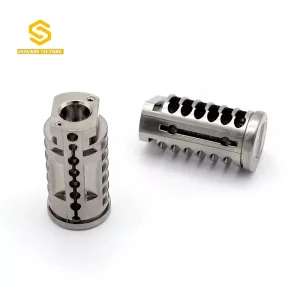
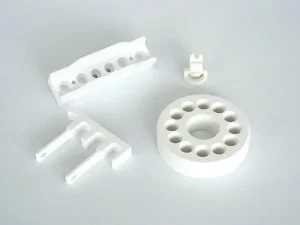
Discover specialized metal injection molded, die-cast, and sintered structural solutions for automotive, electronic, medical, and industrial applications.




Frequently Asked Technical & Procurement Questions (Q&A)
Engineering insights addressing key considerations for wholesale powder metallurgy, tooling ROI, mechanical integrity, and compliance logistics.