Wholesale Powder Metallurgy & Precision MIM Catalog
Explore our top-tier OEM/ODM precision metal injection molding (MIM), powder metallurgy gears, ceramic components, and specialized sintered parts engineered for global industrial buyers.


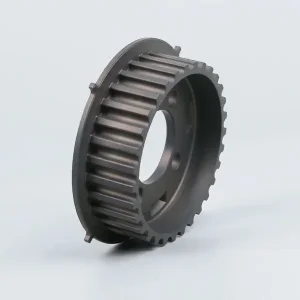


The Commercial Realities of China Powder Metallurgy Manufacturing
Analyzing the shift in global precision metal component sourcing, supply chain integration, and material utilization advantages provided by Chinese manufacturing hubs.
Global Market Dynamics & China's PM Manufacturing Hegemony
Powder Metallurgy (PM) has transitioned from a specialized niche process into the primary engine of modern structural hardware manufacturing. Globally, the demand for lightweight, high-density, and net-shape metal components has surged across automotive powertrains, electric vehicle (EV) drive units, aerospace actuators, medical surgical equipment, and consumer electronics. Within this international trade matrix, China has cemented its position as the world's preeminent manufacturing hub for wholesale powder metallurgy parts.
The concentration of raw metal powder synthesis, advanced sintering furnace production, automated hydraulic pressing equipment, and tooling engineering in Chinese industrial clusters (notably the Yangtze River Delta and Pearl River Delta) creates unmatched economies of scale. Sourcing directly from certified Chinese powder metallurgy factories allows global Tier-1 OEMs and system integrators to secure structural steel, stainless steel, bronze, and titanium alloys at costs significantly lower than North American or European domestic production, without sacrificing dimensional consistency or mechanical integrity.
Key Economic Drivers for Wholesale PM Sourcing in China
- Integrated Material Supply Chains: China produces over 45% of the world's atomized iron, copper, and stainless steel powders, providing direct cost advantages on raw feedstock and eliminating international freight overhead for raw materials.
- Near-Net Shape Efficiency: Conventional subtractive CNC machining can waste up to 60-70% of a raw billet as metal chips. Powder metallurgy achieves over 95% material utilization, drastically lowering expenses on high-value alloys such as 17-4PH stainless steel and Titanium Grade 5.
- Capital Investment in High-Tonnage Pressing: Leading Chinese manufacturers have deployed 1,000-ton (10,000 kN) automated CNC compaction presses and continuous mesh-belt sintering furnaces equipped with multi-zone atmosphere control, capable of producing millions of structural components monthly.
Process Comparison: Press & Sinter, MIM, Die Casting, and CNC
Selecting the appropriate manufacturing route requires a rigorous metallurgical comparison of density, geometric complexity, mechanical strength, and production run economic break-evens.
Press & Sinter (PM)
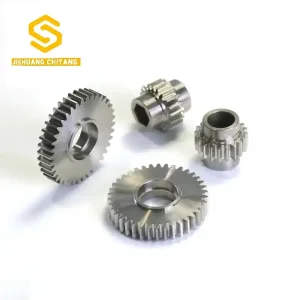
Metal powder compacted under uniaxial hydraulic pressure and sintered in a controlled gas atmosphere furnace below melting point. Unmatched cost-per-part efficiency for spur gears, bushings, and flat structural shapes.
Metal Injection Molding (MIM)
Combines plastic injection molding versatility with powder metallurgy strength. Fine metal powders are mixed with a polymer binder, molded into complex 3D shapes, debound, and sintered to 96-99% theoretical density.
Selective Laser Melting (SLM)
Metal 3D printing utilizing high-powered lasers to fuse spherical metallic powders layer by layer. Ideal for low-volume prototyping, patient-specific medical implants, and ultra-complex internal cooling channels.
| Process Parameter | Press & Sinter (Conventional PM) | Metal Injection Molding (MIM) | Aluminum / Zinc Die Casting | 5-Axis CNC Machining |
|---|---|---|---|---|
| Typical Density Range | 6.8 - 7.4 g/cm³ (85 - 94%) | 7.5 - 7.9 g/cm³ (95 - 99%) | Solid (Alloy Dependent) | 100% Solid Wrought Metal |
| Geometric Complexity | Medium (2.5D Prismatic shapes, gears) | Extreme (3D Undercuts, thin walls) | High (Thin-walled housings) | Moderate to High (Tool-access bound) |
| Tensile Strength (MPIF 35 / AISI) | 400 - 850 MPa | 500 - 1600 MPa (Heat Treated) | 180 - 350 MPa | Dependent on wrought stock |
| Dimensional Tolerance | ±0.02 - ±0.05 mm | ±0.3% to ±0.5% (Up to ±0.01mm) | ±0.05 - ±0.10 mm | ±0.005 - ±0.01 mm |
| Economic Production MOQ | 5,000+ pieces | 2,000+ pieces | 2,000+ pieces | 1 to 500 pieces |
| Material Scrap Yield | < 5% Scrap | < 2% Scrap (Reusable Sprues) | < 10% Scrap | 40% - 80% Chip Waste |
China Powder Metallurgy Technology Roadmap (2025–2035)
Strategic advancements in powder synthesis, warm compaction, sinter-hardening, micro-MIM, and AI-driven quality inspection across Chinese manufacturing facilities.
Warm Compaction & High Density
Heated dies and polymer-coated powders allow compaction single-press densities to reach 7.4–7.6 g/cm³. This eliminates expensive double-press double-sinter (DPDS) steps, elevating yield strengths to forged levels.
In-Furnace Sinter-Hardening
Accelerated cooling zones integrated directly into continuous sintering furnaces transform soft austenite structures into high-hardness martensite, bypassing separate quench heat treatment and oil cleaning.
Titanium MIM (Ti-MIM) Expansion
Overcoming oxygen pick-up challenges during thermal debinding, Chinese factories are mass-producing Titanium Grade 5 (Ti-6Al-4V) components for medical devices, smartwatches, and lightweight aerospace fasteners.
AI-Powered Manufacturing Execution Systems (MES) & Optical Inspection
Leading Chinese powder metallurgy factories have transitioned to Industry 4.0 automated digital workshops. Real-time sensor feedback controls die compaction forces at millisecond intervals, while automated vision systems inspect 100% of finished sintered gears for microscopic micro-cracks, pitch error, and burr formation at speeds exceeding 120 parts per minute.
Macro-Industry Solutions & Localized Use Cases
How sintered metal components and metal injection molded components solve mission-critical challenges across demanding engineering sectors.
Automotive Powertrains & EV Drive Units
Sintered VVT (Variable Valve Timing) rotors, oil pump gears, steering column locks, and planetary gear sets for electric vehicle reducers require high fatigue strength and tight acoustic performance.
Consumer Electronics & Mobile Wearables
Foldable smartphone hinges, smartwatch casings, camera brackets, and miniature linear motor weights manufactured using MIM technology deliver high surface finish, complex internal geometries, and ultra-thin wall profiles.
Medical Instruments & Surgical Tools
Endoscopic grasper jaws, surgical stapler components, scalpel handles, and orthopedic implants produced in 17-4PH and 316L stainless steel provide bio-compatibility, autoclave resistance, and flawless tactile precision.
Frequently Asked Questions for Wholesale Sourcing
In-depth answers from our senior metallurgical engineers regarding material specifications, tooling amortization, tolerance control, and export logistics.
Specialized Gears, 3D Metal Powder & Die Casting Solutions
Explore high-torque gears, stainless steel micro-gears, selective laser melting dental powders, and aluminum die-cast housings built to OEM engineering specifications.