
High-Precision Sintered & Cast Metal Components
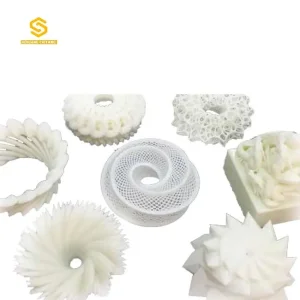
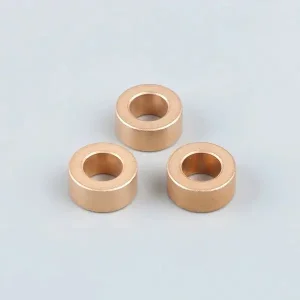
Explore our top OEM manufactured sintered components, bronze sleeve bearings, valve parts, and high-pressure die castings crafted to exact industrial tolerances.





Global Procurement Architecture for Sintered Components
Strategic sourcing insights for Tier-1 automotive integrators, industrial equipment OEMs, and fluid-power system buyers seeking total cost optimization and zero-defect quality.
In contemporary precision manufacturing, powder metallurgy (PM) and solid-state thermal sintering represent the pinnacle of resource-efficient, high-volume component fabrication. Global enterprise procurement directors face mounting pressure to balance dimensional fidelity, mechanical shear strength, and carbon-neutral production. Choosing a qualified wholesale sintered components manufacturer is no longer merely a purchasing decision; it is a critical strategic partnership that directly impacts supply chain resilience, total cost of ownership (TCO), and product lifecycle endurance.
Key Strategic Advantage: Modern powder metallurgy eliminates up to 95% of material scrap inherent to traditional subtractive CNC milling, while providing custom alloy tailorability, self-lubricating porous microstructures, and superior wear resistance at scale.
1. The Shift Toward High-Density Net-Shape Sintering
Historically, sintered components were restricted to low-load bushings and simple porous oil-bearings. However, recent advances in ultra-high pressure multi-stage compaction presses (ranging from 200 to 1,000 tons) combined with vacuum sinter-hardening technology have elevated powder metal alloys into high-torque powertrain gears, hydraulic valve blocks, surgical actuators, and variable valve timing (VVT) system rotors.
Global procurement teams in North America, Europe, and Asia-Pacific are increasingly migrating complex forged and fully machined steel parts toward sinter-hardened steel and metal injection molded (MIM) equivalents. This shift yields part cost reductions of 30% to 50% while guaranteeing grain uniformity and eliminating direction-dependent material weaknesses common in bar-stock machining.
2. Total Cost of Ownership (TCO) Optimization Framework
When evaluating wholesale suppliers for sintered bronze sleeve bearings, copper-iron structural parts, or custom oil pump gears, enterprise buyers must look beyond the initial FOB unit price. A rigorous TCO model incorporates four key dimensions:
- Material Utilization Index (MUI): Sintering achieves over 95% material utilization compared to 30-40% in CNC turning of stainless steel valve parts.
- Secondary Operations Elimination: Near-net-shape geometry eliminates the need for gear tooth hobbing, spline cutting, or internal keyway broaching.
- Logistical & Duty Buffering: Qualified suppliers in established manufacturing hubs like Ningbo provide integrated surface treatments, heat treatment, and direct-to-assembly-line packaging.
- Lifecycle Tribological Gains: Impregnated self-lubricating oil reservoirs in sintered copper bearings dramatically reduce maintenance downtime in industrial electric motors.
The Sintered Component Manufacturing Lifecycle
From elemental powder chemistry to atmosphere-controlled sintering furnaces: How precision components achieve unyielding density and structural integrity.
1. Alloy Powder Chemistry & Blending
High-purity elemental powders (Fe, Cu, Ni, Mo, C, Sn) are atomized and homogenized with solid organic lubricants. Precise particle size distribution ensures fluid powder flowability during high-speed cavity filling.
2. High-Pressure Compaction
Automated hydraulic and CNC mechanical presses exert pressures between 400 and 800 MPa, forming a cohesive "green body" with controlled green density (6.8 – 7.3 g/cm³) and minimal tool wear.
3. Continuous Belt Sintering
Parts pass through multi-zone mesh belt furnaces under protective endothermic, dissociated ammonia, or nitrogen-hydrogen atmospheres at temperatures up to 1150°C - 1280°C to induce solid-state atomic diffusion bonding.
4. Sinter-Hardening & Cooldown
Accelerated convective cooling within the furnace discharge chamber converts austenite directly into fine martensite, achieving high surface hardness (HRC 30-45) without requiring secondary liquid quenching.
5. Sizing & Coining Calibration
For high-precision application features requiring IT6-IT8 tolerances, sintered parts undergo a secondary pressing pass (sizing) to correct thermal shrinkage and refine key operational dimensions.
6. Vacuum Oil Impregnation
Porous bronze bearings and structural bushings undergo deep vacuum oil impregnation using high-performance synthetic lubricants, establishing permanent lifetime self-lubricating capabilities.
Process Benchmarking: Sintering vs. Alternative Technologies
Comparative technical analysis evaluating density profiles, tolerance capabilities, unit cost structures, and manufacturing constraints.
| Manufacturing Process | Typical Density Range | Dimensional Accuracy | Material Scrap Rate | Economic Volume Threshold | Key Mechanical Characteristic |
|---|---|---|---|---|---|
| Powder Metallurgy (PM Sintering) | 6.8 - 7.4 g/cm³ | ±0.02 - ±0.05 mm | < 3% (Near-Zero) | > 5,000 Units | Controlled Porosity / Self-Lubricating |
| Metal Injection Molding (MIM) | 7.5 - 7.8 g/cm³ | ±0.01 - ±0.03 mm | < 5% | > 2,000 Units | Isotropic Mechanical Properties |
| 5-Axis CNC Machining | Solid Stock (100%) | ±0.005 - ±0.01 mm | 40% - 75% | 1 - 500 Units | High Surface Finish / Dynamic Load |
| Aluminum & Zinc Die Casting | Cast Alloy Density | ±0.03 - ±0.08 mm | 5% - 10% | > 2,000 Units | Thin-wall Lightweight Housings |
| Hot Metal Forging | Fully Dense (>99.5%) | ±0.15 - ±0.30 mm | 15% - 25% | > 10,000 Units | Extreme Tensile & Impact Fatigue Strength |
Engineered Sintered Parts for Critical Applications
Discover how high-density sintered metal components power key subsystems across automotive, industrial fluid handling, electric motors, and smart hardware.
Automotive Powertrains & VVT Systems
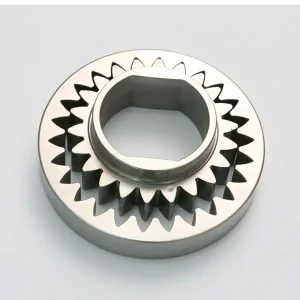
Engineered sintered steel sprockets, variable valve timing rotors, engine oil pump gears, and transmission synchronizer rings capable of withstanding continuous rotational shear stress and thermal shocks up to 150°C.
Self-Lubricating Motor Bushings
Sintered bronze sleeve bearings (SAE 841 / ISO 2795) engineered with microscopic capillary pore networks containing 18-22% oil by volume, eliminating external grease fittings in HVAC blower motors, home appliances, and automotive wiper arms.
Fluid Power & Hydraulic Valves
Stainless steel 316L and 17-4PH mini ball valve seats, fluid metering plates, and sintered bronze filter elements designed for aggressive chemical resistance, zero fluid bypass, and operating pressures exceeding 250 bar.
Smart Locks & Security Hardware
High-precision lock cams, deadbolt actuators, latch gearboxes, and escutcheon components manufactured via powder injection molding and press-and-sintering, offering anti-pick surface hardness and pick-proof dimensional accuracy.
Power Tools & Gearboxes
Planetary gear sets, ring gears, and bevel drive gears featuring high surface fatigue endurance achieved through sinter-hardening alloy chemistry (MPIF FN-0205 & FLN2-4405 standards).
E-Mobility & Drone Actuators
Lightweight high-density copper-steel gear assemblies and soft magnetic composite (SMC) cores engineered for high-frequency electrical efficiency, reduced eddy current losses, and low torque ripple in electric vehicle drive motors.
E-E-A-T Quality Governance & Metallurgical Testing
How our advanced metrology laboratory verifies structural integrity, density distribution, and dimensional tolerance on every production batch.
Purchasing wholesale sintered metal components demands absolute confidence in the manufacturer's quality management system (QMS). Microstructural defects, unrefined pore distribution, or improper sintering atmosphere control can lead to catastrophic field failures in automotive powertrains or high-pressure hydraulic manifolds. Our manufacturing facility enforces a multi-tiered quality assurance protocol compliant with ISO 9001:2015 and IATF 16949:2016 automotive benchmarks.
Comprehensive Metrology Laboratory Protocols
Every lot of wholesale sintered components undergoes six essential laboratory verifications before dispatch:
- Archimedes Density Measurement (ISO 2738): Verifying localized density distribution across complex multi-level steps to prevent low-density stress zones.
- Radial Crushing Strength Testing (ISO 2795 / MPIF Standard 35): Destructive crushing checks on sintered bronze sleeve bearings and cylindrical gears to guarantee minimum yield strength.
- Optical CMM 3D Coordinate Inspection: Sub-micron precision automated scanning verifying profile tooth error, concentricity, runout, and pitch-diameter accuracy.
- Metallographic Pore Analysis: Polished cross-sectional micro-examination under optical microscopy to evaluate pore roundness, grain growth, and carbide formation.
- Spectrometric Material Verification: X-ray fluorescence (XRF) spark atomic emission spectrometry ensuring elemental alloy compliance (RoHS, REACH, and Conflict Minerals certified).
- Micro-Hardness Profiling (Vickers / Rockwell): Traverse hardness depth checks on sinter-hardened teeth to verify martensitic case depth.
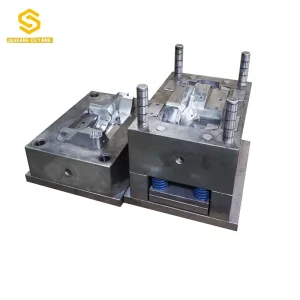
Custom Sintered Metal Parts & Die Casting Solutions
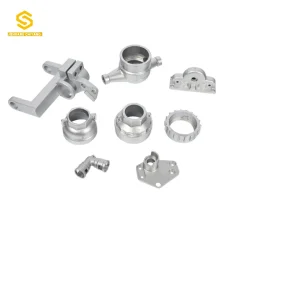
Review our additional OEM sintered metal parts, MIM lock hardware, motor oil bearings, aluminum castings, and precision pump gear components.





Design for Manufacturability (DFM) & Global Supply Chain Integration
Essential geometric design rules for optimizing sintered component tooling, reducing press cycle times, and preventing micro-cracks during compaction.
Critical DFM Principles for Powder Metallurgy
Optimizing component geometry for press-and-sinter manufacturing significantly reduces tooling wear, improves green body density uniformity, and lowers wholesale production costs. Our engineering team recommends adhering to the following structural guidelines:
- Avoid Feather Edges & Sharp Chamfers: Punch tools require minimum flat land widths of at least 0.25mm to prevent tool edge chipping under high press loads.
- Maintain Uniform Wall Thickness: Drastic variations in cross-sectional thickness cause differential density during compaction, leading to warping or cracking during the sintering furnace pass.
- Incorporate Demolding Draft Angles: Although powder pressing allows parallel vertical walls, adding a slight 0.5° to 1° draft angle on complex external splines eases tool ejection and extends punch lifespan.
- Radius Internal Corners: Fillets with a minimum radius of 0.4mm should replace sharp internal 90° corners to redistribute stress concentrations.
Localized Technical Support & Global Fulfillment
To support Tier-1 OEM manufacturing facilities across North America, Europe, and Southeast Asia, we maintain a complete vendor-managed inventory (VMI) buffer framework. From initial CAD drawing submission and DFM review through 3D printed metal rapid prototyping to mass production ramp-up, our application engineers provide continuous technical support, complete PPAP Level 3 documentation, and full material batch traceability.
Wholesale Procurement & Technical FAQ
Direct answers to crucial questions asked by enterprise buyers, quality managers, and mechanical design engineers.