
Featured Sintered & Die Cast Component Solutions
Explore our primary OEM hardware and sintered component lines manufactured with high dimensional precision and tight porosity control.







Global Commercial & Industrial State of Sintered Iron Bushings
An engineering analysis on the global transition from traditional machined bronze bearings to self-lubricating porous sintered iron-copper alloys in high-volume OEM systems.
The Shift Toward Self-Lubricating Porous Powder Metallurgy
In modern industrial mechanical engineering, sintered iron bushings represent a pinnacle of material efficiency and tribological optimization. Unlike solid cast bronze or fully dense machined steel sleeve bearings, sintered iron bushings leverage controlled powder metallurgy (PM) processing to embed interconnected microscopic capillary networks. When impregnated with vacuum-extracted synthetic or mineral lubricating oils under pressure, these bushings act as maintenance-free, self-lubricating hydrodynamic bearings.
Global industrial procurement trends show an accelerated migration toward sintered iron and iron-copper alloys (such as ASTM B438 Grade 1/Grade 2 and MPIF FC-0208). Driven by stringent ESG carbon footprint reduction targets and continuous operational efficiency mandates, industrial buyers rely on top-tier wholesale sintered iron bushings suppliers to replace costly grease-fed bronze journals. Sintered iron offers superior radial compressive yield strength (exceeding 350 MPa in copper-steels) while eliminating secondary oil-hole machining operations.
Hydrodynamic Capillary Action & Micro-Tribology
The core mechanism enabling zero-maintenance operation lies in thermal-capillary oil circulation. As a rotating shaft (journal) spins within the sintered iron sleeve, rotational friction generates micro-localized heating within the contact interface. Because the coefficient of thermal expansion of the impregnated oil is significantly higher than that of the porous iron matrix, hydraulic pressure expands the oil out of the open micro-pores directly into the clearance zone.
This dynamic action establishes a complete hydrodynamic lubricating film that completely separates the metallic shaft from the bearing surface, reducing wear coefficients to less than 0.01. Once rotation stops and temperatures cool, capillary surface tension draws the lubricant back into the sintered iron matrix via interconnected pores. This continuous closed-loop cycle prevents oil starvation, eliminates environmental leakage, and delivers operational lifespans exceeding 10,000 hours without external maintenance.
Technical Insight for Buyers: When specifying wholesale sintered iron bushings, density selection dictates the balance between mechanical strength and oil holding capacity. A density of 5.8 to 6.2 g/cm³ maximizes oil retention (up to 25% by volume) for high-speed light-load applications, whereas 6.4 to 6.8 g/cm³ optimizes compressive strength for heavy-duty low-speed oscillating applications.
Sintered Iron Material Classifications & Roadmap
Detailed comparison of powder metal iron compositions under MPIF Standard 35 and ASTM B438 specifications for industrial decision-making.
| Material Designation | Chemical Composition (%) | Sintered Density (g/cm³) | Tensile Yield Strength (MPa) | Oil Impregnation (Vol %) | Primary Industrial Application |
|---|---|---|---|---|---|
| MPIF F-0000 / ASTM B438 Gr 1 | Fe 99.0% Min, C 0.3% Max | 5.8 - 6.2 | 140 - 180 | 20% - 25% | Light-duty electric fans, home appliances, low-load sleeve bearings. |
| MPIF FC-0205-40 | Fe 96.5%, Cu 1.5-2.5%, C 0.3-0.6% | 6.2 - 6.6 | 240 - 310 | 16% - 20% | Automotive starter motors, window regulators, wiper drive mechanisms. |
| MPIF FC-0208-50 | Fe 95.5%, Cu 1.5-2.5%, C 0.6-0.9% | 6.4 - 6.8 | 350 - 450 | 12% - 16% | Heavy-duty gear pumps, hydraulic valve guides, agricultural pivot points. |
| MPIF FC-1008 (Diluted Bronze) | Fe 88.0%, Cu 9.5-10.5%, C 0.5-0.8% | 6.0 - 6.4 | 280 - 360 | 18% - 22% | Submersible pumps, high-moisture HVAC blowers, noise-critical motors. |
| Heat-Treated Sintered Steel | Fe-Cu-Ni-Mo Alloy Steels | 6.8 - 7.2 | 650 - 900 | 8% - 12% | Extreme PV planetary gearboxes, automotive powertrain components. |
Solid Lubricant Matrix Integration
Next-generation sintered iron bushings incorporate dispersed solid lubricants directly within the elemental powder mixture prior to compaction. By co-sintering Graphite, Molybdenum Disulfide ($MoS_2$), or Hexagonal Boron Nitride ($h-BN$), bearings maintain zero friction even under extreme thermal shocks where liquid lubricants evaporate ($>250^\circ C$).
Nano-Surface Modification & DLC Coating
Combining porous powder metallurgy with modern Diamond-Like Carbon (DLC) physical vapor deposition (PVD) produces hybrid surfaces. The underlying sintered iron lattice retains oil reserves while the sub-micron DLC surface layer delivers diamond-grade surface hardness ($>2000\text{ HV}$), eliminating micro-galling and fretting corrosion during cold start phases.
Industry 4.0 Smart Powder Compaction
Transitioning from mechanical toggle presses to fully multi-axis CNC electro-hydraulic compaction presses enables real-time closed-loop density mapping. Powder displacement sensors detect localized density variations in real-time, delivering uniform wall thickness tolerances within $\pm 0.012\text{ mm}$ across multi-step flange sleeve designs.
Localized Application Scenarios & Engineering Field Use Cases
How global OEM engineers select and integrate sintered iron bushings across automotive, heavy equipment, industrial machinery, and consumer electronics.
Automotive Powertrain & Chassis Actuators
In North American and European automotive supply chains (Tier-1 suppliers), sintered iron-copper bushings (FC-0205) are widely deployed in windshield wiper linkage pivots, starter motor armature supports, electronic throttle bodies, and power seat adjustment gearboxes. The self-lubricating porous matrix withstands aggressive ambient temperature swings from $-40^\circ C$ to $+150^\circ C$ without grease hardening or thermal seizure.
HVAC, Air Handling & Electric Motors
High-efficiency HVAC fan motors and domestic appliance pumps require extremely low acoustic decibel signatures ($<30\text{ dBA}$). Wholesale porous iron-bronze bushings (diluted bronze FC-1008) serve as the preferred bearing solution. Capillary damping within the oil-filled pores absorbs rotor vibration, providing near-silent operation compared to noisy rolling-element ball bearings.
Agricultural & Mining Heavy Linkages
In heavy agricultural machinery (combine harvesters, tractor linkages) and hydraulic excavators, high-density steam-treated sintered iron bushings (density $>6.6\text{ g/cm}^3$) replace solid steel pins. Magnetite ($Fe_3O_4$) surface films created through high-temperature steam oxidation provide exceptional corrosion resistance and anti-galling performance under severe dusty and abrasive field conditions.
Industrial Automation & Robotics
Modern pick-and-place gantry robots and automated conveyor rollers utilize custom flanged sintered iron bushings. Impregnated with high-performance synthetic ester oils, these components ensure continuous linear and rotational motion accuracy under high cyclic loads while preventing fluid oil contamination on cleanroom assembly floors.
China Powder Metallurgy Supply Chain Resilience & Manufacturing Synergy
Why international OEMs partner with Ningbo Jiehuang Chiyang Electronic Tech for large-scale wholesale sintered iron bushing procurement.
End-to-End Vertical Integration
Operating from a modern 28,000 m² facility in Ningbo, China, Jiehuang JHMIM manages the entire powder metallurgy value chain in-house. From water/gas atomized iron powder blending, precision carbide die tooling fabrication, to continuous atmosphere sintering mesh-belt furnaces and automated vacuum oil impregnation systems. Vertical control guarantees 100% batch-to-batch consistency and eliminates external vendor markups.
Material Utilization & Cost Efficiency
Conventional CNC turning of cylindrical sleeve bearings wastes up to 60% of expensive raw material bar stock in the form of metal swarf and chips. Sintered iron technology achieves a near-net-shape metal utilization rate exceeding 97%. By eliminating secondary turning, reaming, and grooving, wholesale unit costs drop by 30% to 50%, providing massive margin expansion for high-volume purchasing managers.
Rapid DFM Prototyping & Rapid Tooling
To reduce time-to-market for prospective automotive and industrial OEM clients, Jiehuang offers comprehensive Design for Manufacturability (DFM) support. Utilizing internal metal 3D printing (Direct Metal Laser Sintering - DMLS) and rapid CNC soft tooling, functional prototype samples can be delivered in under 10 business days for early tribological testing before committing to mass-production hard tooling.
Technical Compliance & Quality Assurance Protocols
Rigorous inspection standards ensuring absolute adherence to international engineering drawings and environmental mandates.
Compliance & International Standards Alignment
Every batch of wholesale sintered iron bushings produced by Jiehuang satisfies or exceeds global mechanical engineering standards:
- ASTM B438 / ISO 2795: Standard specification for porous metal bearings (sintered iron-bronze and iron-copper).
- MPIF Standard 35: Structural PM materials property specifications for density, tensile strength, and pore volume.
- DIN 1850 / JIS B1581: Metric sleeve, flanged, and spherical plain bearing dimensional tolerances (IT7 - IT9 tolerance bands).
- RoHS 3 & REACH: 100% heavy-metal-free, lead-free lubricant options, complying with strict EU and California Proposition 65 directives.
Advanced Inspection Infrastructure
Quality control is governed by an IATF 16949 certified quality management system backed by over 30 dedicated QC engineers:
- Coordinate Measuring Machines (CMM): Sub-micron dimensional inspection of inner diameter, outer diameter, concentricity, and runout.
- Sintered Porosity & Density Testing: Archimedes principle water displacement balances to verify oil holding volume percentages.
- Radial Crush Testing: Hydraulic load presses testing collapse force to ensure structural integrity under radial press fits.
- Spectrophotometry (XRF): Alloy elemental chemical composition verification on incoming raw powder lots.
Comprehensive Precision Manufacturing Portfolio
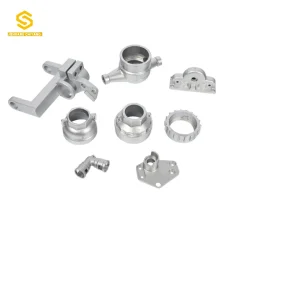
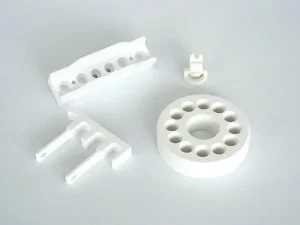
Explore additional precision sintered parts, die castings, and metal injection molding (MIM) products manufactured at our facility.




Frequently Asked Questions (FAQ) for Engineering Buyers
Detailed answers to technical questions concerning sintered iron bushing design, tolerances, load limits, and lubrication maintenance.
What is the maximum allowable PV factor for sintered iron bushings?
The PV factor (Pressure $\times$ Velocity) determines the thermal-load boundary limit of self-lubricating bearings. Standard oil-impregnated sintered iron bushings (MPIF FC-0208) operate comfortably up to a continuous PV factor of 50,000 PSI-FPM (1.75 MPa·m/s). For higher loads or speeds, synthetic diester or polyglycol oil impregnation combined with diluted copper-iron alloys can elevate continuous operational limits to 75,000 PSI-FPM.
How does press-fit installation affect the inner diameter (ID) tolerance of a sintered iron sleeve bushing?
When press-fitting a porous sintered iron bushing into a rigid housing bore (typically with an s6 or r6 housing tolerance), the outer diameter compresses, causing the inner diameter to close in by approximately 60% to 80% of the interference fit value. Our engineering team provides custom DFM sizing calculations so that post-assembly ID dimensions fall perfectly within your target IT7 or IT8 tolerance class without needing secondary reaming.
Why should secondary machining or reaming of sintered iron bushings be avoided?
Conventional turning, drilling, or reaming with standard cutting tools tends to smear the soft metallic matrix across the pore openings, effectively sealing the interconnected capillary network and disrupting self-lubricating oil flow. If secondary machining is required, single-point diamond tools or sharp tungsten carbide cutters with precise positive rake angles must be used, followed by ultrasonic solvent cleaning and re-impregnation.
What types of lubricating oils are used in vacuum impregnation of sintered iron components?
Standard wholesale sintered iron bushings are factory-impregnated under vacuum with ISO VG 68 or ISO VG 100 mineral oils with oxidation inhibitors. For extreme temperature applications, synthetic lubricants are specified: Polyalphaolefin (PAO) for low-temperature automotive start-up ($-40^\circ C$), Fluorosilicone or Perfluoropolyether (PFPE) for continuous high-temperature exposure ($>200^\circ C$), and Food-Grade H1 lubricants for medical/food handling machinery.
How does Jiehuang ensure batch-to-batch dimensional and density uniformity for high-volume orders?
Jiehuang employs multi-cavity precision tungsten carbide compaction dies on closed-loop automated hydraulic presses. Sintering is conducted in nitrogen-hydrogen reducing atmosphere mesh-belt furnaces equipped with multi-zone computerized temperature profiling. Automated 100% optical sorting machines measure outer diameter, length, and wall thickness before vacuum oil impregnation and rust-inhibitor packaging.
What is your standard Minimum Order Quantity (MOQ) and sample turnaround time?
Our standard Minimum Order Quantity (MOQ) for custom wholesale sintered iron bushings is 5,000 pieces for standard geometries and 2,000 pieces for complex metal injection molded (MIM) parts. For engineering validation, we offer rapid metal 3D printing (DMLS) or prototype tooling with initial inspection sample shipment within 14 to 21 business days after drawing approval.