
Featured Wholesale Sintered & Powder Metallurgy Components
Direct from certified precision manufacturing facilities. Fully compliant with ISO 9001 and IATF 16949 international standards.







1. Executive Summary: The Evolution of Global Sintered Metal Manufacturing
In the modern advanced manufacturing matrix, **wholesale sintered metal manufacturers** play an essential role in delivering structurally complex, highly repeatable, and near-net-shape metal components. Modern industrial procurement has evolved beyond simple unit-cost evaluation to embrace total cost of ownership (TCO), material resource efficiency, and carbon footprint reduction.
Sintering—the thermo-chemical consolidation of compacted elemental or alloyed metal powders below their absolute melting points—allows engineers to tailor physical properties, microstructural density, and self-lubricating characteristics that traditional forging or casting processes cannot replicate. As Tier-1 industrial buyers seek reliable global supply chain partners, evaluating qualified wholesale suppliers requires a deep technical understanding of solid-state diffusion, powder atomization techniques, density gradient management, and precision secondary finishing options.
2. Technical Metallurgy: Process Comparison & Engineering Routes
Choosing the right powder metallurgy fabrication method depends directly on component geometry, mechanical load requirements, production volume, and surface finish targets.
Press-and-Sinter PM
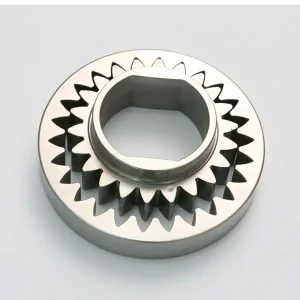
Ideal for 2.5D geometries, structural spur gears, oil pump gears, and self-lubricating bronze bushings. High-tonnage mechanical or hydraulic presses compact metal powder into green compacts, followed by continuous mesh-belt furnace sintering under controlled reducing atmospheres (e.g., endothermic gas or hydrogen-nitrogen blends).
- Max Density: 6.8 - 7.3 g/cm³
- Volume Economic Threshold: >10,000 units
- Key Advantage: Lowest per-unit cost for structural gears
Metal Injection Molding (MIM)
Combines plastic injection molding versatility with metal strength. Fine elemental powders (<20 µm) are blended with thermoplastic polymer binders to create feedstock. After molding, catalytic or solvent debinding removes the binder matrix before high-temperature vacuum sintering shrinks the component to full density.
- Max Density: 95% - 99% theoretical density
- Geometric Capability: Complex 3D contours, threads, micro-wall profiles
- Key Advantage: Replaces 5-axis CNC machining for intricate components
Isostatic & Secondary Sintering
For high-fatigue, extreme-stress environments, Hot Isostatic Pressing (HIP) or secondary re-striking (sizing/coining) eliminates residual internal porosity. Liquid Phase Sintering (LPS) is additionally utilized when combining dissimilar metals (e.g., Fe-Cu-C alloys) to enhance tensile boundary bonding.
- Max Density: Up to 99.8% theoretical density
- Applications: Aerospace turbines, heavy-duty automotive engine timing gears
- Key Advantage: Superior fatigue resistance and elongation
3. Global Material Benchmarks & ASTM / MPIF Standards Comparison
Component designers and procurement executives must evaluate metallurgical grades against recognized standards such as ASTM B925, MPIF Standard 35, ISO 5755, and DIN 30910. Below is an engineering benchmark matrix for common wholesale sintered alloys:
| Material Class | MPIF / ASTM Equivalent | Sintered Density (g/cm³) | Tensile Strength (MPa) | Yield Strength (MPa) | Key Industrial Application |
|---|---|---|---|---|---|
| Sintered Iron-Copper Steel | MPIF FC-0208-50 / ASTM B783 | 6.8 - 7.2 | 450 - 620 | 380 - 500 | Automotive transmission parts, structural sprockets, oil pump gears |
| Nickel-Steel Alloys | MPIF FN-0205-60 / ISO 5755 | 7.0 - 7.4 | 520 - 780 | 400 - 650 | High-torque planetary gears, power tool disks, heavy hardware |
| Austenitic Stainless Steel | MIM 316L / ASTM F2885 | 7.5 - 7.9 | 480 - 550 | 180 - 240 | Medical surgical instruments, mini ball valves, marine fittings |
| Martensitic Stainless Steel | MIM 17-4PH / ASTM A564 | 7.5 - 7.8 | 900 - 1150 | 750 - 950 | Weapon receivers, aerospace latches, high-strength micro-hinges |
| Titanium Alloy MIM | Ti-6Al-4V / ASTM B348 | 4.4 - 4.5 | 860 - 960 | 780 - 880 | Wearables, aerospace fasteners, biomedical implants |
4. Global Enterprise Procurement Demands & Industry Solutions
Sintered metal component purchasing varies significantly by sector. High-volume OEM manufacturers must tailor their quality engineering, supply chain logistics, and testing protocols to regional market demands.
Automotive & EV Systems
Demand for noise-vibration-harshness (NVH) reduction requires extremely quiet gear teeth profiles. Sintered oil pump gears, variable valve timing (VVT) rotors, and electric drive actuator components demand 100% automatic optical inspection (AOI) and IATF 16949 audit compliance.
Medical & Surgical Devices
Micro-scale surgical jaws, endoscopic cutters, and dental tools require ultra-clean MIM processing using 316L stainless steel or Ti-6Al-4V. Procurement focuses heavily on material biocompatibility, passivated corrosion resistance, and ISO 13485 cleanroom handling.
Defense & Firearm Components
Weapon triggers, hammers, safety selectors, and mounting hardware demand maximum density, high impact toughness, and strict dimensional tolerances. Sintered metals offer isotropic material properties without directional grain weaknesses found in sub-grade forgings.
Consumer Electronics & Wearables
Smartwatch cases, smartphone hinge mechanisms, and earbud lock brackets require extreme aesthetic perfection combined with thin-wall structural integrity (<0.5mm). Specialized PVD coating and electro-polishing finishes are critical.
5. DFM Guidelines, Quality Assurance & Technical Roadmap
Designing for Manufacturability (DFM) is key to maximizing cost-efficiencies when partnering with wholesale sintered metal suppliers.
DFM Optimization Rules
To avoid costly tool modifications and structural defects:
- Maintain uniform wall thicknesses to prevent differential shrinkage warping.
- Incorporate generous radii at internal corners (minimum 0.3mm - 0.5mm) to reduce stress concentrations.
- Avoid deep undercuts or sharp knife-edges in compaction direction.
- Allow for standard linear sintering shrinkage (15% to 22% in MIM, 0.5% to 2% in conventional PM).
Inspection & NDT Protocol
World-class suppliers leverage advanced non-destructive and dimensional metrology tools:
- CMM Laser Profiling: 3D coordinate verification against CAD STEP files.
- Micro-CT Scanning: Internal pore morphology and void distribution analysis.
- Eddy Current Testing: Automatic surface crack and flaw detection.
- Metallurgical Micro-hardness: Vickers/Rockwell case-depth validation after heat treatment.
Future Technology Roadmap
Emerging developments transforming the sintered metal industry include:
- Binder Jetting Additive Integration: Hybrid production bridging 3D metal printing with high-volume sintering furnaces.
- AI-Driven Simulation Software: Predictive sintering distortion modeling to optimize mold cavity dimensions before cutting steel.
- Green Energy Sintering: Hydrogen-fueled sintering furnaces to achieve zero-carbon production cycles.
Additional Wholesale Precision Components & Custom Die Casting Options
Full OEM / ODM capabilities encompassing Squeeze Die Casting, CNC Finishing, MIM, and Custom Power Tool Disks.







6. Frequently Asked Questions (FAQ) for Global Procurement Officers
Direct technical answers to common questions regarding sintered metal manufacturing, quality control, tooling investments, and global export lead times.
What is the typical density achieved in wholesale sintered metal manufacturing, and how does it affect strength?
Conventional press-and-sinter powder metallurgy typically achieves densities between 6.8 and 7.3 g/cm³, providing adequate strength for structural gears and automotive pulleys. Metal Injection Molding (MIM) and re-striking processes reach 7.5 to 7.8 g/cm³ (over 95% to 98% of theoretical density), yielding yield strengths and tensile properties directly comparable to wrought metal alloys.
How do sintered metal parts compare in cost to 5-axis CNC machining for high-volume orders?
For production runs exceeding 5,000 to 10,000 units, sintered powder metallurgy and MIM generally reduce component costs by 30% to 60% compared to CNC machining. While tooling involves an initial upfront capital expense, scrap rates dropping from 50%+ (in subtractive cutting) down to <2% (in near-net-shape sintering) offers significant per-unit cost savings.
What dimensional tolerances can be held consistently in as-sintered conditions?
In as-sintered conditions, standard linear tolerances range from ±0.05mm to ±0.1mm depending on component dimensions. If tighter tolerances are required (e.g., IT6 to IT7 gear tooth profile grades), secondary sizing, coining, or CNC finishing can bring critical dimensions down to ±0.005mm.
Can sintered parts undergo post-sintering surface treatments and heat treatments?
Yes. Sintered iron-based components can undergo steam treatment (forming a protective corrosion-resistant black oxide layer), carburizing, carbonitriding, or induction hardening to achieve surface hardness levels exceeding 60 HRC. Electroplating (nickel, zinc, chromium) is also routinely performed after resin impregnation or pore sealing.
What documentation and quality certifications should be required from a China wholesale supplier?
Global procurement departments should insist on ISO 9001:2015 certification at a minimum, and IATF 16949 certification for automotive projects. Each shipment should be delivered with a full Material Test Report (MTR), PPAP Level 3 documentation (if requested), RoHs/REACH compliance certificates, and CMM dimensional measurement sheets.
What is the lead time for custom tooling development and prototype samples?
Standard tooling creation for press-and-sinter dies or MIM injection molds typically takes 25 to 35 calendar days. Initial T1 prototype samples are provided with full FAI (First Article Inspection) reports for customer sign-off prior to releasing mass production.