Wholesale Sintered Metal Manufacturing & Global Supply Engineering
An In-Depth Metallurgical Technical Whitepaper on Powder Metallurgy (PM), Metal Injection Molding (MIM), China Supply Chain Logistics, and Microstructural Material Solutions for Enterprise OEMs.







What Is Sintered Metal? Metallurgical Principles & Processing Thermodynamics
Sintered metal is a high-performance structural material produced through powder metallurgy (PM) or metal injection molding (MIM). The fundamental principle behind sintering is thermal consolidation: solid particulate materials (metal powders) are subjected to elevated temperatures below their absolute melting point ($T_m$). Through solid-state atomic diffusion, surface energy minimization, and capillary forces, discrete metal particles fuse into a coherent, solid mass with controlled microstructural density and tailored mechanical properties.
The 4-Stage Microstructural Evolution of Sintered Metals
To engineer high-precision sintered components capable of withstanding dynamic fatigue, severe friction, and corrosive environments, global manufacturers tightly monitor thermal profiles across four distinct phase transitions:
Powder Atomization & Blending
Elemental or pre-alloyed powders (Fe, Cu, Ni, Mo, Ti, 17-4PH, 316L) are atomized gas/water and blended with organic binders or lubricants.
Compaction & Molding
Uniaxial mechanical pressing (up to 1,000 tons) or injection molding shapes the metal powder into a high-density "green" compact.
Debinding Phase
Thermal, solvent, or catalytic debinding removes organic polymers without disturbing the fragile green particulate skeleton.
Solid-State Sintering
Atmosphere-controlled (Vacuum, $H_2$, $N_2$, $Ar$) sintering at $1100^\circ\text{C} - 1380^\circ\text{C}$ creates interatomic bonds, closing internal voids.
Comparative Process Matrix: Powder Metallurgy vs. MIM vs. CNC vs. Die Casting
Selecting the appropriate manufacturing route for complex metal parts requires evaluating geometry, annual volume, mechanical performance, and total landed unit cost. The data visualization matrix below outlines engineering trade-offs across prime OEM manufacturing technologies:
| Evaluation Parameter | Sintered Powder Metallurgy (PM) | Metal Injection Molding (MIM) | CNC Precision Machining | Aluminum/Zinc Die Casting |
|---|---|---|---|---|
| Target Geometry | 2.5D press-direction gears, bushings, flanges | 3D ultra-complex micro parts, undercuts, threads | Prismatic shapes, simple-to-medium rotational | Thin-walled housings, complex enclosures |
| Part Mass Range | 5 g to 3000 g | 0.1 g to 250 g (Optimal < 100 g) | Unrestricted (Gram to Tons) | 10 g to 15,000 g |
| Relative Density | 85% - 95% (Porosity tailorable) | 95% - 99% (Wrought-like integrity) | 100% (Solid wrought bar/billet) | 90% - 95% (Cast structure) |
| Dimensional Tolerance | $\pm 0.05\text{ mm}$ (IT 8 - IT 10) | $\pm 0.3\%$ to $\pm 0.5\%$ ($\pm 0.02\text{ mm}$) | $\pm 0.005\text{ mm}$ (IT 5 - IT 7) | $\pm 0.1\text{ mm}$ to $\pm 0.2\text{ mm}$ |
| Material Utilization Rate | > 95% (Near-Net-Shape) | > 98% (Scrap recycled) | 15% - 60% (High chip waste) | > 90% (Runners remelted) |
| Economic Order Volume | > 5,000 pcs / run | > 2,000 pcs / run | 1 to 1,000 pcs (Low tooling) | > 2,000 pcs / run |
When to Choose Wholesale Powder Metallurgy (PM)
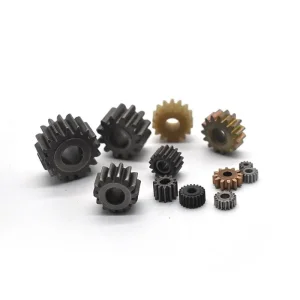
Choose conventional press-and-sinter powder metallurgy for symmetric structural components such as spur gears, timing pulleys, self-lubricating bronze bearings, and planetary gear sets requiring high volume and cost efficiency.
When to Choose Metal Injection Molding (MIM)
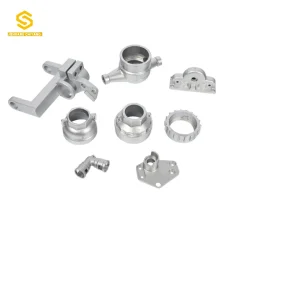
Opt for MIM when designing intricate, multi-axis 3D metal geometries (medical scalpel handles, firearm levers, smartphone hinges, auto sensors) that would otherwise require multiple CNC milling setups or sub-assembly operations.
China Sintered Metal Manufacturing Ecosystem: Competitive Structural Advantages
China has transformed from a low-cost contract manufacturing hub into the world’s most vertically integrated powder metallurgy and MIM technology cluster. Global procurement directors leverage Chinese OEM partners like Ningbo Jiehuang Chiyang Electronic Tech Co., Ltd. for strategic cost, engineering, and supply advantages:
1. Raw Material & Atomization Hub
Direct access to domestic high-purity iron, stainless steel, and titanium powder producers (e.g., water-atomized and gas-atomized grades) eliminates overseas shipping tariffs, stabilizes raw material pricing, and ensures rapid material lot consistency.
2. In-House Tooling & Mold Precision
Ningbo toolmakers utilize Swiss EDM, Sodick wire cutting, and high-speed CNC machining centers to fabricate multi-cavity tungsten carbide dies with tolerances down to $\pm 0.002\text{ mm}$, dropping tooling lead times to 25-35 days.
3. Continuous Atmosphere Sintering
Equipped with automated continuous mesh-belt sintering furnaces and high-vacuum batch furnaces capable of precise carbon potential control, dew-point monitoring ($< -50^\circ\text{C}$), and accelerated cooling (Sinter-Hardening).
Next-Generation Technological Trends in Sintered Metallurgy
As OEM engineering demands lean toward weight reduction, higher power density, and elevated operating temperatures, the global sintered metal sector is undergoing major technical evolutions:
- Ultra-High-Density Sintering (>98% Theoretical Density): Combining warm compaction, double-press double-sinter (DPDS), and Hot Isostatic Pressing (HIP) to achieve dynamic fatigue limits comparable to forged alloys.
- Titanium Metal Injection Molding (TiMIM): Rapid expansion of Ti-6Al-4V and pure Titanium sintering for biomedical implants, high-end consumer wearables, and aerospace fasteners demanding high strength-to-weight ratios.
- AI-Assisted Sintering Shrinkage Modeling: Utilizing finite element analysis (FEA) and machine learning algorithms to simulate non-linear volumetric shrinkage during sintering, achieving mold dimensions correct on the first trial.
- Sinter-Hardening Technology: Rapid forced-gas cooling zones within sintering furnaces that induce martensitic phase transformation directly during the cooling cycle, eliminating post-sinter heat treatment steps.
- Binder Jetting & PM Hybrid Manufacturing: Integrating 3D metal binder jetting for rapid low-volume prototyping with traditional high-volume MIM tooling to shorten validation cycles from months to days.
Cross-Industry Application Scenarios & Turnkey OEM Solutions
Sintered metal manufacturers service critical sub-assemblies across diverse sectors by delivering tailored material formulations and post-sinter surface finishes:
Automotive Powertrains
Variable Valve Timing (VVT) sprockets, oil pump rotors, transmission synchronizer rings, turbocharger vanes, and ABS sensor rings produced under IATF 16949 standards.
Biomedical Devices
Biocompatible 316L and Titanium endoscopic surgical graspers, laparoscopic scissors, dental brackets, and orthopedic joint replacement components requiring zero surface defects.
Industrial & Power Tools
High-torque iron-nickel steel bevel gears, planetary gearboxes, impact driver anvils, and lock core mechanism hardware treated with steam oxidation or carburizing.
Enterprise Procurement Roadmap: Quality Assurance & Risk Mitigation
For enterprise purchasing directors, managing overseas manufacturing risks demands stringent technical qualification. Below is the framework recommended by certified Quality Assurance engineers when contracting custom sintered metal components:
Key Quality Assurance Gates
- Raw Material Certification: ICP-OES chemical analysis, laser diffraction powder particle size distribution (PSD), and tap density testing per batch.
- Dimensional Inspection: Zeiss Coordinate Measuring Machines (CMM), optical profile projectors, and 100% automated optical sorting for micro gears.
- Mechanical & Metallographic Validation: Microhardness testing (Vickers/Rockwell), metallographic grain size evaluation, density measurement via Archimedes' method, and salt spray corrosion testing.
Commercial Risk Mitigation Protocols
- Intellectual Property & NDA: Legally binding bilateral non-disclosure agreements executed prior to STEP/PDF drawing disclosure.
- Tooling Ownership & Life Guarantee: Explicit contractual clause granting 100% tooling ownership to the buyer, accompanied by free lifetime mold maintenance.
- Supply Chain Buffer Management: Vendor-Managed Inventory (VMI) arrangements, safety stocking in regional warehouses, and dual-logistics tracking (Sea/Air/Express).
Frequently Asked Technical & Commercial Questions (FAQ)
Engineering and procurement insights directly from Jiehuang's metallurgical technical team: