
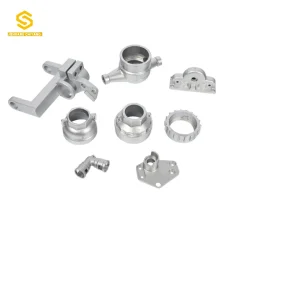
Automotive & High-Precision Casting Lineup




Navigating the Greater Chicago Die Casting & Manufacturing Ecosystem
The Greater Chicago metropolitan area—stretching from the O'Hare industrial corridor through Elk Grove Village and into the broader Rust Belt manufacturing triangle—remains the beating heart of North American heavy industry, automotive EV transformation, and medical equipment engineering.
Heavy Equipment & Machinery Leadership
Chicago serves as the operational headquarters and engineering hub for global giants in agricultural machinery, earthmoving equipment, and hydraulic control systems. Casting suppliers must meet stringent structural integrity requirements, zero-porosity thresholds, and exceptional fatigue resistance for cast aluminum pump housings, transmission covers, and structural brackets.
Automotive & EV Power Train Shift
As Illinois accelerates its transition into an Electric Vehicle (EV) assembly powerhouse, the regional procurement focus has pivoted toward lightweighting. High-pressure aluminum die castings (A380, A360, ADC12) are indispensable for housing battery thermal management circuits, motor enclosures, and lightweight structural crossmembers.
Logistics & Supply Chain Hub Integration
Situated near the O'Hare cargo corridor and major Class-I rail line junctions, Chicago OEMs demand agile lead times, JIT (Just-In-Time) inventory buffering, and seamless duty-paid door-to-door delivery. Bridging high-volume offshore manufacturing with local warehouse buffer stocks guarantees risk mitigation.
Technology Roadmap: Next-Generation Die Casting Capabilities
To satisfy the rigorous specifications of Chicago's design engineers, modern die casting factories must transition beyond traditional melt-and-pour methods into digitally monitored, ultra-dense metallurgical engineering.
1. Vacuum-Assisted HPDC (High-Pressure Die Casting)
By evacuating air from the die cavity prior to alloy injection (maintaining absolute vacuum pressure below 50 mbar), trapped air micro-voids are virtually eliminated. This enables downstream heat treatment (T6) and structural welding without surface blistering, ideal for high-stress automotive frame nodes.
2. MAGMASOFT® Moldflow & Simulation-Driven Design
Before steel is cut for tooling, complete thermodynamic fluid dynamic simulation is conducted. We predict shot velocities, gate runner turbulence, thermal balance, and solidification shrinkage. Chicago engineering leads receive exhaustive DFM reports eliminating costly tooling revision cycles.
3. Thin-Wall Lightweight Aluminum Alloys
Utilizing high-fluidity alloys such as AlSi10MnMg and custom heat-treatable formulations, wall thicknesses can be reduced down to 1.2 mm while maintaining structural yield strengths exceeding 240 MPa. This directly reduces component weight for drone frames, telecommunications heat sinks, and medical enclosures.
Process Selection Framework for Chicago Procurement Managers
Selecting the optimal manufacturing route dictates unit economics, upfront tooling capitalization, and mechanical performance. Compare High-Pressure Die Casting (HPDC) against alternative metalworking technologies.
| Manufacturing Process | Optimal Volume | Min Wall Thickness | Dimensional Accuracy | Tooling Lead Time | Unit Cost (High Vol) |
|---|---|---|---|---|---|
| High-Pressure Die Casting (HPDC) | > 2,000 pcs/year | 1.2 mm - 1.5 mm | ±0.05 mm (Cast) / ±0.01 mm (CNC) | 25 - 35 Days | Lowest |
| Metal Injection Molding (MIM) | > 5,000 pcs/year | 0.5 mm - 3.0 mm | ±0.3% - ±0.5% | 30 - 40 Days | Low (For complex micro-parts) |
| Powder Metallurgy (PM) Sintering | > 5,000 pcs/year | 2.0 mm + | ±0.08 mm | 25 - 30 Days | Very Low (Gears/Bushings) |
| Full CNC Machining from Billet | 1 - 500 pcs | 0.8 mm + | ±0.005 mm | 1 - 3 Days (No tooling) | Very High |
| Gravity Sand/Investment Casting | 100 - 1,000 pcs | 3.0 mm + | ±0.4 mm | 15 - 25 Days | Moderate |
* Note: Engineering recommendations are finalized after reviewing full 2D GD&T drawings and 3D STEP files.
China Factory 4.0: Delivering Resilient Value to the Chicago Market
Combining China’s mature raw material supply chains, rapid toolmaking speed, and Industry 4.0 robotic automation with rigorous North American quality assurance protocols provides Chicago buyers with an unassailable competitive advantage.
30% to 50% TCO (Total Cost of Ownership) Reduction
By leveraging fully integrated in-house mold making, die-casting, shot blasting, CNC precision trimming, and automated powder coating/anodizing, we eliminate vendor markup stacking. Chicago enterprises realize significant net landed cost savings even after factoring in trans-Pacific logistics and tariffs.
Rapid Tooling Acceleration (25-Day Cycle)
Time-to-market is crucial in the fast-evolving Midwest equipment sectors. Utilizing high-speed 5-axis CNC mold machining centers and EDM wire erosion, complex casting dies (H13 steel, hardened to 48-52 HRC) are designed, manufactured, and sampled in as little as 25 calendar days.
Zero-Defect Quality & IATF 16949 Assurance
Every batch shipped to Illinois undergoes full CMM dimensional checks, optical spectral alloy verification, real-time X-ray non-destructive testing for internal voids, and salt-spray corrosion chamber validation under stringent ISO 9001 and IATF 16949 quality protocols.
Frequently Asked Questions for Chicago Procurement & Engineering Teams
Addressing key engineering, logistical, and commercial inquiries regarding custom die casting supply to the Midwest region.
We employ high-vacuum extraction systems (<50 mbar) combined with controlled multi-stage slow-shot cylinder acceleration. Every critical fluid power component undergoes 100% real-time X-ray inspection to guarantee compliance with ASTM E505 Level 1 or Level 2 reference radiographs.
Air freight via O'Hare International Airport (ORD) takes 5 to 7 business days for urgent pilot lots. Standard ocean shipping to the Port of Chicago or rail transit to logistics hubs in Joliet/Elk Grove Village averages 22 to 28 days. Local warehouse stocking agreements are available for release on JIT release schedules.
Yes. We provide transparent HTS code classification (typically under HTS 7907.00 or 7616.99) and complete sub-assembly services to optimize duty valuations. Furthermore, complete PPAP Level 3 documentation, IMDS filings, and full material test reports (MTR) are provided standard.
The client retains 100% legal ownership of all tooling dies upon final payment. Molds are maintained, insured, and preserved in our climate-controlled tooling vault at zero extra charge for the agreed lifecycle (typically guaranteed for 100,000 to 300,000 shots depending on steel grade like Premium H13 or Dievar).
For aluminum, we work extensively with A380, A383, A360, ADC12, and AlSi10Mg. For zinc die casting, we cast Zamak 3, Zamak 5, and ZA-8, ideal for high-precision cosmetic hardware and shielding enclosures.
Yes. We house over 80 high-precision 3-axis, 4-axis, and 5-axis CNC machining centers. Available surface treatments include automated shot blasting, anodizing (Type II/III), powder coating, e-coating, chromate conversion, and electroless nickel plating.
Standard production MOQ is 2,000 pieces per run for aluminum and zinc die castings. For prototype verification or initial pre-series launch, smaller pilot batches are fully supported.
Upon uploading your 3D STEP/IGES files and 2D drawings with tolerance notes, our engineering team issues a detailed quotation along with an initial DFM feedback report within 24 to 48 hours.
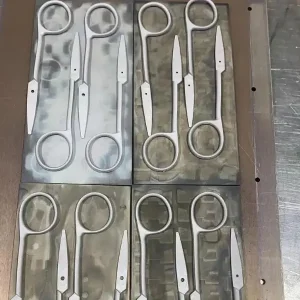
Industrial, MIM, & Hardware Casting Solutions





Ready to Upgrade Your Die Casting Sourcing for Chicago?
Get a comprehensive engineering DFM evaluation, tool flow simulation, and itemized quotation within 48 hours. Protect your intellectual property with our mutual NDA.