
Featured OEM Powdered Metal & MIM Parts
Explore initial custom sintered components engineered for high-performance acoustic, structural, and electro-mechanical applications.




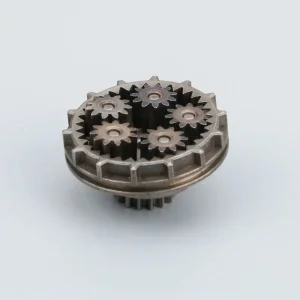


The Evolution of Custom Powdered Metal Parts in Global Manufacturing
As global original equipment manufacturers (OEMs) aggressively seek weight reduction, geometric complexity, and superior material utilization, custom powdered metallurgy (PM) and Metal Injection Molding (MIM) have emerged as foundational pillars of modern precision engineering.
Shift from Subtractive CNC to Near-Net-Shape Forming
Traditional subtractive CNC machining from solid billet often results in chip waste exceeding 60% to 80% of total alloy mass. In contrast, modern Press-and-Sinter Powder Metallurgy and Metal Injection Molding achieve material utilization rates greater than 95%. By compacting fine elemental or pre-alloyed powders (ranging from 1 to 100 micrometers) inside specialized precision tooling, engineers eliminate multi-axis milling setups, cut cycle times by order of magnitude, and achieve component densities approaching 98% of theoretical maximum wrought steel density.
Critical Demand Across High-Growth Verticals
The global demand for custom powdered metal parts is powered by four mega-trends:
- Automotive Electrification & Transmission: High-density planetary gears, variable valve timing (VVT) rotors, and electric drive e-axle components require superior fatigue resistance.
- Medical Robotics & Surgical Devices: Surgical stapler jaws, endoscopic grippers, and micro-actuators using biocompatible 316L and 17-4PH stainless steel.
- Consumer Electronics & Wearables: Complex structural hinges for foldable smartphones, smart watch casings, and acoustic earphone nozzles.
- Industrial Automation & Power Tools: Hardened iron-nickel gearboxes and wear-resistant hydraulic pump components.
Process Selection Matrix: Powder Metallurgy vs. MIM vs. CNC vs. Additive
Selecting the optimal custom metal forming process requires evaluating production volume, geometric complexity, material density, and dimensional tolerances.
| Manufacturing Route | Optimal Volume (Pcs/Year) | Geometric Complexity | Relative Material Utilization | Target Density (% Wrought) | Standard Dimensional Tolerance |
|---|---|---|---|---|---|
| Conventional PM (Press & Sinter) | 10,000 – 1,000,000+ | Medium (2.5D Axial Pressing) | 95% – 98% | 85% – 92% (Up to 95% with warm pressing) | ±0.05 mm (ISO IT 8–10) |
| Metal Injection Molding (MIM) | 5,000 – 500,000+ | Extreme (3D Complex / Undercuts) | 92% – 96% | 96% – 99% (Near Wrought) | ±0.3% to ±0.5% nominal |
| Subtractive CNC Machining | 1 – 2,000 | High (Limited by tool path access) | 15% – 40% | 100% (Solid Billet) | ±0.005 mm (ISO IT 5–7) |
| Selective Laser Melting (SLM / 3D) | 1 – 500 | Unlimited (Internal cooling channels) | 88% – 92% | 98% – 99.5% | ±0.1 mm |
China Factory 4.0: Supply Chain Resilience & Digital Precision
China’s leadership in powder metallurgy is no longer defined solely by cost efficiency. Today, top-tier Chinese manufacturers integrate digital twins, closed-loop atmosphere sintering, and localized powder synthesis into unified smart factories.
Closed-Loop Sintering Atmosphere Control
Modern Chinese sintering facilities utilize continuous mesh-belt and vacuum debinding-sintering furnaces equipped with closed-loop gas feedback controls. By continuously monitoring partial pressures of Hydrogen (H₂), Nitrogen (N₂), and Argon (Ar), combined with infrared pyrometry, temperature zones are held within ±2°C up to 1380°C. This strict environmental control eliminates intergranular oxidation and guarantees homogeneous carbon profile control across massive production lots.
Finite Element Analysis (FEA) & Mold Simulation
Before steel is cut for tooling, advanced computer simulation software—including Moldex3D for MIM feedstock flow and specialized powder compaction FEA—predicts green density distribution, binder burnout distortion, and isotropic thermal shrinkage. This digital twin approach shortens prototype iterations from months to days, cutting mold modification cycles by up to 70%.
Upstream Atomization & Powder Synthesis Synergy
China hosts the world’s most integrated supply ecosystem for spherical stainless steel, titanium, iron-nickel, and soft magnetic powder synthesis. Water atomization and gas atomization plants located within regional industrial clusters provide raw metal powders with tightly controlled particle size distributions (D50 ranges from 5μm for MIM to 45μm for press-and-sinter). This domestic raw material security insulates buyers from global supply disruptions while ensuring raw material cost advantages.
E-E-A-T Technical Insight: The integration of 100% automated optical inspection (AOI) sorting machines utilizing high-resolution vision systems allows leading Chinese PM plants to achieve defective rates below 10 PPM (parts per million) on critical automotive gear dimensions, completely checking key tolerances such as pitch diameter runout and tooth thickness.
Metallurgical Excellence & Material Performance
Custom powdered metal components are engineered to comply strictly with international standards, including MPIF Standard 35, ISO 22068, ASTM B883, and DIN 30910.
Pre-Alloyed vs. Elemental Powder Formulations
Achieving structural performance requires careful powder metallurgy formulation. Pre-alloyed powders involve atomizing a melt where each individual powder particle contains the exact nominal alloy composition (e.g., Fe-2Ni-0.5Mo). This guarantees absolute chemical homogeneity throughout the matrix after sintering.
Alternatively, diffusion-alloyed (partially alloyed) powders bond elemental nickel, copper, or molybdenum particles onto pure iron powder bases during high-temperature thermal treatments. This strategy maintains high green compactibility while promoting localized micro-duplex microstructures that resist impact loads and fatigue propagation.
Secondary Operations & Surface Engineering
Sintered parts can undergo tailored secondary processing to achieve demanding blueprint specifications:
- Resin & Copper Impregnation: Seals interconnected surface pores to make components pressure-tight for hydraulic applications or prepare them for electroplating.
- Steam Treatment (Fe₃O₄ Oxide Layering): Exposes iron parts to superheated steam at 540°C, forming a hard magnetite layer inside surface pores that boosts wear resistance and compressive strength.
- Case Hardening & Nitriding: Gas carburizing creates surface hardnesses up to 60–62 HRC while maintaining a tough, ductile core.
Design for Manufacturability (DFM) & Vertical Applications
Optimizing your part geometry for custom powder metal processes prevents costly tooling rework and ensures long-term manufacturing consistency.
Essential DFM Guidelines for PM & MIM
- Maintain Uniform Wall Thicknesses: Avoid abrupt cross-sectional changes. In MIM, uneven walls cause thermal debinding voids and differential shrinkage during sintering.
- Incorporate Generous Fillets and Radii: Internal sharp corners act as severe stress risers during powder compaction and ejection. Specify a minimum radius of 0.38 mm on all internal edges.
- Design Mold Ejection Draft Angles: For press-and-sinter parts, vertical die walls should be parallel, but step features and punches require 1° to 2° draft angles for smooth tool retraction.
- Avoid Feather Edges on Punches: Bevel angles under 45° on tool faces lead to fragile punch edges that chip prematurely under 600–800 MPa compaction pressures.
Localized Application Case Scenarios
High-density sintered planetary gears, oil pump rotors, variable valve timing (VVT) stators, and sensor targets produced in mass volume under IATF 16949 audits.
Micro-scale 17-4PH stainless steel endo-cutter jaws, laparoscopic shears, and titanium implant tools engineered with intricate 3D geometries.
Heavy-duty impact wrench bevel gears, cordless drill gearboxes, lock mechanisms, and pneumatic valve bodies.
End-to-End OEM Custom Production Workflow
From initial STEP drawing validation to global door-to-door delivery, every step is rigorously monitored.
2D/3D file review, FEA stress modeling & filling analysis.
Precision CNC machining & EDM wire-cutting of hardened steel dies.
High-tonnage pressing or feedstock injection molding.
Thermal/solvent binder removal followed by high-temp sintering.
Heat treatment, CNC sizing, CMM & 100% optical inspection.
Specialized Alloys, Molded Assemblies & Die Cast Solutions
Discover our extended line of precision custom components, including titanium MIM, selective laser melting 3D printing powders, and aluminum die castings.



Frequently Asked Questions by Global Engineers & Buyers
Clear, authoritative answers regarding dimensional tolerances, minimum order quantities, material specifications, and DFM reviews.
For standard press-and-sinter powder metallurgy components, as-sintered radial tolerances typically fall within ±0.05 mm (ISO IT Grade 8 to 10). When combined with secondary sizing (coining) operations, critical dimensions achieve tight tolerances of ±0.012 mm. For Metal Injection Molding (MIM), standard linear tolerances are held to ±0.3% to ±0.5% of nominal dimensions. Where sub-hundredth millimeter accuracy is required, post-sinter CNC finishing or grinding is applied.
Sintered part strength is directly proportional to final component density. Modern MIM components achieve densities ranging between 96% and 99% of theoretical wrought metal density, resulting in ultimate tensile strength, elongation, and fatigue strength virtually identical to wrought bar stock. High-density pressed-and-sintered alloy steels (density > 7.4 g/cm³), especially when heat-treated (carburized or induction hardened), deliver tensile strengths exceeding 1200 to 1500 MPa, making them fully capable of handling high-torque transmission loads.
Standard production MOQs are set at 2,000 pieces for MIM parts and 5,000 pieces for conventional powder metallurgy press-and-sinter parts to optimize setup times and furnace runs. However, prototype validation lots and pre-production pilot samples are routinely manufactured during tooling qualification. Tooling fabrication typically requires 25 to 35 calendar days, followed by sample inspection reports (FAI with full CMM data) within 7 days post-tool completion.
Our material capabilities encompass a broad portfolio compliant with international standards:
- Stainless Steels: 316L, 17-4PH, 304L, 420, 440C (Corrosion resistant and surgical grade).
- Low Alloy Steels: Fe-Ni-C (FN-0205, FN-0208), Fe-Cu-C, 4140, 8620 (High strength structural parts).
- Soft Magnetic Alloys: Fe-Ni (Permalloy), Fe-Si, Stainless 430L (Solenoids and magnetic actuators).
- Lightweight & Titanium Alloys: Ti-6Al-4V, pure Titanium (Aerospace and medical wearables).
- Non-Ferrous Alloys: Copper, Brass, Bronze bushings, and Wolfram/Tungsten heavy alloys.
Yes. Protecting customer intellectual property is central to our OEM operations. We execute formal bilateral Non-Disclosure Agreements (using your corporate template or our standard legal template) before reviewing confidential 2D/3D CAD drawings, material specs, or application parameters.
Manufacturing facilities operate under fully certified ISO 9001:2015 and automotive-grade IATF 16949 quality management systems. In-house quality control labs feature Zeiss 3D Coordinate Measuring Machines (CMM), optical video measuring systems, carbon-sulfur analytical instruments, metallographic micro-hardness testers, salt-spray corrosion chambers, and universal tensile test benches.
Accelerate Your Precision Hardware Sourcing Today
Submit your 2D PDF and 3D STEP drawings to receive a comprehensive engineer-reviewed DFM report, tooling strategy, and itemized unit price quote within 48 hours.
Request Engineering Review & Quotation