
Precision Sintered & Die Cast Manufacturing Catalog (Part 1)
Explore our custom engineered powder metallurgy components, aluminum/zinc die castings, and high-density MIM parts designed for high-stress industrial applications.



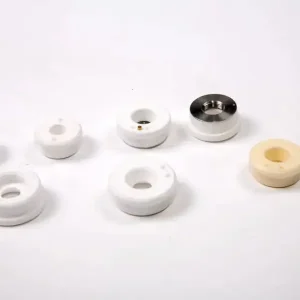



Executive Summary: Powder Metal Sintering Science & Industrial Execution
In modern precision manufacturing, powder metallurgy (PM) sintering stands as a foundational net-shape forming technology. By consolidating atomized elemental or pre-alloyed powders under immense mechanical pressure and thermal bonding below the liquidus temperature, China powder metal sintering manufacturers provide global engineering sectors with unprecedented material utilization, complex geometric capabilities, and structural durability.
Solid-State Sintering Kinetics
During thermal processing in continuous mesh-belt or vacuum furnaces, metal particles undergo atomic diffusion across contact points. Neck growth, grain boundary migration, and pore volume reduction occur naturally without fully melting the base metal, resulting in predictable density profiles and dimensional repeatability.
Atmosphere Control & Hardening
Optimized sintering requires controlled gaseous environments—including endothermic gas, nitrogen-hydrogen mixes, or high-vacuum chambers. Modern sinter-hardening technology integrates rapid cooling zones directly within the furnace to yield martensitic microstructures without separate quenching cycles.
Precision Density & Porosity Engineering
From self-lubricating porous bronze bushings (15–25% interconnected porosity) to ultra-dense structural automotive gears (>7.4 g/cm³ density achieved via double-press double-sintering or MIM), China sintering factories tailor microstructures to client performance parameters.
Strategic Advantages of Sourcing Sintered Metal Parts from China
Over the past two decades, Ningbo and the broader Yangtze River Delta region have emerged as global nerve centers for powder metallurgy innovation. Sourcing from top-tier Chinese sintering manufacturers provides structural cost efficiencies combined with world-class engineering capability.
1. Complete Upstream & Downstream Integration
Chinese sintering hubs benefit from localized raw material supply chains—ranging from water-atomized iron, stainless steel (316L, 17-4PH), and copper powders to high-purity binder formulations. Downstream operations like secondary CNC finishing, heat treatment, PVD coating, and electroplating reside within a tight industrial radius, drastically reducing production lead times.
2. Cost Optimization & Near-Net-Shape Economics
Subtractive machining of complex aerospace or automotive alloys often wastes over 60–70% of initial raw stock. Powder metal sintering achieves near-net shapes with 95%+ material utilization. Combined with automated multi-station presses, tooling amortizes quickly, dropping per-unit costs by 30% to 50% compared to full CNC milling.
3. Stringent Quality Control Standards
Leading Chinese factories operate under strict ISO 9001 and IATF 16949 quality management frameworks. Advanced inspection infrastructure—including coordinate measuring machines (CMM), optical image measurement systems, automated density meters, and salt-spray testing chambers—guarantees batch-to-batch consistency and zero-defect delivery.
Engineering Comparison Matrix: PM vs. MIM vs. Die Casting vs. CNC
Selecting the appropriate metal manufacturing technology depends on part geometry, material requirement, structural strength, and annual production volumes. Use our engineering guidelines below:
| Manufacturing Process | Ideal Part Geometry | Target Mass / Size | Achievable Tolerances | Material Utilization | Economic MOQ |
|---|---|---|---|---|---|
| Powder Metallurgy (PM Press & Sinter) | 2.5D stepped profiles, spur gears, bushings, structural plates | 5 g to 2,000 g (Up to 150 mm dia.) | ±0.03 mm to ±0.05 mm | 95% - 98% | 5,000 Pcs |
| Metal Injection Molding (MIM) | Highly complex 3D shapes, undercuts, micro-threads, thin walls | 0.2 g to 100 g (Max ~286 g) | ±0.1 mm to ±0.3% of nominal | 95% - 98% | 2,000 Pcs |
| Aluminum & Zinc Die Casting | Thin-walled housings, heat sinks, structural brackets | 50 g to 10,000 g | ±0.05 mm (Post CNC) | 85% - 90% | 2,000 Pcs |
| Precision CNC Machining | Simple to moderate 3D profiles, prototypes, low volume | Virtually Unlimited | ±0.005 mm to ±0.01 mm | 20% - 50% | 100 Pcs |
Macro Trends Driving Next-Gen Powder Metallurgy & Sintering
The powder metallurgy landscape is evolving rapidly driven by global electrification, medical miniaturization, and green industrial initiatives. Chinese manufacturers are investing heavily in advanced R&D to lead these global technological shifts.
High-Density Warm Compaction & Spark Plasma Sintering (SPS)
To meet the torque requirements of New Energy Vehicle (NEV) electric drive transmissions, advanced sintering factories employ warm compaction systems. By heating both the powder and die to optimized temperatures (~130°C), single-press compaction achieves green densities exceeding 7.25 g/cm³. Combined with high-temperature sintering, mechanical properties match traditional forged steels.
Titanium Metal Injection Molding (TiMIM) Breakthroughs
Titanium alloys (Ti-6Al-4V, Commercially Pure Ti) offer superior strength-to-weight ratios and biocompatibility. Recent breakthroughs in oxygen-controlled debinding and vacuum sintering allow Chinese facilities to mass-produce lightweight surgical tools, aerospace fasteners, and luxury consumer wearable housings with ultra-low oxygen pickup.
Additive Manufacturing & MIM Process Hybridization
Bridging rapid prototyping and high-volume mass production, factories utilize Selective Laser Melting (SLM) and Binder Jetting 3D printing. Engineering teams validate complex geometries using metal 3D printing for design verification prior to cutting multi-cavity MIM tooling, eliminating costly tooling redesign iterations.
Carbon-Neutral Sintering & Zero-Waste Manufacturing
Industrial sustainability is now a core procurement criterion. Sintering factories in China are adopting energy-efficient continuous electric mesh furnaces, closed-loop atmosphere recycling systems, and 100% scrap powder reclamation, drastically reducing the embodied carbon footprint per component.
Industry Application Scenarios & Engineering Solutions
Precision sintered components serve critical functional roles across diverse high-stress industrial applications globally:
Automotive Powertrains & Chassis
Variable Valve Timing (VVT) stator and rotor hubs, oil pump rotors, ABS sensor rings, transmission synchronizer rings, and electric power steering (EPS) gears produced with high fatigue endurance.
Medical Instruments & Surgical Handpieces
MIM 17-4PH and 316L stainless steel laparoscopic articulation joints, endoscopic cable pulleys, surgical scalpel handles, and dental bracket fixtures requiring non-corrosive biocompatibility.
Industrial Hardware & Smart Locks
High-security lock core rotors, heavy-duty hydraulic motor gears, planetary gearheads for power tools, and wear-resistant valve plates operating under high torque contact stress.
OEM Procurement Guide: Design for Manufacturability (DFM) Rules
To maximize part performance while maintaining optimal unit pricing, engineering teams should align drawing specifications with powder metal sintering physics early in the product development cycle.
Wall Thickness & Geometry Constraints
Maintain uniform wall thickness throughout the part where possible. For powder metallurgy (press and sinter), avoid wall sections below 1.5 mm to prevent compaction void defects. For MIM parts, ideal wall thicknesses range from 0.8 mm to 3.0 mm to facilitate clean debinding without internal cracking.
Draft Angles & Tool Ejection
While die-wall lubrication allows minimal draft in conventional axial pressing, incorporating a 0.5° to 1° draft angle on vertical features significantly extends compaction tooling life and eliminates surface micro-scoring during part ejection.
Shrinkage Factor Management
MIM components undergo 15% to 20% volumetric shrinkage during sintering as debinding polymers evaporate. China factories utilize proprietary mold cavity scaling algorithms to ensure final sintered dimensions meet tight geometric dimensioning and tolerancing (GD&T) callouts.
Cross-Border Quality Verification Protocol
Ensure your supplier submits complete PPAP (Production Part Approval Process) documentation including Level 3 ISIR, material chemical spectrum analysis reports, density verification, and full batch CMM dimensional inspection sheets prior to tooling sign-off.
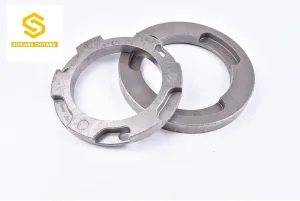
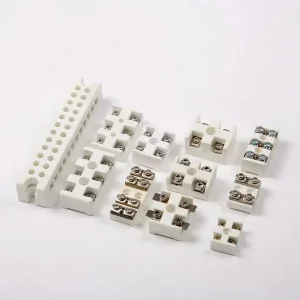
Precision Sintered & MIM Hardware Components Catalog (Part 2)
Discover our extensive range of high-performance custom sintered gears, MIM earphone components, lock fittings, and specialized ceramic hardware.






Frequently Asked Questions (Technical & Procurement FAQ)
Direct technical answers from our engineering team regarding powder metal sintering, material properties, and order logistics.
Q1 Can you sign our Non-Disclosure Agreement (NDA) before reviewing project drawings?
Yes. We routinely sign bilateral NDAs before reviewing proprietary CAD files or technical specifications. Your intellectual property is protected under strict internal digital access controls and secure engineering servers.
Q2 How do you manage dimensional tolerance variations caused by sintering shrinkage?
Our engineers calculate exact material-specific shrinkage coefficients during mold cavity design. For critical features requiring tighter tolerances than standard sintering allows (e.g., < ±0.02 mm), we implement secondary sizing/coining operations or high-precision CNC finishing pass.
Q3 What are the primary differences between Conventional PM Pressing and Metal Injection Molding (MIM)?
Conventional PM presses metal powder axially in rigid dies, making it ideal for 2.5D shapes like gears and bushings up to 150 mm in size. MIM mixes metal powder with a polymer binder to injection-mold complex 3D shapes (undercuts, cross-holes) suitable for smaller precision parts (typically under 100g).
Q4 What international material standards do your sintered components comply with?
Our materials comply with major global standards, including MPIF Standard 35 (USA), ISO 5755, DIN 30910, and JIS Z2550. We offer material certifications for Fe-Cu-C alloys, 316L/17-4PH stainless steel, nickel steel alloys, and biocompatible Titanium (Ti-6Al-4V).
Q5 What is the typical lead time for prototype samples and production tooling?
Tooling design and sample fabrication typically take 25 to 35 days. For rapid prototype verification prior to cutting production tooling, our in-house metal 3D printing equipment can deliver functional prototype parts within 5 to 7 business days.
Q6 What Minimum Order Quantities (MOQ) do you require?
Standard MOQs are 2,000 pieces for MIM and CNC machined components, 2,000 pieces for aluminum/zinc die casting, and 5,000 pieces for high-volume powder metallurgy (PM) pressed parts. Prototype and pilot runs are supported upon initial DFM review.
Q7 How quickly can we receive a formal engineering DFM report and quotation?
Upon receiving your complete 2D (PDF with tolerances) and 3D CAD files (STEP/IGES format), our engineering department returns a full DFM manufacturability evaluation and transparent itemized quotation within 48 hours.
Ready to Optimize Your Metal Component Cost & Quality?
Submit your 2D/3D technical drawings today. Our senior metallurgical engineering team will provide a complimentary Design for Manufacturability (DFM) review and comprehensive quotation within 48 hours.
Request Free Engineering Quotation & DFM