

Global Procurement Landscape & Strategic China Sintering Sourcing
In modern mechanical engineering and automated drive design, the global demand for sintered gear technology has reached unprecedented growth. Original Equipment Manufacturers (OEMs) and Tier-1 automotive integrators across North America, Europe, and Asia-Pacific are increasingly turning to premier powder metallurgy (PM) manufacturers in China to fulfill strict volumetric, structural, and economic targets. Sintering—the process of compacting elemental or alloy powders into complex near-net shapes followed by solid-state thermal bonding below the melting point—offers unmatched material efficiency and geometric freedom.
Sourcing custom gear solutions from an established China sintering gears manufacturer provides a definitive competitive edge. Beyond the obvious direct unit-cost optimization (frequently yielding 30% to 50% savings over subtractive CNC gear hobbing and broaching), leading Chinese manufacturing centers in Zhejiang (such as Ningbo) have scaled advanced technical capabilities. By integrating high-tonnage CNC compacting presses, atmosphere-controlled mesh belt sintering furnaces, and automated optical gear checking systems, premier suppliers satisfy the stringent defect-free mandates of ISO/TS and IATF 16949 certified quality frameworks.
The primary procurement motivation for enterprise buyers focuses on total cost of ownership (TCO) and long-term supply chain resilience. Traditional gear fabrication relies heavily on heavy machining, leading to excessive material scrap (up to 60% metal waste) and high tool wear. In contrast, powder metal gear sintering operates near 95% material utilization. For complex gear geometries—such as multi-tier compound spur gears, integrated timing pulleys, internal ring gears, and bevel drive assemblies—powder compaction combined with precision tooling allows single-operation mass production that eliminates multi-stage machining setups.
Advanced Powder Metallurgy & Gear Sintering Metallurgy
High-performance gear sintering is an intricate metallurgical discipline combining alloy powder chemistry, green compact density optimization, thermal dynamics, and secondary densification. Understanding the technical roadmap of custom sintered gears is essential for engineering leaders specifying structural drive components.
Custom Alloy Formulation
Utilizing atomized iron powders blended with targeted alloying additions—including Nickel (Ni), Molybdenum (Mo), Copper (Cu), and Carbon (C). Formulations are tailored per MPIF Standard 35 specifications (e.g., FC-0208, FN-0205, FLN2-4405) to balance toughness, fatigue endurance, and wear resistance.
High-Pressure Compaction
Pre-alloyed powders undergo multi-axial CNC hydraulic compaction at pressures reaching 600 to 800 MPa. Advanced tool kinematics control uniform "green density" distribution across variable tooth profiles, preventing micro-void formation at root radii.
Controlled Sintering Furnace
Parts traverse continuous mesh-belt furnaces under endothermic or synthetic Nitrogen-Hydrogen protective atmospheres at temperatures ranging between 1120°C and 1280°C. Solid-state atomic diffusion bonds powder particles, establishing final mechanical strength.
Engineering Benchmark: Sintered PM Alloys vs. Traditional Machined Steels
| Material Standard / Process | Sintered Density (g/cm³) | Tensile Strength (MPa) | Apparent Hardness (HRC/HRB) | Tooth Root Fatigue Limit | Geometric Complexity Support |
|---|---|---|---|---|---|
| MPIF FC-0208-50 (Sintered Fe-Cu-C) | 6.8 - 7.1 | 450 - 550 | 75 - 85 HRB | 180 MPa | High (Multi-step profiles) |
| MPIF FLN2-4405-120HT (Sinter-Hardened) | 7.1 - 7.3 | 850 - 1100 | 35 - 45 HRC | 320 MPa | Very High (Near Net Shape) |
| MPIF FN-0205-180HT (High-Density Ni-Steel) | 7.2 - 7.5 | 1050 - 1250 | 40 - 48 HRC | 360 MPa | Very High (Intricate hubs) |
| Conventional Machined 20CrMnTi (Wrought) | 7.85 | 980 - 1150 | 58 - 62 HRC | 420 MPa | Low (Requires multi-axis milling) |
| MIM 17-4PH / Stainless Steel (Injection Molded) | 7.5 - 7.7 | 900 - 1150 | 38 - 42 HRC | 340 MPa | Extreme (Micro-gear geometries) |
To achieve maximum power transmission density, specialized post-sintering processes such as surface roll-densification, vacuum resin impregnation, steam treatment (magnetite oxidation layer formation), and sinter-hardening are deployed. Sinter-hardening utilizes rapid cooling zones in the furnace to transform the austenite matrix directly into martensite, eliminating secondary quench treatment and maintaining exceptional dimensional stability across critical gear pitch diameters.
Cross-Industry Solutions & Engineered Applications
Custom sintered gears engineered by Chinese suppliers serve as vital mechanical drives across diverse commercial sectors. By adapting density, tooth surface finish, and microstructural phase balance, powder metal gears deliver robust performance under dynamic stress, acoustic sensitivity, and high-duty cycles.
Automotive Powertrain & Actuators
Used extensively in Electronic Throttle Control (ETC) systems, Variable Valve Timing (VVT) phaser sprockets, oil pump rotors, seat adjustment mechanisms, and electric parking brake (EPB) gearboxes. High structural integrity prevents tooth shear under sudden torque peaks.
Power Tools & Cordless Drives
Planetary gear reduction systems in high-torque cordless drills, impact drivers, and rotary hammers benefit from copper-infiltrated sintered steel gears. Controlled porosity absorbs lubrication oils, reducing operating temperature and vibration noise.
Industrial Automation & Robotics
Low-backlash spur gears, helical drive sets, and bevel gear configurations for AGV drive units, conveyor speed reducers, and robotic joint actuators. Sintered metallurgy provides dimensional consistency for high-repeatability motion control.
Medical & Precision Hardware
Micro sintered gear assemblies, valve actuators, and stainless steel (316L/17-4PH) drive components for medical pumps and surgical tools. Metal Injection Molding (MIM) gear sintering enables complex features on parts weighing less than 5 grams.
Self-Lubrication Advantage in Sintered Bushings & Gears
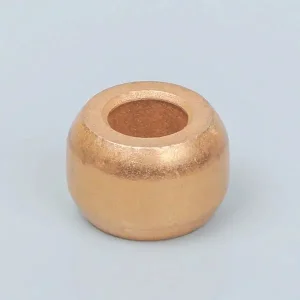
The inherent interconnected porosity of powdered metal gears (typically 10% to 20% by volume) acts as a internal reservoir for synthetic lubricants. When operational friction generates heat, oil draws to the tooth interface via capillary action; upon cooling, oil recirculates into the matrix. This eliminates external grease application in maintenance-free appliance gearboxes.
Acoustic Dampening & NVH Optimization
Engineered porosity provides internal micro-dampening against mechanical resonance. Sintered iron-steel gears demonstrate 3 to 6 dB lower gear-mesh noise levels compared to solid wrought steel counterparts, directly assisting automotive OEM targets for Noise, Vibration, and Harshness (NVH) compliance.
Global Quality Systems, Technical Inspection & Compliance
Navigating international procurement requires transparent quality verification, standardized material certifications, and robust environmental compliance. Premium Chinese manufacturers operate structured technical verification protocols at every production milestone.
IATF 16949 & ISO Certified
Manufacturing facilities undergo strict third-party audits to maintain automotive-grade quality management systems. Complete PPAP (Production Part Approval Process) Level 3 documentation—including FMEA, Control Plans, and Capability Studies (Cpk > 1.67)—is routinely supplied for volume gear projects.
Metrology & Metrological Lab
Gear tooth accuracy is inspected using specialized CNC Gear Measurement Centers (evaluating total radial composite error, tooth profile variation, helix angle deviation, and pitch error according to ISO 1328 and DIN 3962 standards), alongside automated optical profile sorting machines.
Environmental & Material Compliance
All powder formulations and secondary surface finishes strictly adhere to EU RoHS, REACH, and Conflict Minerals requirements. Full spectroscopic material test certificates (XRF powder analysis) accompany every production heat lot for complete supply chain traceability.
Next-Generation Metallurgy: Technology Roadmap & Future Outlook
The powder metallurgy domain is advancing through the integration of digital manufacturing, additive powder hybrid processes, and zero-carbon metallurgical practices. Enterprise buyers partnering with forward-looking Chinese sintering producers gain immediate access to these emerging technologies:
3D Metal Printing Hybrid Tooling
Integration of Selective Laser Melting (SLM) to create compaction dies with conformal cooling and heating channels. This speeds up tool development cycles for pilot-run custom gear geometries prior to hard tool sign-off.
AI Closed-Loop Density Sensing
In-line acoustic emission sensors and AI pressure feedback loops monitor compaction forces in real-time. Automatic hydraulic stroke corrections prevent green-density gradients across asymmetrical gear tooth profiles.
Green Hydrogen Sintering
Transitioning sintering furnace atmospheres from cracked ammonia to 100% green hydrogen generated via onsite electrolysis, drastically lowering the carbon footprint of powder metal structural components.
Frequently Asked Questions: Technical & Sourcing Engineering Guide
Answers to critical commercial and technical questions frequently raised by global procurement executives and mechanical design teams when specifying sintered metal gears.