
Featured Precision OEM MIM & Sintered Components
Explore our high-density powder metallurgy, titanium MIM, and micro-machined medical and industrial solutions engineered for global Tier-1 OEMs.
Global Commercial & Industrial Landscape of MIM Medical Forceps
An authoritative insight into how Metal Injection Molding is revolutionizing modern surgical instrumentation supply chains worldwide.
The modern surgical device industry is undergoing a structural transformation toward minimally invasive surgery (MIS), robotic-assisted surgical systems (RASS), and specialized microsurgical tools. At the heart of this revolution lies the requirement for intricate, biocompatible, micro-scale metal components—most notably medical forceps jaws, grasping mechanisms, scissor blades, and articulating hinges. Traditional sub-tractive CNC machining and investment casting struggle to meet the dual challenges of complex 3D geometric freedom and cost efficiency at scale. This is where high-precision Metal Injection Molding (MIM) and Titanium Metal Injection Molding (TiMIM) have emerged as indispensable core manufacturing technologies.
The global medical MIM market was valued at over USD 450 million in 2024 and is projected to expand at a compound annual growth rate (CAGR) exceeding 8.5% through 2032. Medical forceps components account for a substantial portion of this growth, driven by an escalating volume of laparoscopic, endoscopic, ophthalmic, and neurosurgical procedures. Leading OEM medical device brand owners across North America, Western Europe, and Japan are shifting high-volume procurement to specialized contract manufacturers capability-rich in MIM technological infrastructure.
Geometric Freedom
MIM allows complex 3D contours, internal flushing channels, micro serrations (<0.1mm tooth radius), and integrated clevis-pin holes without secondary machining, achieving near-net shape in a single sintering step.
Metallurgical Integrity
Achieving relative densities between 96% and 99.5% of theoretical density, MIM medical forceps exhibit mechanical properties—tensile strength, yield strength, and fatigue limits—virtually identical to wrought metals.
Scale & Economy
Tooling amortization across tens of thousands of forceps assemblies yields unit cost savings of 30% to 60% compared to full 5-axis CNC micro-milling, making disposable surgical tools economically viable.
Industry Trends & Technological Breakthroughs in MIM Forceps Manufacturing
From micro-MIM to advanced titanium sintering, explore the technical frontiers elevating medical forceps performance.
1. Micro-MIM and Ultra-Thin Wall Geometry
Surgical trends demand smaller access ports (3mm down to 1.4mm laparoscopic channels). Micro-MIM technology utilizes ultrafine powders ($D_{50} < 4\mu m$) and specialized binder systems to replicate forceps walls as thin as 0.15mm with precise micro-serrations that securely clamp soft tissue without slippage or excessive trauma.
2. Robotic Surgery Articulated Wrist Mechanics
Robotic surgical systems require forceps jaws with multiple degrees of freedom. MIM enables the batch production of wrist pins, pulley-driven actuation links, and multi-hinge forceps bases with sub-10 micron tolerances, empowering complex movements inside restricted anatomical cavities.
3. Advanced Surface Integrity & Biocompatibility
Post-sintering surface enhancements, including electropolishing, nitric/citric acid passivation, and PVD/DLC (Diamond-Like Carbon) coatings, elevate corrosion resistance and minimize protein adhesion. Surgical forceps pass rigorous ISO 10993 cytotoxicity, hemolysis, and systemic toxicity testing.
4. Bi-Material & Hybrid MIM (Co-MIM)
Next-generation electrosurgical forceps require conductive jaws bonded to electrically insulating ceramic frames. Bi-material injection molding allows two different metal powders (e.g., non-magnetic stainless steel and high-conductive copper alloy) or ceramic/metal combinations to be co-injected and co-sintered seamlessly.
Specialized Application Scenarios for OEM MIM Surgical Forceps
Delivering tailored metallurgical performance across diverse clinical specialties and surgical environments.
| Clinical Scenario | Forceps Type | Material Selection | Key MIM Engineering Challenges | Performance Benefit |
|---|---|---|---|---|
| Laparoscopic Surgery | Babcock & Maryland Grasping Forceps | 17-4PH Stainless Steel (Custom 450) | Multi-faceted teeth profiles, long thin shaft pinhole alignment | High yield strength (>1100 MPa), firm tissue hold without deflection |
| Flexible Endoscopy | Biopsy Forceps Cups & Micro-Alligators | 316L Stainless Steel / Custom MIM Alloys | Wall thickness down to 0.12mm, sharp biting edge sharpness | Optimal corrosion resistance against body fluids, clean tissue cutting |
| Electrosurgery (RF) | Bipolar Sealing Forceps Jaws | Custom Fe-Ni / Ceramic-MIM Insulators | Co-sintering insulation barrier, thermal dissipation channels | Precise vessel sealing, minimal thermal lateral spread |
| Robotic Surgery (RASS) | Articulating Micro-Forceps & Needle Drivers | Ti-6Al-4V (Grade 5 Titanium) / 17-4PH | Integrate cable pulleys into tiny jaw base, tight tolerances (±0.03mm) | Ultra-lightweight, high tactile torque responsiveness, extreme fatigue life |
| Ophthalmic & Neuro | Ultra-Fine Tying Forceps & Micro Scissors | High-Hardness Martensitic Stainless Steel | Micro-scale geometry retention during debinding/sintering stage | Zero jaw misalignment, surgical precision under 20x magnification |
Macro Industry Solutions: Turnkey Engineering & DFM Framework
How Jiehuang (JHMIM) bridges raw CAD concept design to high-volume medical device mass production.
Phase 1: DFMA Engineering Review
Our senior MIM engineering team performs a thorough Design for Manufacturability and Assembly (DFMA) audit. We optimize draft angles, uniform wall transitions, and gate locations to eliminate voids, weld lines, and sintering distortion prior to mold fabrication.
Phase 2: Proprietary Feedstock & Tooling
We blend atomized metal powders with custom polymer binders to achieve optimal flowability into complex multi-cavity molds. Tooling is constructed with imported Swiss HSS/Carbide inserts to guarantee multi-million cycle tool life.
Phase 3: Solvent Debinding & Sintering
Components undergo environmentally controlled catalytic or solvent debinding, followed by high-vacuum, atmosphere-controlled thermal sintering at temperatures up to 1380°C to form dense, homogenous metallic structures.
Phase 4: Post-Processing & QA
Secondary CNC touch-ups (if needed for sub-10μm holes), heat treatment (H900/H1150 conditioning), electropolishing, and 100% automated optical inspection (AOI) with coordinate measuring machines (CMM) ensure complete adherence to ISO 13485 quality standards.
Technology Roadmap & Future Outlook (2025–2035)
Pioneering smart simulation, bio-absorbable metals, and additive-MIM synergy for tomorrow's surgical innovations.
AI-Driven Sintering Shrinkage Modeling
Sintering inherently induces linear shrinkage of 15% to 20%. JHMIM is integrating finite element analysis (FEA) and machine learning algorithms to simulate grain boundary kinetics, allowing pre-compensated mold designs that achieve net-shape tolerances down to ±0.15% without post-machining.
Titanium & Nitinol Shape-Memory Forceps
As titanium MIM (TiMIM) matures, the weight reduction and MR-compatibility of surgical tools drastically improve. Furthermore, research into MIM processing of superelastic Nitinol (NiTi) alloys opens doors for self-expanding, flexible forceps tips capable of navigating complex arterial pathways.
Additive Manufacturing Synergy (Binder Jetting)
Bridging low-volume prototyping and high-volume injection molding, metal Binder Jetting (BJM) utilizes identical powder feedstocks and sintering furnaces as MIM. This allows medical OEM clients to validate surgical forceps prototypes in days before committing to hard tooling.
Comprehensive OEM Metal Molding & Component Capabilities
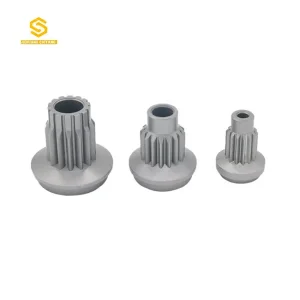
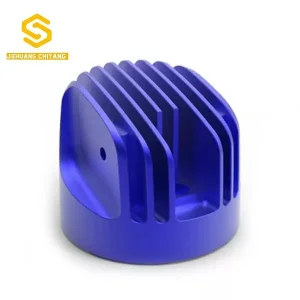
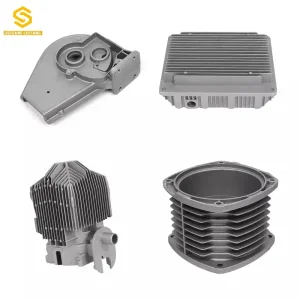
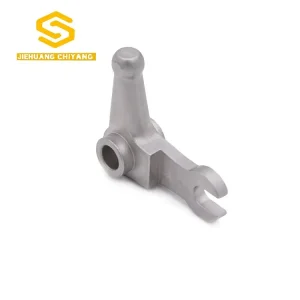
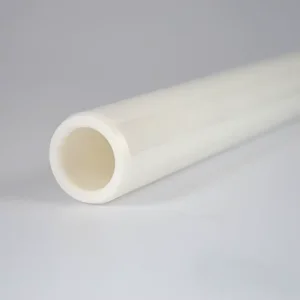
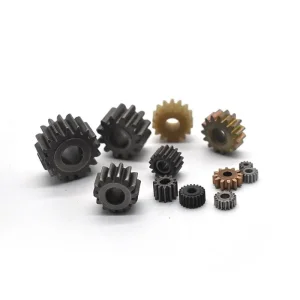
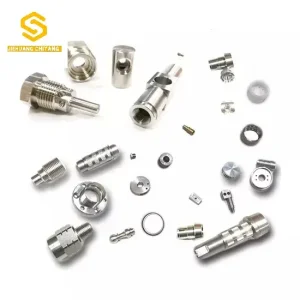
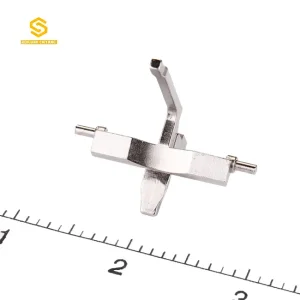
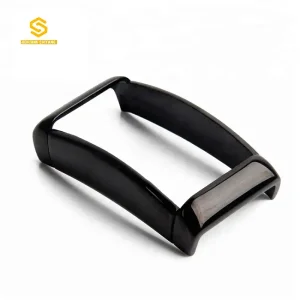
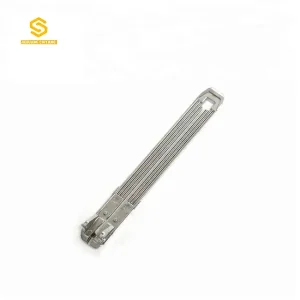
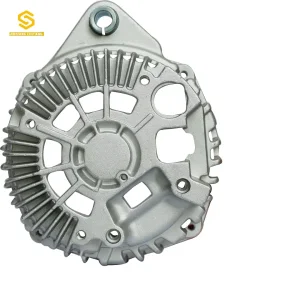
Discover our full product spectrum spanning ceramic tubes, micro gears, automotive die casting, and custom powder metallurgy parts.
Frequently Asked Questions (FAQ) for OEM Medical MIM Forceps
Detailed technical answers to common procurement, engineering, and compliance inquiries.
What materials are most suitable for MIM surgical medical forceps?
The vast majority of MIM medical forceps are manufactured from 17-4PH martensitic stainless steel due to its high tensile strength (>1100 MPa post H900 heat treatment) and excellent fatigue resistance under clamping loads. For applications requiring extreme chemical passivity or non-magnetic behavior, 316L austenitic stainless steel is selected. For ultra-lightweight or implantable-adjacent surgical tools, Ti-6Al-4V (Grade 5 Titanium) processed via TiMIM is the optimal material.
What tolerances can JHMIM achieve for micro medical forceps jaws?
Our standard as-sintered MIM tolerances range between ±0.3% to ±0.5% of nominal dimension. For critical features on micro forceps—such as pivot pin holes, cable grooves, and mating teeth serrations—we implement precision coining, sizing dies, or secondary CNC micro-machining to achieve tight tolerances down to ±0.01mm (10 microns).
How does MIM compare to CNC machining for high-volume medical forceps production?
While CNC machining offers quick setup for prototypes (<500 units), MIM is dramatically more cost-effective for annual production volumes exceeding 2,000 to 5,000 units. MIM eliminates up to 90% of material scrap (especially valuable with expensive alloys), creates complex 3D serrations and curved ergonomic geometry in a single stroke, and reduces unit part costs by 40% to 60% relative to 5-axis micro-milling.
What quality certifications and biocompatibility assurances do you provide?
Jiehuang operates under ISO 9001 and IATF 16949 quality frameworks, with full alignment to ISO 13485 medical device manufacturing requirements. All raw material powders come with full lot traceability, chemical composition certificates, and compliance declarations. Finished medical components undergo passivation in accordance with ASTM F1089 and pass ISO 10993 cytotoxicity and corrosion evaluation protocols.
Can you assist with rapid prototyping before investing in MIM production tooling?
Yes! We provide metal 3D printing (Direct Metal Laser Sintering - DMLS and Binder Jetting) services to produce functional metal prototypes within 3 to 7 business days. This enables your clinical engineering team to perform tactile testing, anatomical simulation, and handle assembly verification prior to committing to multi-cavity MIM injection mold production.