
Precision Powder Metallurgy & Metal Components
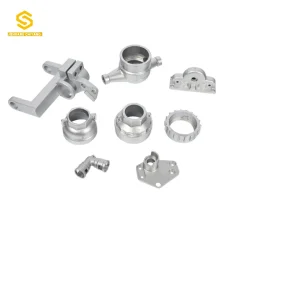
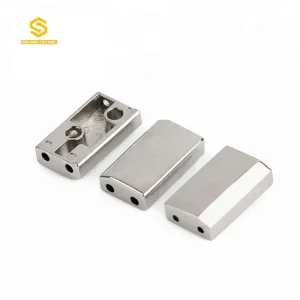
Explore our custom-engineered gear units, sintered mechanical spare parts, MIM components, and die-cast housing assemblies engineered for high-volume wholesale requirements.






Global Powder Metallurgy Gear Manufacturing Landscape
A comprehensive analysis of market growth drivers, material advancements, density optimization, and structural advantages in high-volume OEM gear fabrication.
Industrial Context & Market Drivers
The global demand for wholesale powder metallurgy gear manufacturing has experienced a transformative shift driven by the rapid growth of electric vehicles (EVs), industrial automation, smart robotics, and high-torque power tools. Powder Metallurgy (PM)—encompassing conventional press-and-sinter processes as well as advanced Metal Injection Molding (MIM)—represents the premier near-net-shape manufacturing technique for producing complex spur gears, helical gears, bevel gears, and planetary gear sets.
Compared to traditional subtractive gear machining, gear hobbing, and broaching, Powder Metallurgy offers unparalleled material utilization (exceeding 95-98%), significantly reduced energy consumption, and the ability to combine multi-piece gear assemblies into a single consolidated sintered part. In modern high-volume supply chains, global OEMs leverage PM gear technology to eliminate costly secondary machining steps while achieving rigorous AGMA (American Gear Manufacturers Association) and ISO quality tolerances.
Key global market drivers include:
- Electrification of Powertrains: High-density sintered gears provide exceptional acoustic damping and high fatigue resistance in EV auxiliary drives, electric parking brakes (EPB), and variable valve timing (VVT) actuators.
- Robotics & Precision Actuators: Micro PM gears engineered with modified tooth profiles enable ultra-compact planetary gearboxes for collaborative robots (cobots) and medical surgical units.
- Sustainability and Net-Zero Targets: PM manufacturing dramatically reduces scrap metal generation and carbon footprint compared to forged bar stock machining.
Metallurgical Density Profiling & Sintering Science
Understanding the interplay between powder composition, compaction pressure, sintering kinetics, and heat treatment in achieving peak mechanical performance.
1. Compaction & Density Optimization
The mechanical properties of a sintered PM gear—including tensile strength, impact toughness, and fatigue limits—are directly proportional to its final density. Standard press-and-sinter gears reach densities between 6.8 and 7.2 g/cm³.
Through Warm Compaction, high-pressure CNC pressing (up to 800 MPa), and double-press double-sinter (DPDS) routes, advanced manufacturers achieve densities up to 7.4–7.6 g/cm³, achieving mechanical performance approaching wrought steel.
2. High-Temperature Sintering
Sintering takes place in continuous mesh-belt or walking-beam furnaces at temperatures ranging from 1120°C to 1280°C under protective nitrogen-hydrogen or vacuum atmospheres.
During sintering, solid-state diffusion creates atomic bonds between metal powder particles, forming strong necking regions. High-temperature sintering promotes pore rounding and homogenization of alloying elements like Nickel, Molybdenum, and Chromium.
3. Surface Densification & Heat Treatment
For demanding power transmission applications, Surface Rolling Densification is applied to the root and flank of the gear teeth. This process creates a fully dense (7.8 g/cm³) surface layer up to 1 mm deep while retaining a ductile porous core for weight savings and vibration dampening.
Post-sintering processes such as Case Carburizing, Carbonitriding, and Induction Hardening yield surface hardness values exceeding 58-62 HRC.
Common Powder Metallurgy Gear Alloy Specifications
Technical performance comparison according to MPIF Standard 35 and ISO 5755 international standards for engineering decision-making.
| Material Grade (MPIF 35) | Base Composition | Sintered Density (g/cm³) | Tensile Strength (MPa) | Apparent Hardness | Primary Industrial Applications |
|---|---|---|---|---|---|
| FC-0208-50 | Fe-Cu-C (2% Cu, 0.8% C) | 6.8 – 7.2 | 450 – 650 | 75 – 85 HRB | General power tool spur gears, lawn equipment drives, appliance gears |
| FN-0208-65 | Fe-Ni-C (2% Ni, 0.8% C) | 7.0 – 7.3 | 600 – 850 | 25 – 35 HRC | High-torque planetary gears, automotive oil pump drives, sprockets |
| FLN2-4405-120HT | Pre-alloyed Fe-Ni-Mo Steel | 7.1 – 7.4 | 1100 – 1350 | 42 – 50 HRC | Automotive transmission gears, electric parking brake gears, heavy duty drives |
| FLC-4608-140HT | Pre-alloyed Ni-Mo-Cu Steel | 7.3 – 7.55 | 1250 – 1550 | 50 – 58 HRC | Extreme fatigue resistance bevel gears, aerospace actuators, EV reduction units |
| SS-316L / SS-17-4PH (MIM) | Austenitic / Precipitation Hardened SS | 7.6 – 7.75 | 520 – 1150 | 20 HRB / 38–44 HRC | Medical instruments, corrosive chemical pump gears, marine hardware |
Industry-Specific Solutions & Macro Deployment
How specialized powder metallurgy gear manufacturing addresses critical operational challenges across key industrial sectors worldwide.
Automotive Powertrains & e-Mobility
Modern vehicles contain over 30 kg of powder metallurgy components. High-precision PM gears are extensively integrated into Engine Variable Valve Timing (VVT) systems, Electronic Throttle Controls (ETC), ABS pump gear sets, seat adjustment drives, and EV auxiliary gearboxes.
Engineering Advantage: Exceptional dimensional consistency (IT6 to IT8 gear accuracy standards), integrated weight-reduction pockets, and inherent self-lubricating oil-impregnation capabilities that reduce NVH (Noise, Vibration, and Harshness).
Industrial Power Tools & Smart Hardware
High-torque cordless drills, impact drivers, angle grinders, and lawn equipment rely on compact multi-stage planetary gear systems. PM processes allow multi-level complex geometries—such as combining a spur gear and a bevel gear into a single monolithic sintered component—eliminating assembly labor and press-fit failures.
Engineering Advantage: Elimination of gear tooth shaping steps, ultra-high surface hardness post-carburizing, and unit cost reductions up to 50% on annual volume orders above 50,000 units.
Smart Appliances & Home Automation
Sintered bronze and iron-copper planetary gear sets drive automatic vacuum robots, smart lock mechanisms, HVAC actuator controls, and kitchen food processors. Controlled porosity allows oil impregnation (Sint-80, ISO VG 68/100) for lifetime maintenance-free lubrication.
Engineering Advantage: Silent operation due to internal pore damping of resonance, low friction coefficients, and consistent zero-backlash mesh tolerances.
Aerospace, Defense & Medical Devices
Utilizing high-precision Metal Injection Molding (MIM) with 17-4PH or Titanium powders, micro gears weighing less than 0.5 grams are produced with internal spline details, micro-pitch gear teeth, and surgical-grade corrosion resistance for robotic endoscopic surgical tools and aerospace wing-flap actuators.
Engineering Advantage: Complex 3D shape capability matching plastic injection molding flexibility combined with full metallic tensile strengths above 1100 MPa.
Technology Roadmap & Future Innovations (2025–2035)
Strategic advancements reshaping the next decade of powder metal gear design, manufacturing automation, and material performance.
AI-Driven Generative Gear Tooling Design
Integration of Finite Element Analysis (FEA) and machine learning algorithms allows for predictive simulation of powder flow, die compaction stress, and thermal shrinkage during sintering.
This eliminates expensive multi-iteration tooling adjustments, cutting prototype-to-mass-production lead times from 12 weeks to under 4 weeks.
Binder Jetting & PM Hybrid Manufacturing
Combines 3D Binder Jetting additive manufacturing with industrial liquid-phase sintering furnaces. This hybrid process enables ultra-low-volume prototype gear production without upfront hard tooling costs.
Engineers can iterate custom gear teeth profiles and weight-saving lattice hubs before committing to multi-cavity production tooling.
Green Metal Powders & Zero-Carbon Sintering
Leading global manufacturers are transitioning to water-atomized powders produced using 100% recycled steel scrap and hydrogen-reduced iron powders.
Utilizing high-efficiency electric vacuum furnaces powered by renewable energy reduces the embedded carbon footprint per gear component by up to 65%.
Manufacturing Process Trade-Off Analysis
Evaluating Powder Metallurgy against CNC Hobbing, Die Casting, and Investment Casting for high-volume wholesale sourcing.
| Evaluation Parameter | Press-and-Sinter PM | Metal Injection Molding (MIM) | CNC Hobbing / Machining | Precision Investment Casting |
|---|---|---|---|---|
| Optimal Production Volume | High (> 10,000 pcs/yr) | High (> 20,000 pcs/yr) | Low to Medium (1 – 5,000 pcs) | Medium (500 – 10,000 pcs) |
| Geometric Complexity | Medium (Axial 2.5D shapes, multi-step) | Extreme (Complex 3D features, undercuts) | Limited by cutter access path | High 3D flexibility |
| Dimensional Tolerance | ISO IT7 – IT9 (AGMA 7-8) | ISO IT8 – IT10 | ISO IT5 – IT7 (AGMA 9-11) | ISO IT11 – IT13 |
| Unit Cost at Volume | Lowest ($) | Low to Medium ($$) | High ($$$$) | Medium to High ($$$) |
| Material Scrap Rate | < 2% (Near-net shape) | < 3% (Recyclable feedstock) | 30% – 60% (Chip swarf) | 15% – 25% (Runners/Gates) |
| Surface Finish (Ra) | 1.6 – 3.2 µm | 0.8 – 1.6 µm | 0.8 – 3.2 µm | 3.2 – 6.3 µm |
Rigorous Inspection Protocols & Certifications
Ensuring zero-defect manufacturing through certified quality management systems and advanced gear metrology laboratory controls.
IATF 16949 & ISO 9001 Systems
Our manufacturing partner facilities adhere strictly to IATF 16949 automotive quality management standards. Every wholesale gear batch undergoes thorough PPAP Level III documentation, FMEA analysis, Control Plans, and full SPC tracking.
Advanced Gear Tooth Metrology
Equipped with Zeiss 3D CNC Coordinate Measuring Machines (CMM) and specialized gear measuring centers. We verify pitch error, profile angular deviation (Fα), lead deviation (Fβ), tooth runout (Fr), and surface micro-finish topography against AGMA and ISO guidelines.
Non-Destructive & Fatigue Testing
100% batch verification includes density measurement (Archimedes method), microstructural metallographic grain analysis, Rockwell/Vickers hardness testing, ultrasonic pore detection, and cyclic torsional fatigue testing for critical load-bearing gears.
Frequently Asked Questions
Key technical considerations, tooling lead times, MOQs, and engineering capabilities for wholesale buyers and OEM supply chain managers.
1. What is the typical Minimum Order Quantity (MOQ) for custom wholesale powder metallurgy gears?
Due to the custom engineering of hard compaction die tooling and high-efficiency continuous furnace operation, standard MOQs for press-and-sinter powder metallurgy gears typically start at 5,000 to 10,000 pieces per batch. For complex micro gears manufactured via Metal Injection Molding (MIM), MOQs start at 2,000 to 5,000 pieces. Pilot prototype lots can be arranged during DFM stages using Binder Jetting or rapid soft tooling.
2. Can powder metallurgy gears match the mechanical strength of machined wrought steel gears?
Yes. By utilizing pre-alloyed steel powders (such as Fe-Ni-Mo-C), Warm Compaction pressing, and post-sintering surface rolling densification, PM gears achieve density levels of 7.4–7.6 g/cm³ and surface hardness up to 60 HRC. This yields tensile strengths exceeding 1300 MPa, delivering fatigue life and torque performance fully comparable to machined AISI 8620 or 4140 wrought steel gears.
3. What gear tooth precision classes can be held directly from the sintering process?
Directly after compaction and sintering, standard PM gears achieve DIN 8 to DIN 9 (AGMA 7 to 8) tolerances. When secondary sizing (coining) or precision gear tooth shaving/grinding is integrated, dimensional tolerances can be improved to DIN 6 to DIN 7 (AGMA 10) quality levels with tooth-to-tooth spacing errors held within ±0.008 mm.
4. How does oil impregnation work in sintered powder metallurgy gears?
The interconnecting microporosity (typically 8% to 15% by volume) in sintered metal gears acts as a microscopic reservoir for synthetic lubricating oils. Through vacuum impregnation, oil is forced into the pores. During operation, thermal expansion and friction draw the oil to the meshing tooth surface, creating a self-lubricating boundary layer that eliminates wear and dramatically lowers operational noise.
5. What is the typical lead time for custom tooling development and initial FAI sample approval?
Standard press-and-sinter compaction tooling design, CNC EDM fabrication, and initial First Article Inspection (FAI) sample delivery take approximately 30 to 45 calendar days. Upon sample approval and CMM dimensional sign-off, mass production lead times are generally 3 to 4 weeks depending on order volume and secondary plating/heat treatment requirements.
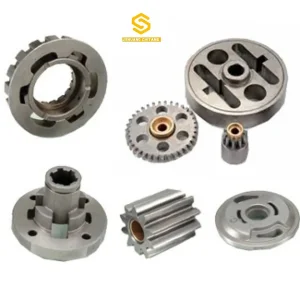
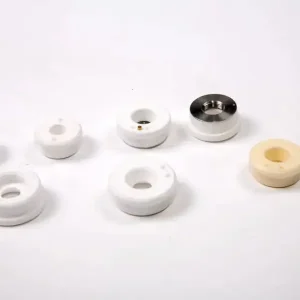
Additional OEM Precision Components & Tooling Capabilities
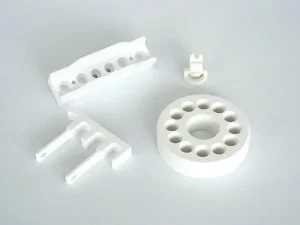
Explore our extended portfolio of sintered stainless steel, high-density low alloy components, die castings, and ceramic parts.



Optimize Your Gear Supply Chain Today
Partner with an IATF 16949 certified leader in powder metallurgy gear manufacturing. Our engineering team provides complimentary Design for Manufacturability (DFM) reviews, material density profiling, and transparent tooling quotations within 48 hours.