
High-Precision MIM Solutions for Swiss Tool & Hardware OEMs
Standard-setting sintered components optimized for Swiss industrial machinery, lock assemblies, micro-valves, and high-wear tooling applications.



Navigating Switzerland's High-Precision Industrial & Tooling Supply Chain
Switzerland’s industrial landscape—renowned across Zurich, Winterthur, St. Gallen, Baden, and the historic Watch Valley—is globally recognized as the benchmark for ultra-high-precision mechanical engineering. Swiss original equipment manufacturers (OEMs), toolmakers, medical technology developers, and high-end machinery producers require components with dimensional tolerances that routinely push physical limits. However, the contemporary Swiss industrial ecosystem faces an unprecedented dual challenge: rising domestic energy and labor overheads alongside an intensifying global demand for micro-sized, geometrically complex metal assemblies.
Historically, Swiss engineers relied heavily on 5-axis CNC micro-machining, EDM (Electrical Discharge Machining), and multi-stage subtractive milling to manufacture intricate steel alloys, titanium, and valve bodies. While subtractive machining offers extreme precision, it yields exorbitant scrap rates (often exceeding 60–70% raw material waste) and scaling bottlenecks for annual production runs exceeding 5,000 to 500,000 units. This is precisely where advanced Metal Injection Molding (MIM) from China bridges the structural gap.
By blending fine metal powders (typically 4–20 μm particle size) with specialized thermoplastic binder systems, MIM combines the geometric flexibility of plastic injection molding with the structural integrity, mechanical toughness, and thermal performance of wrought metal alloys. For Swiss buyers in power tools, lock hardware, automation, and textile machinery, MIM delivers near-net-shape parts featuring complex undercuts, internal threads, lightweight pocketing, and internal fluid channels—eliminating secondary machining passes while preserving true metallurgical excellence.
Technological Roadmap & Advanced MIM Process Science
How China’s Industry 4.0 powder metallurgy centers master sintering shrinkage kinetics, debinding stability, and custom alloy formulations.
Catalytic & Thermal Debinding Systems
Utilizing nitric acid vapor catalytic debinding (Catamold system) to rapidly decompose polyoxymethylene (POM) binder matrices. This prevents internal pore collapse or micro-cracking prior to high-temperature vacuum sintering, maintaining flawless structural density.
Isotropic Shrinkage Control (±0.3%)
During sintering at temperatures up to 1380°C, linear shrinkage ranges between 14% and 18%. Advanced mold cavity scaling (using proprietary DFM simulation software) guarantees that final sintered dimensions adhere strictly to Swiss DIN ISO 2768-mK specs.
Controlled Atmosphere Vacuum Sintering
Continuous mesh-belt and ultra-clean batch vacuum furnaces equipped with partial pressure Argon or Hydrogen atmospheres ensure minimal interstitial gas pickup, avoiding hydrogen embrittlement and maintaining micro-structural uniformity.
Comprehensive Material Performance Matrix for Swiss Industrial Procurement
Below is an engineering benchmark highlighting key MIM materials deployed across Swiss industrial tools, fluidic controls, and mechanical drive systems:
| Alloy Grade | Metallurgical Standard | Tensile Strength (MPa) | Yield Strength (MPa) | Hardness / Density | Target Swiss Industry Applications |
|---|---|---|---|---|---|
| 17-4PH (1.4542) | ASTM A564 / MIM-17-4PH | 1,150 – 1,300 | 1,000 – 1,150 | 38 – 44 HRC / ≥7.65 g/cm³ | High-torque tool ratchets, industrial lock pawls, power tool housings. |
| 316L (1.4404) | ASTM A240 / MIM-316L | 520 – 600 | 200 – 250 | 220 HV10 / ≥7.90 g/cm³ | Fluidic mini-valves, chemical meters, textile yarn guides, watchcase links. |
| Fe-2Ni / Fe-8Ni | MPIF 35 / MIM-2200 | 650 – 950 (heat treated) | 500 – 750 | 25 – 40 HRC / ≥7.60 g/cm³ | Precision gears, drive cams, industrial power transmission components. |
| Ti-6Al-4V (Grade 5) | ASTM B348 / TiMIM | 890 – 1,000 | 820 – 910 | 30 – 36 HRC / ≥4.43 g/cm³ | Aerospace micro-actuators, lightweight surgical tool chassis, specialty sports equipment. |
| Tungsten Heavy Alloys | ASTM B777 / Heavy Metal | 850 – 980 | 600 – 700 | 28 – 35 HRC / ≥17.5 g/cm³ | Balance weights for high-speed rotors, counterweights in horological instrumentation. |
Industry-Specific Solutions for Swiss Precision OEM Sectors
Addressing strict European regulatory mandates, high fatigue requirements, and severe operating environments.
1. High-End Industrial Tools & Security Locking Systems
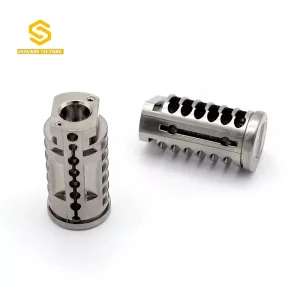
Swiss tool manufacturers require components that can sustain millions of high-impact load cycles without plastic deformation. By utilizing gas-atomized 17-4PH and heat-treated Fe-Ni powders, our MIM locking cylinders, ratchet teeth, and safety interlocks deliver exceptional fatigue strength and wear resistance. Near-net-shape molding permits complex internal anti-picking profiles that are impossible to execute via traditional milling.
2. Precision Fluidics, Hydraulics & Mini Valve Components
Serving Switzerland’s chemical processing and pneumatic automation corridors, we supply fully dense 316L and custom titanium mini-ball valve stems, fluid manifold bodies, and nozzle inserts. The isotropic nature of MIM ensures pressure tightness up to 300 bar without risk of directional porosity or micro-leakage found in bar-stock or sand castings.
3. Advanced Textile Machinery & High-Speed Automation
Swiss textile machinery demands extreme dimensional consistency across tens of thousands of identical yarn guides, thread grippers, and shuttle latches. Our 316L and alloy MIM parts undergo mirror-finish electropolishing and micro-tumbling, reducing surface roughness to Ra ≤ 0.4 μm to prevent synthetic fiber abrasion at line speeds exceeding 1,500 m/min.
4. MedTech Instrumentation & Micro-Mechanisms
Aligning with ISO 13485 guidelines, our biocompatible Ti-6Al-4V and 316L micro-MIM processes produce surgical jaws, endoscopic articulation joints, and dental handpiece gears weighing as little as 0.05 grams with sub-millimeter wall thicknesses.
China Factory 4.0: Supply Chain Resilience & Efficiency Advantages
Combining 28,000 m² of automated plant infrastructure, 1,000-ton compaction presses, and full MES digital traceability.
Operating out of Ningbo, China—one of the world's most concentrated logistics and metallurgy hubs—Ningbo Jiehuang Chiyang Electronic Tech Co., Ltd. (JHMIM) represents the pinnacle of modern powder metallurgy. For Swiss buyers accustomed to rigorous quality standards, partnering with JHMIM yields direct operational, financial, and strategic advantages:
Vertical Process Integration
From in-house mold design (using Swiss AGIE EDM and high-speed CNC centers) to feedstock mixing, catalytic debinding, sintering, heat treatment (H900, carburizing), and PVD coating—every phase is executed under one roof.
1,000-Ton Compaction Pressing
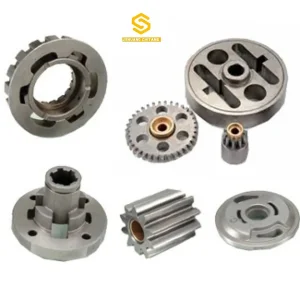
For heavy-duty powder metallurgy gears and structural components up to 150 mm in diameter, our 10,000 kN automated presses provide uniform core density, setting us apart from standard MIM shops restricted to ultra-light items.
Full Digital Traceability (MES)
Every raw material batch is tracked with spectroscopic powder certificates. Our Manufacturing Execution System records furnace temperature logs, dew point levels, and continuous CMM dimensional inspection data for 100% batch integrity.
Cost Reduction Case Benchmark for Swiss Procurement Directors
A Zurich-based industrial tool OEM sought to reduce the manufacturing cost of a 17-4PH locking ratchet component previously produced via multi-axis CNC milling. By transitioning the design to JHMIM’s net-shape MIM process, the unit cost dropped by 44%, annual material scrap was reduced by 82%, and lead times for high-volume batches (50,000 pcs/year) were stabilized down to 4 weeks, inclusive of air-freight DDP Zurich delivery.
Swiss Localization Support & Strict Regulatory Compliance
Procuring custom engineering components across international boundaries requires absolute regulatory transparency, strict Intellectual Property (IP) protection, and seamless logistical execution. JHMIM provides a comprehensive support structure customized specifically for Swiss corporate buyers:
- REACH & RoHS Compliance: All alloy feedstocks and chemical binder residues strictly satisfy EU Regulation (EC) No 1907/2006 (REACH) and Directive 2011/65/EU (RoHS). Material Safety Data Sheets (MSDS) and chemical testing reports are provided with every first-article inspection (FAI) lot.
- Conflict-Free Minerals Certification: In accordance with Swiss SVAMV guidelines and global OECD frameworks, all raw metallic powders (Tungsten, Nickel, Cobalt, Titanium) are sourced exclusively from audited, conflict-free smelters.
- Strict Non-Disclosure Agreements (NDAs): We routinely execute bilateral NDAs governed under Swiss law or mutually agreed jurisdiction. Project 3D STEP models, technical drawings, and tooling files are maintained on isolated encrypted servers.
- DDP (Delivered Duty Paid) Logistics: We handle complete export customs documentation, Swiss import customs clearance (Federal Customs and Border Security FCOS), and direct truck delivery to facilities in Zurich, Basel, Bern, Geneva, or Lugano.
Frequently Asked Questions by Swiss OEM Engineers & Buyers
Clear, definitive technical answers addressing lead times, tolerances, prototyping, and quality validation.
Our dedicated international engineering team provides complete Design for Manufacturability (DFM) feedback within 24–48 hours of drawing receipt. We review gate locations, parting lines, draft angles, radii, and wall thickness uniformity in English, accommodating German or French documentation requirements.
In the as-sintered state, MIM tolerances are typically held within ±0.3% to ±0.5% of nominal dimensions (e.g., ±0.03 mm on a 10 mm dimension). For critical high-precision features requiring ±0.005 mm (5 μm), we integrate secondary CNC sizing, coining, or grinding operations in-house.
Yes. We utilize in-house Selective Laser Melting (SLM) metal 3D printing and soft-tooling prototype options to create fully functional metal prototypes in identical or equivalent alloys (such as 316L or 17-4PH) within 5–7 working days for physical testing before committing to hard MIM tooling.
Standard mold build and First Article Inspection (FAI) sample delivery takes approximately 25 to 35 days. Accelerated tooling tracks can be completed in 18 to 21 days for urgent product launch programs.
Every production batch includes an inspection certificate containing full CMM dimensional data, material spectral chemical analysis, hardness/density test reports, heat treatment graphs, and a certificate of compliance (CoC). PPAP Level III reports are available upon request.
Comprehensive OEM MIM, PM & Die Casting Capabilities
Explore our full line of sintered components, metal 3D printing, titanium parts, and high-precision casting solutions.





Accelerate Your Swiss Tooling & MIM Development Project
Send us your 2D (PDF) and 3D (STEP) CAD files today. Receive a comprehensive DFM review, material optimization plan, and transparent itemized quote within 48 hours.
Send Inquiry Now