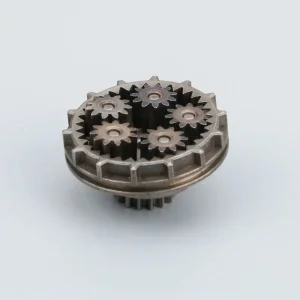
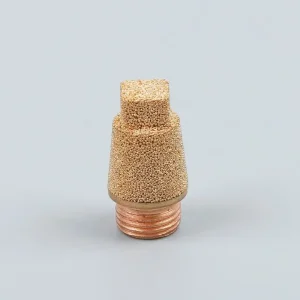
Precision Sintered & Metallurgical Components
Explore our core engineering hardware catalog. Click any item to request a custom DFM review and bulk wholesale quotation.





Metallurgical Foundations of Oil-Impregnated Bronze Bearings
Understanding capillary action, microscopic porosity dynamics, and hydrodynamic boundary lubrication in powdered metal self-lubricating sleeve bearings.
Interconnected Micro-Porosity Matrix
Oil-impregnated bronze bearings (commonly manufactured to SAE 841 / ASTM B438 Grade 1 Type II standards) are fabricated using advanced powder metallurgy. Pure copper and tin powders are blended, compacted under extreme pressure, and sintered below melting temperature. This creates a rigid metal matrix containing an interconnected sponge-like microscopic pore structure holding 18% to 22% oil by volume.
Hydrodynamic Self-Lubrication Mechanism
When the journal shaft rotates inside the sleeve bearing, frictional heat causes both shaft motion and thermal expansion. The impregnated synthetic or mineral oil expands faster than the bronze matrix, drawing lubricant to the bearing surface via capillary motion. This forms a continuous microscopic hydrodynamic oil film, drastically reducing friction coefficient (μ = 0.04 - 0.12) without external pumps or grease fittings.
Automatic Re-Absorption upon Rest
Once rotational motion ceases and the assembly cools down, capillary pressure pulls the excess lubricant back into the microscopic pores of the sintered bronze sleeve. This closed-loop self-lubrication system prevents oil leakage, eliminates maintenance downtime, and extends equipment operational life under maintenance-free continuous operation conditions.
Engineering Specifications & Material Benchmark
A rigorous comparative analysis evaluating oil-impregnated sintered bronze against traditional bearing materials for high-load industrial design selection.
| Performance Characteristic | Sintered Bronze (SAE 841 / Oil-Impregnated) | Solid Cast Bronze (C93200 / SAE 660) | PTFE / Polymer Composite Bearings | Needle Roller Bearings |
|---|---|---|---|---|
| Lubrication Requirement | Self-Lubricating (Maintenance Free) | Requires Continuous External Grease/Oil | Self-Lubricating (Dry / Solid Film) | Requires Periodic Relubrication |
| Max PV Limit (PSI × SFM) | 50,000 PSI-SFM | 75,000 PSI-SFM (with lube) | 10,000 - 25,000 PSI-SFM | 100,000+ PSI-SFM |
| Operating Temp Range | -10°C to +120°C (up to 150°C synth) | -40°C to +230°C | -200°C to +260°C | -30°C to +120°C |
| Acoustic / Vibration Dampening | Exceptional (Porous matrix absorbs sound) | Moderate | High | Poor (Metal-on-metal roller noise) |
| Cost at Mass Scale (Wholesale) | Very Low (Near-Net-Shape Powder Molding) | High (Machining bar stock waste) | Moderate to High | High (Multi-component assembly) |
| Radial Clearance Tolerance | Precision Burnished (IT7 - IT8 Class) | CNC Precision Machined | Thermal expansion variability | High Shaft Hardness Required |
Why Source Sintered Bronze Bearings From China Factories?
Combining world-class powder metallurgy technology, high-speed automated presses, and vertical supply chain integration for unbeatable cost performance.
1,000-Ton Automated Compaction Capacity
Leading Chinese powder metallurgy factories feature multi-axis CNC hydraulic compaction presses ranging from 15 to 1,000 tons. This high-density pressing capability ensures consistent green density, uniform pore distribution, and tight structural integrity across complex flanged, spherical, and sleeve bearing geometries.
Integrated Raw Material Supply Chain
China holds a robust ecosystem for ultra-pure electrolytic copper powder, atomized tin, graphite, and specialty lubricants. Domestic powder synthesis and mesh refinement eliminate raw material markups, offering global OEMs up to 30% to 50% unit cost savings over North American or European counterparts without sacrificing performance.
Automated Vacuum Oil Impregnation
Modern Chinese manufacturing facilities utilize continuous mesh belt sintering furnaces with controlled endothermic gas atmospheres, followed by sub-atmospheric vacuum impregnation lines operating at 0.09 MPa vacuum pressure. This guarantees 99.5%+ cavity oil filling rates using high-grade synthetic oils (SAE 30, synthetic diesters, or food-grade NSF H1 oils).
100% Optical & CMM Quality Control
To adhere to strict international automotive (IATF 16949) standards, advanced visual sorting units, automated pneumatic dimension gauges, and 3D Coordinate Measuring Machines (CMM) inspect every batch for concentricity, perpendicularity, ID/OD tolerance, and crush strength before packaging.
Industry Development Trends & Next-Gen Bearing Tech
How powder metallurgy advancements are powering electric mobility, smart home automation, and green industrial solutions.
EV Silent Micromotors
As Electric Vehicles replace internal combustion engines, background cabin noise is significantly reduced, making HVAC actuator noise noticeable. Micro sintered bronze bushings with custom spherical geometries and acoustic dampening synthetic oils provide ultra-quiet rotation (<25 dB), critical for EV climate systems, power windows, and electronic throttle actuators.
Nano-Lubricants & Solid Additives
Emerging applications require higher PV ratings and extended thermal bounds. Modern PM research integrates Graphene, Molybdenum Disulfide (MoS2), and PTFE nano-powder additives directly into the copper-tin matrix, allowing dry emergency operation during extreme thermal spikes up to +200°C without fluid breakdown.
Eco-Friendly Bio-Synthetic Oils
Global environmental mandates (RoHS 3.0, REACH, TSCA) drive the adoption of biodegradable, non-toxic synthetic ester fluids inside self-lubricating sleeve bearings. These eco-lubricants ensure zero hazardous VOC emissions in household electronics, personal care gear, and food-processing equipment.
Target Application Scenarios & Industry Solutions
From high-vibration power tools to precision medical actuators, oil-impregnated bronze bearings deliver maintenance-free reliability across diverse sectors.
Automotive OEM Subsystems
Used extensively in windshield wiper linkages, starter motor armature supports, power seat adjusters, cooling fan assembly motors, and electronic throttle valves where grease maintenance is impossible and low start-up torque is required.
Household Appliances & HVAC
Washing machine drain pumps, kitchen blender drives, refrigerator condenser fans, ceiling fans, and air conditioner blower units rely on sleeve bearings to ensure smooth rotational speed and low acoustic resonance throughout a 10+ year product lifespan.
Industrial Power Tools
Cordless angle grinders, rotary hammer drills, and circular saws experience heavy radial shock loads and high RPMs. Sintered bronze flanged bushings absorb extreme shock vibration while maintaining axial gear alignment under heavy duty work conditions.
Office Automation & Medical Devices
3D printers, laser copiers, automated paper feed rollers, dialysis fluid pumps, and surgical bed actuators demand clean, grease-free bearing interfaces that will not contaminate sensitive electronic optical sensors or hygienic environments.
Global Enterprise Sourcing & OEM Best Practices
A step-by-step framework for international procurement directors, engineering lead buyers, and supply chain managers.
1. Technical Drawing & 3D Model Submission
Supply 2D PDF engineering drawings specifying Inner Diameter (ID), Outer Diameter (OD), Length (L), Flange Diameter (Fl-D), and Flange Thickness (Fl-T). 2D drawings must include GD&T specs, concentricity limits, and target PV factors. STEP or IGES 3D files enable rapid mold flow and sizing tool design.
2. Material Standard & Oil Selection
Specify the powder composition: Standard SAE 841 (88-90% Cu, 9-11% Sn) for general sleeve bushings, or iron-bronze blends (SAE 863) for higher static loads at lower speeds. Choose the proper lubricant viscosity: ISO VG 68/100 standard mineral oil, high-temp synthetic diester, or NSF H1 food-grade oil.
3. PPAP Level 3 & Quality Approvals
Require your supplier to deliver complete Production Part Approval Process (PPAP) Level 3 documentation, including Material Test Certificates (MTC), Process Flow Diagrams, FMEA analysis, Dimensional CMM inspection reports, and Radial Crush Strength Test records per ASTM B438 standards.
4. Packaging, MOQ & Logistics Execution
Because oil-impregnated bronze bearings are porous and sensitive to ambient dust/moisture, insist on vacuum-sealed anti-static plastic bags with corrosion inhibitors (VCI) inside heavy-duty corrugated export cartons. Minimum order quantities (MOQ) typically start at 2,000 to 5,000 pieces for standard custom tooling.
Press-Fitting & Installation Best Practices
Prevent bore close-in and guarantee correct operating clearance during automated factory assembly.
Use Sizing Arbors During Press-Fit
Sintered bronze sleeve bearings must be press-fitted into rigid housing bores using a insertion arbor pin. Pressing without a sizing arbor causes the inner diameter to close in unpredictably. A shoulder arbor ensures the inside diameter maintains proper running clearance with the rotating shaft.
Never Machine or Ream the Inner Diameter
Critical Engineering Warning: Standard machining, reaming, or grinding of the bearing bore using conventional tools smears the ductile bronze matrix, sealing over the microscopic surface pores. This destroys the self-lubricating oil path. If tighter ID tolerances are necessary after insertion, use a polished carbide burnishing tool.
Shaft Finish & Hardness Recommendations
For maximum wear life, mate oil-impregnated bronze bearings with ground, polished steel shafts featuring a surface roughness of Ra 0.2 to 0.4 μm (8-16 micro-inches). For heavy load applications (PV > 25,000), shaft hardness should exceed HRC 45 to prevent shaft scoring.
Oil-Impregnated Bronze Bearings Technical Q&A
Direct answers from our senior metallurgical team regarding design, testing, oil re-impregnation, and custom manufacturing.
Request Your Custom Sintered Bronze Engineering Quote
Send your 2D PDF / 3D STEP drawings today. Our engineering sales team delivers a comprehensive DFM review, mold design cost, and bulk wholesale pricing within 48 hours.
Get Instant 48-Hour QuotationSintered Gear & Powder Metallurgy Hardware Solutions
Browse additional custom powdered metal OEM products manufactured in our Ningbo facility.