
High-Precision Sintered Metal Parts Batch Production
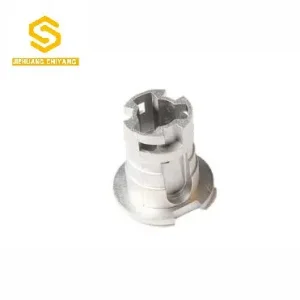
Explore our core catalog of custom sintered alloys, stainless steel components, structural gears, and micro-MIM hardware engineered for high-duty applications.





Global Business Status of Wholesale Sinter Metals Manufacturing
Sintered metal manufacturing—encompassing traditional Press-and-Sinter Powder Metallurgy (PM) and advanced Metal Injection Molding (MIM)—has evolved from a specialized component fabrication technique into a foundational pillar of modern global precision manufacturing. Across high-volume industrial sectors, engineering procurement leaders are systematically pivoting away from high-scrap subtractive CNC machining toward near-net-shape solid-state mass transport processes.
In the current industrial landscape, global demand for wholesale sinter metal components is expanding rapidly, projected to reach over USD 19.5 Billion by 2030. The driving forces behind this global shift include the demand for lightweight structural components, complex micro-geometries in automotive electrification, medical device miniaturization, and aggressive corporate decarbonization targets requiring high raw-material yield.
Subtractive vs. Sintered Efficiency
Conventional CNC subtractive machining wastes between 40% to 75% of raw alloy stock as metal shavings. Sinter metal processing achieves material utilization rates exceeding 95%, delivering unmatched cost optimization at scale.
Geometrical Multi-Flexibility
By integrating fine metallic powders with specialized thermoplastic binder matrices, sinter metal factories mold intricate internal cavities, undercut grooves, and multi-axis gear teeth in a single automated sintering stroke.
Controlled Densification
Modern continuous mesh-belt and vacuum sintering furnaces control thermal profiles up to 1380°C, enabling tailored mechanical density profiles ranging from 85% controlled porosity (filters) up to 99.5% theoretical density (structural parts).
China Factory Efficiency & JHMIM Benchmark Scale
When global OEMs evaluate wholesale sinter metals factories, Chinese powder metallurgy ecosystems—specifically concentrated in Ningbo, Zhejiang—stand out as premier manufacturing partners. Ningbo Jiehuang Chiyang Electronic Tech Co., Ltd. (JHMIM) demonstrates how specialized technology clusters combine massive capital equipment investment with unmatched supply chain responsiveness.
The efficiency advantage of China’s top-tier wholesale sinter metal suppliers is not merely based on competitive labor; it stems from comprehensive vertical integration. From raw gas-atomized metal powder blending, precision multi-cavity tooling fabrication, and high-vacuum debinding-sintering loops to automated CMM dimensional verification, every critical step occurs under a unified ISO 9001 and IATF 16949 quality standard.
Integrated Tooling & Rapid Prototyping
JHMIM utilizes in-house metal 3D printing (Binder Jetting & SLM) alongside precision CNC EDM tooling centers. This allows global engineering teams to test physical prototypes within days, avoiding the prohibitive upfront lead times typical of Western tooling shops.
Rigorous Batch-to-Batch Repeatability
Equipped with Japanese-imported continuous sintering furnaces and computer-controlled atmosphere regulators (Hydrogen/Nitrogen mix), our facilities ensure zero micro-cracking, uniform grain growth, and strict tolerance stability across multi-million piece manufacturing runs.
Powder Metallurgy vs. Metal Injection Molding (MIM) Specification Matrix
Selecting the correct manufacturing route within a wholesale sinter metals factory requires a deep understanding of component geometry, density targets, dynamic stress factors, and annual volume expectations. The table below outlines the core metrics used by JHMIM engineers during Design for Manufacturability (DFM) evaluations.
| Engineering Parameter | Press-and-Sinter Powder Metallurgy (PM) | Metal Injection Molding (MIM) | Sintered Porous Filters |
|---|---|---|---|
| Target Geometry | 2.5D press-direction profiles, spur gears, bushings | Complex 3D geometries, thin walls, threads, undercuts | Tubular, disc, planar porous structures |
| Typical Weight Range | 5 g to 5,000 g (up to 150mm diameter) | 0.1 g to 286 g (ideal < 100 g) | Custom filter dimensions |
| Achievable Density | 85% - 94% of theoretical density | 96% - 99.5% of theoretical density | Controlled Porosity (15% - 60% void space) |
| Primary Alloy Grades | Fe-Ni-Cu alloys, Bronze, Stainless Steel (316L, 410) | 17-4PH, 316L, Ti-6Al-4V, Low-Alloy Steels (4605) | 316L Stainless Steel, Titanium, Inconel |
| Mechanical Properties | High compression strength, self-lubricating options | Wrought-like tensile strength, fatigue resistance | Controlled permeability, thermal resistance |
| Standard Tolerances | ±0.05 mm (CT 5-7 standard) | ±0.3% nominal dimension (down to ±0.02mm) | ±0.1 mm structural housing specs |
Localized Industrial Engineering Case Applications
Sintered metal parts are deployed across critical mission-essential assemblies globally. By matching precise alloy formulations with targeted heat-treatment post-processing (such as case hardening, nitriding, and hot isostatic pressing), JHMIM components serve across multiple demanding sectors:
Automotive & E-Mobility Powertrains
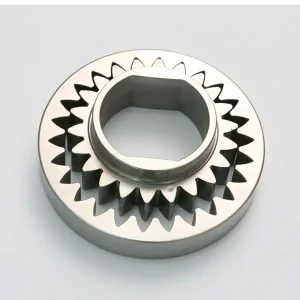
In modern ICE and Electric Vehicles (EVs), sintered metals are non-negotiable for high-torque transmission gears, Variable Valve Timing (VVT) rotors, electric steering lock cams, and sintered oil pump gears. High structural density prevents gear tooth fatigue under cyclic dynamic stress.
Medical Surgical & Orthodontic Devices
Biocompatible 316L and 17-4PH MIM parts enable complex endoscopic surgical instrument jaws, laparoscopic stapler heads, and self-ligating dental brackets. Micro-MIM eliminates thousands of hours of painstaking miniature manual machining.
Consumer Smart Devices & Wearables
From ultra-slim titanium smartwatch watchband connectors and folding phone hinge mechanisms to camera ring bezels, metal injection molding delivers high cosmetic polish compatibility and corrosion resistance in sleek miniaturized form factors.
Heavy Industrial & Hydraulic Valves
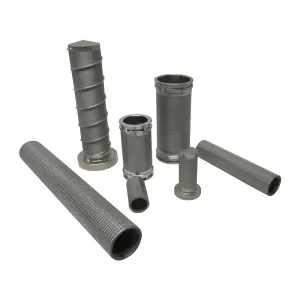
In high-pressure fluid flow applications, sintered stainless steel filter discs and porous spargers offer uniform pore distribution for precise chemical filtration, while sintered mini ball valve components provide leak-free fluid control.
Global Procurement Risk Mitigation & TCO Optimization
For global VP of Supply Chain and Procurement Directors, sourcing from a wholesale sinter metals factory requires balancing Total Cost of Ownership (TCO) against long-term operational risks. Working with an audited manufacturer like JHMIM directly mitigates common cross-border procurement challenges:
1. Tooling Longevity & Amortization
Our hardened tool steels (such as SKD11 and tungsten carbide inserts) deliver tooling lifespans exceeding 500,000 to 1,000,000 cycles. Low upfront tooling expenses quickly amortize over production runs, dropping per-unit costs drastically.
2. Quality Assurance Protocols
Every batch includes full First Article Inspection (FAI) reports, metallographic grain density charts, CMM dimensional checks, and RoHS/REACH material certificates under our IATF 16949 quality standard.
3. IP Protection & NDA Integrity
We enforce strict military-grade internal digital access controls. Project CAD files, customer specifications, and custom alloy recipes are protected under legally binding non-disclosure agreements before drawing review.
Industry Development Trends in Advanced Metal Sintering
The next decade of sinter metals manufacturing is being reshaped by four major technological breakthroughs currently being deployed across JHMIM facilities:
A. Green Hydrogen Sintering Furnaces
Replacing conventional cracked-ammonia atmospheres with pure hydrogen atmospheric continuous sintering reduces carbon intensity by up to 60%, aligning wholesale component production with global corporate ESG targets.
B. Titanium MIM (Ti-MIM) Expansion
Ti-6Al-4V titanium alloy sintering has traditionally been hindered by oxygen pickup. Breakthrough inert-vacuum debinding techniques now allow high-volume production of lightweight, high-strength medical and aerospace parts.
C. AI-Driven Shrinkage Simulation
Sintering inherently causes isotropic volumetric shrinkage of 12% to 18%. Advanced FEA mold-simulation algorithms predict thermal distortion prior to steel cutting, reducing tooling iteration loops from weeks to days.
D. Micro-MIM Multi-Material Sintering
Co-injection molding of dissimilar metals (e.g., bonding high-wear tool steel to high-conductivity copper) within a single sintered component eliminates secondary mechanical assembly steps entirely.
Wholesale Sintered Parts & Custom Engineering Solutions
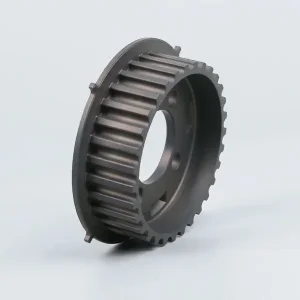
Browse our specialized lines of die-casted components, timing pulleys, sintered filters, and customized structural OEM assemblies.





Frequently Asked Questions by Global Sourcing Teams
Get direct technical answers from JHMIM’s chief powder metallurgists and procurement advisors.